
Moving an established apparel style to a new factory requires more than transferring patterns and a tech pack. The new manufacturer must understand the approved construction, materials, fit, quality requirements, and production issues already resolved by the previous supplier.
For US apparel brands, a successful factory transfer starts with a controlled technical handover, followed by sample validation and a documented first-production review. The objective is to reproduce the approved product consistently without losing the knowledge accumulated during earlier production runs.
Before releasing bulk production, confirm three things: the technical package is current, the new factory can reproduce the approved garment, and any significant quality risks have been addressed.
Why Apparel Production Transfers Can Go Wrong
An established style often contains years of development decisions that are not immediately visible in its latest drawings.
A factory may know that a particular seam requires special handling, that a fabric needs additional relaxation before cutting, or that an earlier quality problem was resolved through a specific construction adjustment.
When production moves, these details can be lost.
Three risks deserve particular attention.
Incomplete technical information. The incoming manufacturer receives patterns and specifications but not the processing details or quality history needed to reproduce the garment reliably.
Outdated documentation. Patterns, measurements, and bills of materials may have been revised over several production runs. If the transferred files do not match the latest approved construction, the new factory may produce the wrong version.
Material differences. A substitute fabric or trim may appear equivalent but behave differently during sewing, washing, or wear.
A structured transfer process should address these risks before the new factory begins bulk production.
1. Assemble a Controlled Technical Handover Package
Begin by gathering the documents and physical references that define the product being transferred.
The package should reflect the latest approved production version, not simply the files used when the style was originally developed.
| Handover item | Required information | Purpose |
|---|---|---|
| Graded patterns | Approved pattern files and all required sizes | Preserve fit and grading |
| Measurement specifications | Points of measure, tolerances, and measuring instructions | Establish objective fit and inspection requirements |
| Tech pack | Construction, stitching, finishing, artwork, and technical notes | Define how the garment should be produced |
| Bill of materials (BOM) | Approved fabric, trims, thread, labels, and supplier requirements | Control material consistency |
| Approved physical samples | Identified and dated reference samples | Confirm approved appearance and construction |
| Material standards | Fabric quality, colors, finishes, and performance requirements | Support material approval |
| Packaging specifications | Folding, labels, hangtags, cartons, and packing instructions | Maintain shipment consistency |
| Quality requirements | Test criteria, inspection procedures, and defect classifications | Define production acceptance |
Where available, include relevant production notes describing equipment setups, sewing attachments, pressing methods, and other process details that affect the finished product.
These records should describe the required result and any essential process controls without assuming that the new factory must use identical machinery.
Check the Approved Reference Sample
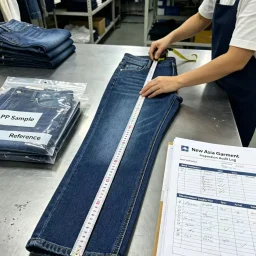
An approved reference sample helps resolve differences that are difficult to communicate through drawings alone.
Before the transfer, confirm that the retained sample represents the current approved product.
Check its style, size, colorway, approval date, and specification revision.
If the sample has been damaged, altered, or lost, establish an agreed replacement reference before relying on it for production approval.
A sample photograph can support communication, but it may not adequately capture fabric hand feel, construction, or detailed fit.
The physical sample, approved patterns, specifications, and quality requirements should be treated as complementary references rather than interchangeable documents.
2. Verify Document Versions Before Handover
Version control is particularly important when a style has been produced for several seasons.
A garment may have undergone small adjustments to its pattern, seam construction, trims, or finishing without every change being incorporated into the original tech pack.
Before sending the package, prepare a revision record.
| Document | Current revision | Approval date | Responsible approver |
|---|---|---|---|
| Pattern and grading | To confirm | To confirm | To confirm |
| Measurement specification | To confirm | To confirm | To confirm |
| BOM | To confirm | To confirm | To confirm |
| Construction details | To confirm | To confirm | To confirm |
| Approved reference sample | To confirm | To confirm | To confirm |
| Packaging instructions | To confirm | To confirm | To confirm |
Cross-check these records against the most recent accepted production run.
Ask which pattern revision was used, which material suppliers supplied the approved components, and whether production changes were made after the last formal approval.
If the previous factory used an undocumented adjustment, evaluate and record it before transferring the style.
Do not automatically treat the newest file date as proof that a document is authoritative.
The handover package should establish one approved product version that both the brand and incoming manufacturer can identify.
3. Transfer Material and Trim Requirements
A BOM may identify the required components without explaining their full performance characteristics or sourcing restrictions.
For each critical material, confirm:
- Fiber composition and fabric construction.
- Fabric weight and usable width, where relevant.
- Approved color and finish.
- Relevant dimensional stability and colorfastness requirements.
- Approved component specifications.
- Supplier identification and sourcing restrictions.
- Substitution approval requirements.
For example, describing a component as a “metal zipper” may not be sufficient when its dimensions, slider configuration, finish, or installed performance affects garment quality.
Where exact component specifications are important, identify the approved part or an objectively defined equivalent.
Control Material Substitutions
The new factory may use different fabric mills or trim suppliers from the previous manufacturer.
A proposed substitute should be evaluated against the approved specification.
Depending on the component and its intended function, this may involve reviewing technical data, physical samples, laboratory evidence, or performance after laundering.
Not every supplier change requires every test to be repeated. The validation needed should reflect the potential effect on fit, appearance, quality, and performance.
Record the evaluation and obtain the required approval before the substitute enters production.
4. Transfer the Style’s Quality History
A technical package explains the product requirements. Quality history explains where the product has been difficult to manufacture consistently.
This information can help the new factory avoid repeating problems resolved during earlier production.
Where records are available, include:
- Recurring defects from previous production runs.
- Corrective actions and their documented outcomes.
- Inline and final inspection findings.
- Rework patterns and their causes.
- Relevant customer complaints and product returns.
- Material or construction problems identified after laundering.
- Retailer-specific inspection or packaging requirements.
For each important issue, describe the observed problem, the available evidence, and the action that addressed it.
Avoid presenting an unverified root cause as an established fact.
Convert Quality History Into Inspection Priorities
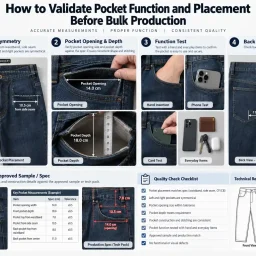
Suppose previous production records show repeated pocket-corner tearing.
The transfer package should identify the affected construction and any approved reinforcement requirements.
The incoming factory can then include that area in its sample review and early production inspections.
Similarly, if earlier production showed recurring waistband measurement deviations, the new factory should understand the relevant measurement method, tolerance, and process controls.
The goal is to turn documented experience into useful production requirements.
Confirm the Inspection Plan
Transfer the applicable quality plan, including:
- Critical, major, and minor defect classifications.
- Inspection stages and responsible parties.
- Sampling procedures.
- Measurement methods and tolerances.
- Acceptance and rejection criteria.
- Corrective-action and reinspection requirements.
If an AQL-based inspection plan is used, identify the agreed standard and edition, inspection level, sampling scheme, and applicable acceptance criteria.
ISO 2859-1:2026 provides an AQL-indexed system for lot-by-lot inspection by attributes. The actual sampling arrangement must be selected and agreed for the program.
AQL inspection should complement process controls and product-specific requirements, not replace them.
5. Validate the New Factory’s Samples
Even when an established style has already passed development and production approval, the incoming factory may need to demonstrate that it can reproduce the approved garment.
The necessary sampling sequence depends on the garment’s complexity, available references, material changes, and manufacturing risks.
A practical transfer validation process may include the following stages.
Technical and Construction Review
The new factory reviews the approved patterns, technical specifications, BOM, and reference samples.
Any unclear measurements, missing specifications, or proposed construction changes should be resolved before sampling.
Transfer Sample
Produce a representative sample using the approved pattern and agreed materials or suitable development materials.
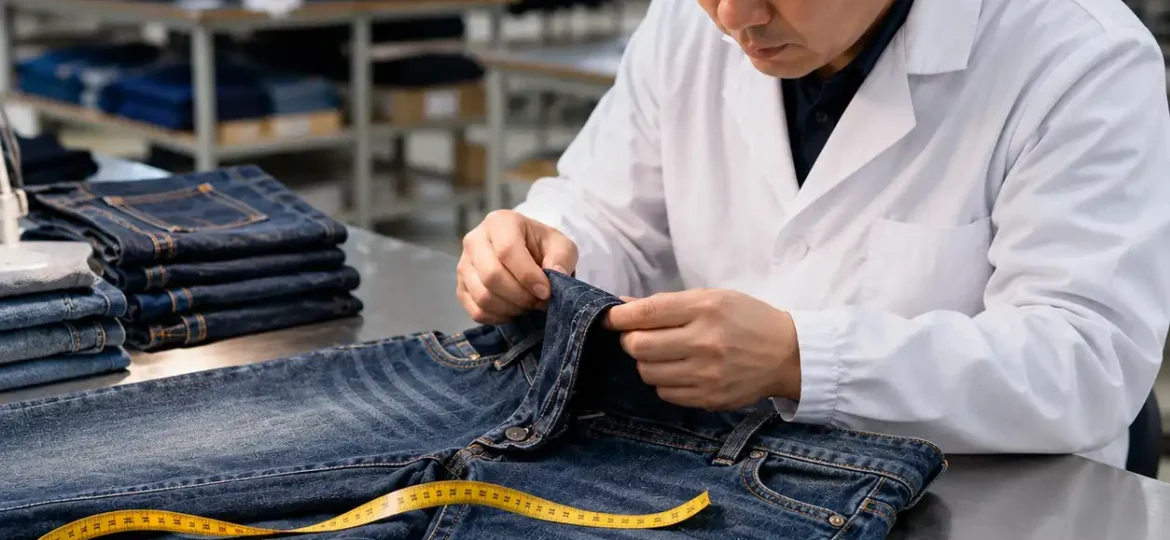
Check construction, measurements, appearance, and important functional details against the approved references.
Where the sample does not meet the requirements, document the discrepancy and determine whether correction or further sampling is necessary.
A pattern change should not be made merely because the style is moving to another factory.
Fit Validation
Compare the transferred garment against the approved fit standard.
Fit evaluation may include the base size and other sizes where grading, construction, or product risk justifies additional review.
If measurements and fit already conform, unnecessary pattern alterations should be avoided.
Where corrections are required, record the changes and obtain approval before updating the production pattern.
Pre-Production Sample Approval
Before releasing bulk cutting, review a pre-production (PP) sample made with the intended production materials and construction.
Confirm that the sample meets the agreed requirements for:
- Fit and measurements.
- Fabric and color.
- Sewing construction.
- Trims and closures.
- Washing and finishing.
- Labels and packaging, where applicable.
- Relevant product testing and quality requirements.
Material nonconformities that affect product safety, regulatory compliance, fit, or contractual quality requirements should be resolved before the affected production activity proceeds.
Minor or documentation-related issues may be closed through an approved corrective action where the buyer’s quality procedure permits.
The PP approval should establish a documented release decision, not simply confirm that a sample has been received.
6. Validate the First Production Run
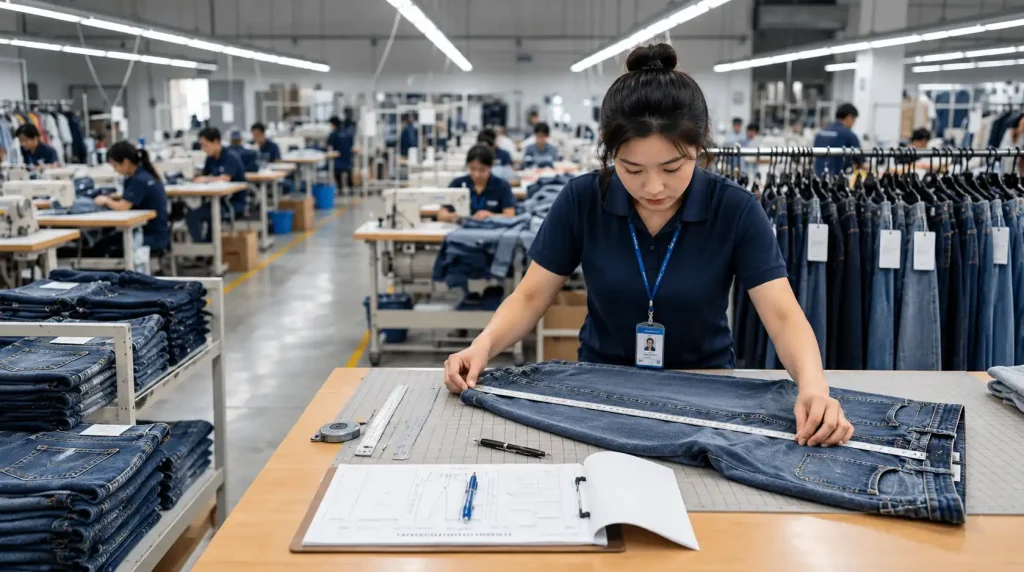
The first production run at a new factory provides an opportunity to confirm that approved samples can be reproduced consistently under actual manufacturing conditions.
Where practical, consider a controlled first batch or pilot production run before committing the full order.
The appropriate quantity and inspection intensity should reflect the product, delivery requirements, and manufacturing risks.
Check Production From the Start
Early inspections can identify problems before large quantities are completed.
Focus on:
- Critical measurements and fit-related construction.
- Sewing operations associated with previous defects.
- Fabric and trim conformity.
- Washing or finishing consistency.
- Workmanship and appearance.
- Labeling and packaging requirements.
Use the approved technical package and reference samples as the acceptance basis.
Do not replace approved quality requirements with the results of the first production run.
Review the Results Before Scaling Up
A practical first-run review should consider the following:
| Review area | Release question |
|---|---|
| Measurements | Are finished garments within the approved tolerances? |
| Construction | Do the seams, reinforcements, and details match the approved requirements? |
| Materials | Are the correct fabrics and trims being used? |
| Quality history | Have previously identified failure risks been adequately controlled? |
| Workmanship | Are observed defects within the agreed acceptance criteria? |
| Process consistency | Are recurring problems or unusual variations emerging? |
| Documentation | Are inspection results, corrective actions, and approvals recorded? |
If significant problems appear, determine their cause and document appropriate corrective actions before expanding the affected production.
Corrective actions may involve training, equipment settings, material controls, revised instructions, or an approved construction change.
Recheck the affected requirements to confirm that the action has addressed the problem.
The objective is to use the first run to establish evidence of the new factory’s process performance while continuing to judge product quality against the approved standards.
7. Control Changes During the Transfer
Factory transfers often create pressure to make small process or material adjustments.
Some changes may be necessary because of differences in equipment, supplier availability, or production layout.
However, changes should not be implemented informally when they affect approved product requirements.
Use a documented change-control process for:
- Pattern or grading revisions.
- Material and trim substitutions.
- Construction changes.
- Relevant sewing process adjustments.
- Washing and finishing changes.
- Quality or testing requirement changes.
- Labeling and packaging revisions.
The record should identify the proposed change, reason, affected products, potential risks, required verification, and approval authority.
Changes that do not alter the approved product or relevant performance may require less validation than substantial changes.
Where new testing or sampling is necessary, complete the agreed review before releasing the affected production.
Update the controlled technical documents so future orders use the correct approved version.
8. Agree on Responsibilities Before the First Production Order
A technical transfer works best when the brand and incoming factory clearly understand who is responsible for each approval and record.
Before placing the first production order, confirm:
- The technical package revision governing production.
- Approved material and trim sources.
- The sampling and fit approval process.
- Required product tests and evidence.
- Inspection methods and acceptance criteria.
- Authority to approve material or construction changes.
- Responsibilities for corrective actions and reinspection.
- Required production records and document retention.
- Escalation procedures for unresolved technical issues.
- The conditions that must be met before bulk cutting, production expansion, and shipment release.
Commercial terms should also be agreed separately, including pricing, minimum order quantities, development charges, delivery schedules, and responsibility for additional work.
These terms affect the feasibility of the transfer, but a competitive price does not replace technical validation.
Apparel Factory Transfer Checklist
Use this checklist to organize the transfer of an established style.
| Stage | Required confirmation |
|---|---|
| Technical handover | Current patterns, specifications, BOM, and approved samples identified |
| Version control | Latest approved revisions confirmed against production history |
| Materials | Fabric, trims, color references, and sourcing restrictions documented |
| Quality history | Relevant defects, corrective actions, and inspection requirements transferred |
| Factory review | Incoming manufacturer has reviewed the package and raised open questions |
| Sampling | Representative transfer samples evaluated |
| Fit approval | Relevant sizes and measurements approved |
| PP approval | Intended production materials and construction validated |
| First-run inspection | Early production checked against approved requirements |
| Corrective actions | Material issues resolved and effectiveness verified |
| Change control | Revisions approved and documents updated |
| Production release | Responsible approver confirms the next production stage may proceed |
Keep supporting records linked to the applicable style, revision, production order, and approval date.
Frequently Asked Questions
Q1:Can a brand transfer production without changing the pattern?
Yes. If the existing pattern remains suitable and the new factory can reproduce the approved garment, a pattern change may not be necessary.
The incoming factory should still verify the relevant measurements, construction, and fit.
Q2:Does every factory transfer require full product redevelopment?
No. An established style may require less development work than a new design.
The scope of re-sampling and testing should depend on the differences between the previous and new manufacturing arrangements and the available evidence.
Q3:Should the new factory use the same material suppliers?
Not necessarily.
The brand should identify which suppliers or components are mandatory and where alternatives are permitted.
Any proposed substitution should be evaluated against the relevant requirements before approval.
Q4:Is a PP sample enough to approve bulk production?
A PP sample is an important approval reference, but it does not automatically demonstrate that the new factory can maintain consistent quality throughout production.
Early production inspections and appropriate quality controls provide additional evidence.
Q5:What if the previous factory cannot provide complete records?
Identify the missing information and assess its significance.
Where important records or physical standards are unavailable, the brand may need additional sampling, measurement verification, material testing, or documented approvals before production release.
Do not assume that undocumented specifications are correct.
Working With a New Apparel Manufacturing Partner
Moving an established apparel style requires coordination between the brand’s technical team and the incoming manufacturing partner.
Before discussing production, prepare the current tech pack, approved patterns, BOM, reference samples, and any relevant quality history.
These materials help the prospective manufacturer understand the existing product and identify what must be confirmed during sampling.
New Asia Garment is a B2B apparel OEM/ODM manufacturer supporting apparel development, sampling, and production.
If you are planning to move an established style, share the approved specifications, material requirements, target order quantity, and any known production concerns to discuss the project’s handover and validation requirements.
Specific transfer procedures, technical capabilities, testing arrangements, and production commitments should be confirmed for the individual program.
Conclusion
A successful apparel factory transfer depends on preserving the product knowledge behind the approved garment.
The most important steps are to establish the current technical baseline, transfer relevant material and quality requirements, validate the new factory’s samples, and verify the first production run before expanding volume.
A controlled handover does not eliminate manufacturing risk, but it gives the brand and its new production partner a clearer basis for identifying problems, approving changes, and maintaining product consistency.
Read More
- Moving Apparel Production to a New Factory: A Handover and Validation Checklist
- How to Compare Clothing Manufacturer Quotes: A Cost Checklist for Apparel Brands
- How to Build Durability Tests Around High-Stress Garment Areas
- How to Control Fabric Shade Variation Before Bulk Production
- What US Apparel Brands Should Verify About Care Labels Before Bulk Production