
In garment manufacturing, production specifications can change even after a style has been developed or approved.
A fabric supplier may become unavailable. A zipper may be replaced. A buyer may request a different trim, construction detail, label, or packaging method. These changes can affect fit, quality, cost, compliance, lead time, and bulk production consistency.
Changes are also common in repeat orders. A style may use the same design and purchase-order specifications as a previous production run, but the material source, dye lot, finishing process, or component supplier may have changed.
A repeat order should not automatically inherit every approval from the previous order when the conditions supporting those approvals are no longer the same.
This is why apparel change control matters.
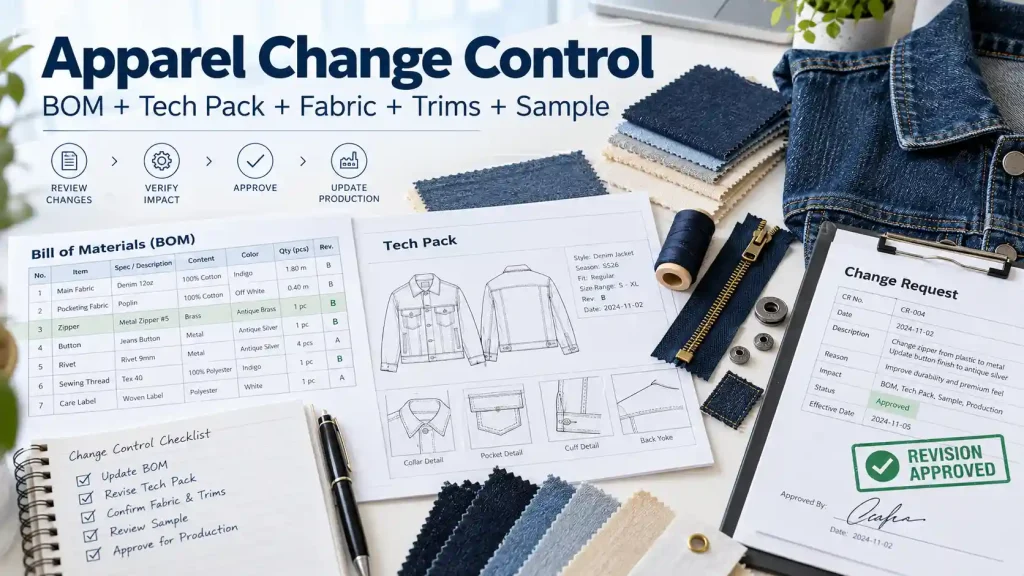
Apparel change control provides a structured way to identify, assess, approve, document, and implement product revisions before they become the new production standard.
For garment factories and apparel buyers, the objective is straightforward: everyone involved in production should work from the same current and approved specification, supported by appropriate validation evidence.
This guide explains how to manage BOM, material, pattern, and construction revisions, including which repeat-order changes require resampling, retesting, or document-only approval.
What Is Apparel Change Control?
Apparel change control is the process used to manage revisions to an approved or developing garment specification.
Changes may involve:
- Bill of Materials (BOM)
- Main fabric or lining
- Trims and accessories
- Zippers, buttons, and snaps
- Thread, elastic, rib, or interlining
- Pattern and measurements
- Sewing construction
- Print and embroidery
- Labels and hangtags
- Washing and finishing
- Packaging
- Testing and compliance requirements
Not every change requires the same level of review.
For example, correcting a non-critical carton mark may only require a document update. Replacing the main fabric may require material testing, garment sampling, fit evaluation, and buyer approval.
The level of change control should match the potential impact of the revision.
For repeat orders, the review should also determine whether previous approvals and test results remain applicable to the materials, processes, and production conditions now being proposed.
Why Change Control Matters in Apparel Manufacturing
Garment production involves multiple departments and suppliers. Product information may pass between product development, sourcing, purchasing, pattern making, cutting, sewing, finishing, quality control, and packing.
Without revision control, different teams may unknowingly use different specifications.
For example:
- The BOM lists Fabric A.
- Purchasing orders Fabric B.
- The approved sample uses Fabric A.
- Production cuts Fabric B.
- QC receives an older measurement specification.
The result may be inconsistent production, rework, delays, or disputes about what was actually approved.
A controlled apparel tech pack establishes the technical reference for materials, measurements, construction, artwork, and other manufacturing requirements.
Change Control Is More Than Sending an Email
A message such as “Please use the new zipper” does not provide sufficient change control.
A complete change record should answer:
- What is changing?
- Why is the change required?
- What was the previous specification?
- What is the proposed specification?
- Which styles, colors, sizes, orders, or production lots are affected?
- What risks could the change create?
- Is additional testing required?
- Is a new component, construction, or garment sample required?
- Who reviewed and approved the change?
- When does the new revision become effective?
For repeat orders, the record should also identify the previous approved production reference and whether existing validation evidence can still be relied upon.
These details create a traceable decision record and reduce confusion during production.
What Apparel Changes Usually Require Approval?
1. BOM Revisions
The Bill of Materials (BOM) identifies the materials and components required to manufacture a garment.
Common BOM changes include:
- Main fabric substitution
- New fabric supplier
- Lining replacement
- Zipper change
- Button or snap change
- Thread specification
- Elastic or rib change
- Interlining change
- Label revision
- Packaging material change
A BOM revision should show both the previous and proposed specifications.
| Component | Previous | Proposed | Required Review |
|---|---|---|---|
| Main fabric | Article A123 | Article A127 | Material validation |
| Lining | Polyester | Recycled polyester | Material and compliance review |
| Zipper | ZP-102 | ZP-108 | Function and compatibility review |
| Button | ABS | Recycled ABS | Appearance, attachment, and applicable material review |
These article codes and substitutions are illustrative examples, not actual New Asia Garment production records.
The review should identify whether a new component is genuinely equivalent to the approved version and whether previous test evidence remains applicable.
A different supplier code alone does not establish a performance difference, but an equivalence claim must be supported by relevant specifications and evidence.
2. Material Substitutions
Material changes can affect garment fit, appearance, durability, and performance.
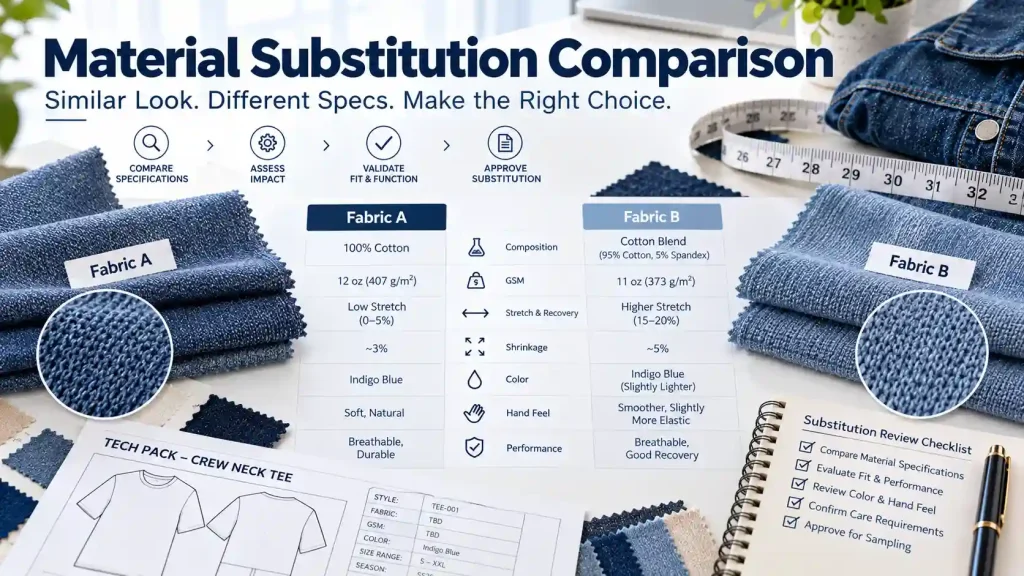
When reviewing a replacement fabric, compare it with the approved material for:
- Fiber composition
- GSM
- Fabric width
- Stretch and recovery
- Shrinkage
- Color
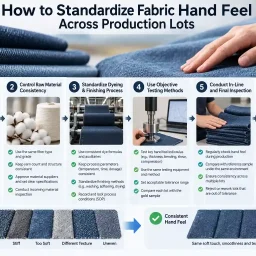
- Hand feel
- Fabric construction
- Finishing
- Pilling
- Colorfastness
- Product-specific performance
A fabric should not be approved simply because it looks similar.
For example, a replacement fabric with higher stretch may alter garment measurements and recovery. A fabric with different shrinkage behavior may affect finished dimensions after laundering.
Depending on the risk, material validation may include fabric inspection, laboratory testing, wash testing, or garment-level evaluation.
A significant substitution may also require a revised garment sample.
Material substitution is a technical approval decision, not only a purchasing decision.
3. Construction Revisions
Construction changes affect how a garment is assembled.
Examples include:
- Seam type
- Stitch type
- Stitch density
- Seam allowance
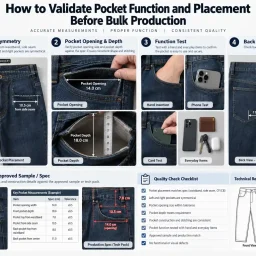
- Pocket construction
- Collar construction
- Cuff construction
- Hem construction
- Reinforcement
- Bartack placement
- Fusing
- Topstitching
- Sewing sequence
A factory may suggest a different construction to improve efficiency or reduce sewing time.
However, the revised method should still be assessed for:
- Appearance
- Strength
- Durability
- Fit
- Production consistency
- Machine requirements
- Washing and finishing performance
A construction method that works on one development sample must also be suitable for repeatable bulk manufacturing.
Where a change affects a high-stress area, the buyer and factory should review whether the original durability evidence remains relevant.
4. Pattern and Measurement Revisions
Pattern changes can directly affect garment fit.
Typical revisions include:
- Chest
- Waist
- Hip
- Shoulder
- Body length
- Sleeve length
- Armhole
- Neck opening
- Rise
- Inseam
- Hem opening
- Pocket position
For relevant revisions, record the previous and new measurements.
| Point of Measurement (POM) | Previous | Revised | Example Tolerance |
|---|---|---|---|
| Chest | 52 cm | 53 cm | ±1 cm |
| Body length | 70 cm | 69 cm | ±1 cm |
| Sleeve length | 62 cm | 61.5 cm | ±1 cm |
These are illustrative measurements and tolerances. Actual acceptance limits must be defined in the buyer-approved specification.
For repeat orders, the review should establish whether the previous approved fit sample and grading rules remain valid.
If the pattern has changed, the production team should not assume that an earlier sample approval covers the revised garment.
A Practical Apparel Change Control Process
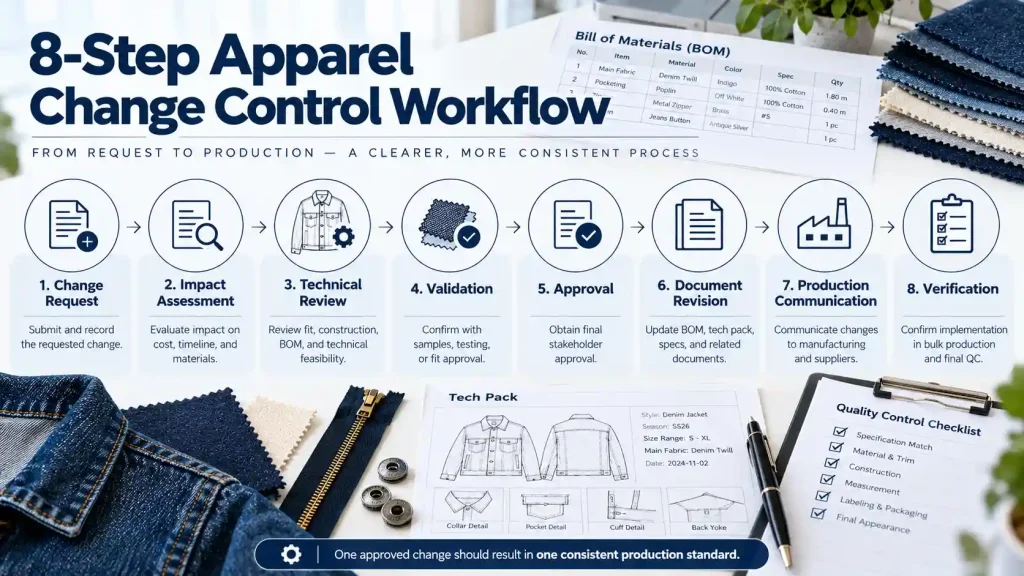
A controlled apparel revision can follow eight stages:
Change Request → Impact Assessment → Technical Review → Validation → Approval → Document Revision → Production Communication → Verification
The same workflow can be applied to a new product or a repeat order. However, repeat orders require an additional question: which previous approvals are still supported by the current production conditions?
Step 1: Create a Change Request
Give every significant revision a unique reference number, such as CC-003.
The request should include:
- Style number
- Purchase order or repeat-order reference
- Color and size range
- Current revision
- Proposed revision
- Reason for change
- Affected component or process
- Supplier or material lot, where relevant
- Requested implementation date
- Responsible person
For a repeat order, identify the previous approved production reference and any records being carried forward.
This creates a clear starting point for review.
Step 2: Assess the Impact
Before approving a revision, consider how it could affect the garment and the production process.
| Area | Key Question |
|---|---|
| Quality | Will performance or appearance change? |
| Fit | Will measurements, balance, or stretch behavior change? |
| Cost | Will material, testing, sampling, or labor costs change? |
| Compliance | Are new tests, labels, or approvals required? |
| Production | Will processes, machinery, or work instructions change? |
| Supply chain | Will lead time, material availability, or traceability change? |
Changes can be categorized according to their potential risk.
Low-Risk Changes
Examples may include administrative corrections or minor packaging information updates that do not affect product quality, safety, regulatory compliance, or relevant manufacturing operations.
Medium-Risk Changes
Examples may include certain secondary trim substitutions, artwork changes, or localized construction adjustments that require focused verification.
High-Risk Changes
Examples may include:
- Main fabric substitution
- Fiber-content change
- Major pattern revision
- Significant wash-process change
- Safety-related component change
- Compliance-related information change
- Material or construction change affecting critical product performance
Higher-risk changes generally require stronger validation evidence before affected production operations are released.
Risk classifications should be defined by the buyer’s requirements and the actual impact of the change, rather than by a fixed universal list.
Step 3: Compare the Original and New Specification
Do not approve a change solely because a proposed material or component is described as “equivalent.”
Compare the actual requirements.
For materials, review composition, GSM, width, stretch, shrinkage, color, and relevant performance properties.
For construction, compare seam type, stitch density, reinforcement, appearance, and durability.
For BOM revisions, record the original and replacement component references, supplier, consumption, cost, and implementation date.
For repeat orders, compare the proposed change against the previously approved product and identify which earlier validation results remain applicable.
The result should be a documented difference assessment rather than a general statement that nothing significant has changed.
Step 4: Decide Whether Testing or Sampling Is Required
The next decision is whether the proposed change could affect the physical garment, its performance, or the validity of existing approvals.
Depending on the risk, validation may include:
- Fabric inspection
- Material testing
- Color approval
- Shrinkage testing
- Colorfastness testing
- Stretch and recovery testing
- Wash testing
- Fit evaluation
- Construction sample
- Revised PP sample
A minor administrative correction may require document approval only.
A main-fabric substitution may require a revised sample and additional testing.
However, sampling and testing should not be treated as interchangeable activities. A garment sample can demonstrate fit, appearance, and construction, but it does not necessarily establish fabric durability, colorfastness, or regulatory compliance.
Likewise, acceptable laboratory results from a replacement fabric do not automatically demonstrate that the finished garment will retain the same fit or appearance.
The validation plan should address the actual risks introduced by the change and identify which previous approvals can still be used.
Which Repeat-Order Changes Require Resampling or Retesting?
A repeat order often starts with an approved production reference, established patterns, an agreed BOM, and previous quality or testing records.
These references can reduce unnecessary development work when the production conditions remain sufficiently comparable.
However, repeat-order status is not proof that every material, process, or performance characteristic remains unchanged.
The buyer and manufacturer should decide whether the proposed revision requires:
- Document-only approval: The change does not affect relevant product or process requirements, and existing approval evidence remains applicable.
- Targeted retesting: A particular material, component, process, or performance characteristic needs to be verified.
- Partial or full resampling: The revised garment or affected construction needs physical evaluation.
- Combined resampling and retesting: Both garment-level and material or performance evidence are required.
The choice should be documented before the affected production operation begins.
Repeat-Order Change Decision Matrix
The following matrix provides a practical starting point for apparel brands. The requirements are risk-based recommendations, not universal testing obligations.
| Repeat-Order Change | Key Verification Requirements | Resampling or Retesting Decision |
|---|---|---|
| Same approved fabric specification, new supply lot | Supplier and lot identification, critical material properties, shade, applicable incoming inspection | Lot verification may be required; a new full garment sample is not automatically necessary |
| Main fabric from a different supplier or mill | Composition, construction, GSM, width, shrinkage, stretch, colorfastness, hand feel, intended performance | Targeted material testing; garment resampling if fit, appearance, construction, or performance may change |
| Replacement fabric with changed composition or construction | Material properties, dimensional stability, recovery, care requirements, compliance implications | Relevant retesting and generally garment-level validation; revised PP sample where required |
| Changed garment-washing recipe or processing conditions | Finished shade, dimensions, hand feel, strength, surface effects, trim compatibility, relevant durability | Wash trial and affected performance retesting; revised finished-garment sample where necessary |
| Same approved wash process, new production batch | Batch identity, process records, finished appearance, dimensions, applicable quality checks | Batch-level verification; full resampling depends on changes and risk |
| New zipper, button, snap, or other functional trim | Dimensions, material, attachment, function, durability, safety or compliance where applicable | Component testing and localized garment validation; full PP resampling only when justified |
| Revised elastic, ribbing, or interlining | Stretch, recovery, tension, bonding, dimensions, appearance, comfort | Targeted testing plus garment fit or construction review where affected |
| Changed seam type, stitch construction, or reinforcement | Seam strength, slippage, appearance, durability, process repeatability | Construction sample and relevant performance testing; garment resampling if fit or overall function changes |
| Changed pattern, grading, or key measurements | POM comparison, fit, grading, garment balance, relevant performance | Revised sample and fit validation for affected sizes, with further testing where required |
| Administrative or non-critical packaging correction | Artwork accuracy, affected document revisions, downstream requirements | Document or artwork approval may be sufficient |
A new supplier does not always require a full PP sample. Equally, retaining the same supplier does not automatically eliminate the need for new verification.
The decision depends on the actual change, the reliability and applicability of existing evidence, the intended product, and the buyer’s contractual or compliance requirements.
1. Fabric Source Changes: When Is Material Retesting Enough?
When a fabric supplier or mill changes, the first task is to establish whether the proposed material is technically equivalent to the approved specification.
Review the available supplier information, material identification, construction details, relevant test reports, and production samples.
Where suitable evidence confirms that the material meets the required specification, the buyer may authorize focused verification rather than a complete product-development cycle.
However, differences in shrinkage, stretch recovery, thickness, drape, or finishing may alter the garment even if the nominal composition and GSM remain unchanged.
In those situations, garment-level evaluation may be necessary.
For example, a replacement stretch-denim fabric may pass a basic composition check but behave differently at the knees, waist, or seat after wear and laundering.
A material-level result alone may not resolve that garment-fit risk.
The purpose of change control is to decide which evidence must be renewed—not to repeat every historical test without justification.
Detailed control of gradual variation between approved fabric specifications and production lots should be addressed through a separate fabric specification monitoring process. This section focuses on the approval consequences of an identified material-source change.
2. Washing and Finishing Changes: When Is a New Wash Trial Required?
Washing and finishing can affect more than appearance.
Changes in enzyme treatment, garment dyeing, bleaching, mechanical abrasion, softening, drying, or other finishing conditions may influence:
- Finished color and surface effects
- Dimensional stability
- Hand feel and drape
- Seam and fabric strength
- Stretch recovery
- Trim appearance or corrosion
- Print or embroidery performance
- Finished garment measurements
If a repeat order uses a materially different wash recipe or processing route, a representative wash trial should be considered before bulk finishing.
Where the change affects the approved finished appearance or dimensions, the buyer may also need to review a new finished-garment sample.
A new wash batch using the same approved process may require routine batch verification rather than complete resampling, provided the previous approvals remain applicable and the required acceptance criteria are met.
For example, switching from an approved mild enzyme treatment to a more aggressive abrasion process could affect both the wash appearance and fabric strength.
Approving the shade alone would not necessarily establish acceptable garment durability.
The required validation should therefore reflect the actual process change and its possible consequences.
3. Trim Changes: When Is Component Testing Sufficient?
A replacement zipper, button, snap, or other trim may affect function without changing the overall garment silhouette.
For these revisions, a localized component or garment-assembly test may provide the necessary evidence.
Review the relevant properties, such as:
- Component dimensions and compatibility
- Opening and closing function
- Attachment strength
- Durability during intended use
- Corrosion or washing resistance where relevant
- Safety and regulatory requirements
- Appearance against the approved product
A complete revised PP sample may not be necessary if the replacement component has been appropriately validated and does not affect fit, appearance, construction, or other product requirements.
However, a change to waistband elastic or collar ribbing may affect fit and recovery.
In that case, the review may need to include both material testing and garment fit evaluation.
For compliance-sensitive components, the buyer should confirm whether previous safety or regulatory evidence remains applicable.
4. Construction Changes: When Is a Revised Garment Sample Necessary?
Construction revisions should be assessed according to their impact on fit, appearance, seam performance, and manufacturing repeatability.
For example, changing reinforcement at a pocket corner may require a localized construction sample and relevant durability evaluation.
Changing a major seam construction may have broader consequences for garment dimensions, bulk production methods, or wearer comfort.
A revised garment sample should be considered when the change affects the complete garment’s fit, balance, function, or approved appearance.
A localized construction sample may be sufficient when the affected feature can be evaluated independently and all other relevant requirements remain unchanged.
The factory should also confirm that the revised process can be consistently executed with the intended equipment, operators, and production conditions.
How Should Buyers Decide Between Resampling and Retesting?
A practical decision can follow five questions:
- What changed? Identify the exact material, component, process, pattern, or construction revision.
- What could be affected? Assess fit, appearance, dimensions, durability, safety, compliance, and production consistency.
- Which existing evidence remains valid? Review previous test reports, approved samples, supplier records, and relevant production results.
- What new evidence is required? Specify document review, targeted testing, construction sampling, garment resampling, or a combination.
- Who can accept the result? Identify the responsible technical reviewer and authorized buyer approver before affected production begins.
The decision should not depend on a fixed rule such as “all repeat orders require no new samples” or “every BOM revision requires a complete PP sample.”
Instead, the required evidence should be proportional to the change and supported by documented acceptance criteria.
What Evidence Must Be Recorded Before Approval?
A resampling or retesting decision should be traceable to the exact revision and production scope.
| Record Field | Required Information |
|---|---|
| Change identification | Change number, style, PO, affected colors, sizes, and production lots |
| Previous approved reference | Prior BOM, tech pack, sample, and relevant test report revisions |
| Proposed change | New supplier, material, wash process, trim, pattern, or construction specification |
| Risk assessment | Potential effects on fit, quality, durability, compliance, and production |
| Validation decision | Document-only approval, targeted retesting, resampling, or combined validation |
| Test requirements | Applicable method, agreed acceptance criteria, sample identification, and required evidence |
| Actual verification | Test results, measurements, sample review findings, and report references |
| Final disposition | Accepted, rejected, conditionally accepted, or pending further verification |
| Authorization | Approver, approval date, conditions, and effective production scope |
For example, a test record should establish the applicable method, agreed acceptance criteria, actual result, and report reference.
A statement such as “shrinkage passed” is insufficient if the reviewer cannot determine which fabric, test method, acceptance limit, and production lot the result relates to.
Similarly, a revised garment sample should be identified by its actual materials and construction revisions.
An approval is only reliable when the evidence corresponds to the product and production conditions being released.
Example: A Repeat Hoodie Order With a New Fabric Source
Consider a hypothetical repeat order for 3,000 cotton-blend hoodies.
The previous production run used Fabric A, and the brand approved the garment’s fit, hand feel, dimensions, and finished appearance.
For the new order, the original mill cannot provide the same material. The factory proposes Fabric B from another supplier.
Both fabrics are described as having the same nominal composition and GSM.
However, this does not establish that their physical behavior is identical.
A controlled review would:
- Compare the full material specifications, including construction and finishing.
- Check relevant test evidence for dimensional stability, stretch behavior, colorfastness, and other required properties.
- Identify any differences that could affect garment fit, appearance, or performance.
- Conduct additional material tests where existing evidence is insufficient.
- Produce and evaluate a revised hoodie sample if those differences could affect the finished garment.
- Record buyer acceptance and update the BOM, material specification, and applicable production references.
- Verify the first production output against the newly approved requirements.
If sufficient evidence demonstrates material equivalence and the garment-level risk is low, a complete resampling cycle may not be necessary.
If the replacement fabric changes dimensional stability or fit, additional garment validation may be required.
This is a hypothetical example illustrating the approval decision; it is not a documented New Asia Garment order.
The governing principle is that repeat-order approval must follow verified production equivalence, not merely identical style numbers or fabric descriptions.
Step 5: Obtain Formal Approval
A change should not become a production requirement simply because it was mentioned in a meeting or email.
The approval record should identify:
- Change number
- Previous revision
- New revision
- Reason for change
- Required validation
- Validation results and references
- Approval date
- Authorized approver
- Effective production date or lot
- Remaining conditions, if any
Depending on the project, approval may involve the buyer, product development, technical team, sourcing, QA, or compliance team.
If resampling or retesting is required, the approval should identify whether the evidence has been accepted.
A conditional approval should also specify which operations can proceed and which remain on hold.
The distinction between accepting a revised sample and authorizing production is further explained in our guide to pre-production sample approval before bulk manufacturing.
Step 6: Update the Controlled Documents
After approval, update every document affected by the revision.
These may include:
- BOM
- Tech pack
- Pattern
- Measurement specification
- Construction specification
- Material specification
- Artwork
- Label specification
- Packaging specification
- Cost sheet
- QC specification
- Testing requirements
- Purchase order
A repeat-order change should also identify which previous approvals remain valid and which have been replaced.
The factory should not have to choose between conflicting old and new documents.
One approved change should result in one consistent production standard for the affected order and implementation scope.
Step 7: Communicate the New Revision
The revised information should reach all relevant departments.
These may include:
- Purchasing
- Material warehouse
- Pattern department
- Cutting
- Sewing
- Finishing
- QC
- Packing
- External suppliers
Obsolete documents should be withdrawn or clearly marked as superseded.
If a revision applies only to a particular repeat order, fabric lot, colorway, or production quantity, those limits should be communicated explicitly.
This is especially important when different orders or subcontractors are operating at the same time.
Step 8: Verify the First Production Output
Change control does not end when the approval document is signed.
For relevant revisions, the manufacturer should verify the first production output against the approved specification.
Checks may include:
- Correct material
- Pattern version
- Measurements
- Construction
- Artwork
- Labels
- Finishing
- Packaging
For repeat orders, first-output verification should also confirm that the validated replacement material, component, or process was actually used.
If the approved revision specifies Fabric B but production uses an unapproved additional lot or substitute material, the previous validation decision may no longer cover the actual production conditions.
QC should inspect against the current authorized revision and applicable acceptance criteria.
Where a change is discovered after production has begun, the affected output should be identified and assessed before further release.
This final verification confirms that the approved change has reached production as intended.
Change Control After PP Sample Approval
Changes before PP approval are normally part of product development.
After PP approval, revisions require greater control because the approved sample establishes a physical manufacturing reference.
For example, if the PP sample was produced using Fabric A but bulk manufacturing is planned with Fabric B, the factory should not assume that the original approval automatically covers the replacement.
The change may require:
- Written approval
- Updated BOM
- Updated tech pack
- Material validation
- Revised sample
- Additional testing
- First-output inspection
The PP sample and bulk production process should therefore be connected to the change control system.
If a revision changes the garment’s fit, appearance, measurements, performance, or compliance status, the affected requirements should be reviewed before production release.
The same principle applies to repeat orders. Previous PP approval may remain useful evidence, but its applicability must be reassessed whenever important materials, processes, or specifications change.
A previous approval should not be automatically extended to a new supplier, revised construction, additional material lot, or changed production process outside its authorized scope.
Apparel Change Control Checklist
Before approving a significant revision, confirm:
- Change number assigned
- Original specification recorded
- New specification recorded
- Reason documented
- Affected production scope identified
- Material impact assessed
- Construction impact assessed
- Fit and measurement impact checked
- Previous approval evidence reviewed
- Retesting requirements confirmed
- Resampling requirements confirmed
- Required validation completed or controlled as an open condition
- Test methods and acceptance criteria identified
- Results linked to the relevant materials, samples, and lots
- Cost impact reviewed
- Lead-time impact reviewed
- BOM updated
- Tech pack updated
- QC specification updated
- Buyer approval recorded
- Production team informed
- First production output verified where required
If required information remains unresolved, the change should not be treated as fully released for affected production operations.
Frequently Asked Questions
1. What is apparel change control?
Apparel change control is the process of identifying, assessing, approving, documenting, and verifying revisions to garment specifications, including BOM, materials, patterns, measurements, construction, washing, trims, artwork, labels, and packaging. It helps ensure that production follows the current approved requirements.
2. Which repeat-order changes require resampling or retesting?
Changes to fabric sources, fiber composition, washing processes, functional trims, patterns, or critical construction may require renewed validation. The decision depends on the potential effect on garment fit, appearance, performance, safety, and compliance, as well as whether previous approval evidence remains applicable.
3. Does every fabric supplier change require a new PP sample?
No. A new supplier does not automatically require a complete PP sample. However, the proposed fabric must be assessed against the approved specification. Targeted material testing may be sufficient for some changes, while a revised garment sample may be necessary if fit, dimensions, appearance, or performance could be affected.
4. Can a repeat order use previous test reports?
Yes, where the reports remain applicable to the actual material, component, process, production conditions, and contractual or regulatory requirements. Previous results should not automatically be carried forward if the relevant specifications or manufacturing conditions have changed.
5. Who should approve material and construction changes?
Approval responsibilities depend on the buyer’s organization and the project. Product developers, technical teams, sourcing personnel, QA, compliance specialists, and authorized buyer representatives may all participate. The final decision and permitted production scope should be recorded.
6. How can buyers prevent old and new revisions from being mixed during production?
Use controlled revision numbers, effective dates, current BOM and tech pack references, documented approvals, and clear departmental communication. Superseded instructions should be withdrawn or marked obsolete. The first production output should be verified against the approved revision where required.
Key Takeaways
Effective apparel change control is not about preventing every manufacturing change or repeating every historical test.
It is about making sure significant revisions are:
- Clearly identified
- Technically assessed
- Evaluated against previous approval evidence
- Supported by appropriate sampling or testing
- Commercially reviewed
- Formally approved
- Added to controlled documents
- Communicated to production
- Verified during manufacturing
For repeat orders, the central decision is whether the proposed production conditions remain sufficiently comparable to those already approved.
A change that affects only administrative documentation may need little additional validation. A change affecting material performance, washing, garment fit, functional trims, or critical construction may require targeted retesting, revised samples, or both.
One garment style should have one current, approved production standard for each defined production scope—and the validation evidence should support that standard.
If you are reviewing a BOM revision, material substitution, construction change, or repeat-order production plan, contact New Asia Garment with your current BOM, tech pack, approved sample information, previous test records, and proposed revision.
This provides a practical starting point for discussing the sampling, verification, quality, cost, and delivery requirements before the affected bulk manufacturing operations are released.
Read more
- Knitwear Manufacturer: Custom Sweaters, Cardigans & Cable Knit
- Garment-Dyed vs Piece-Dyed Hoodies: MOQ, Shrinkage and Color Approval Trade-Offs
- Moving Apparel Production to a New Factory: A Handover and Validation Checklist
- How to Compare Clothing Manufacturer Quotes: A Cost Checklist for Apparel Brands
- How to Build Durability Tests Around High-Stress Garment Areas