
High return rates are one of the biggest challenges facing fashion e-commerce brands. For companies selling denim online, the problem can be particularly difficult because customers cannot physically try on or inspect a pair of jeans before purchasing.
A small difference in waist measurement, inseam length, stretch recovery, wash shade, or garment construction can turn an otherwise acceptable product into a return.
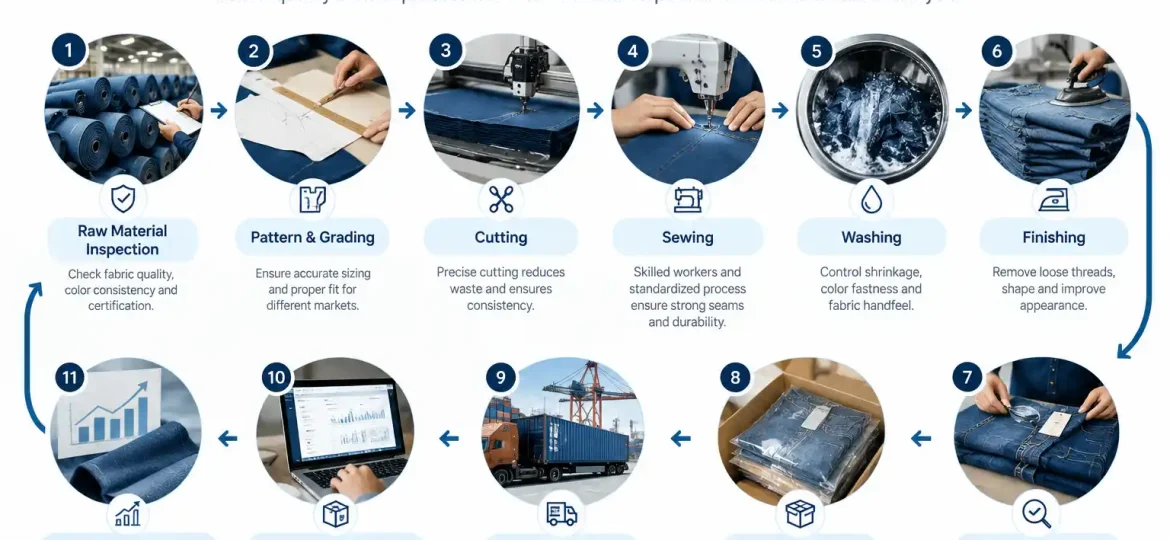
This is why denim quality control should not be treated as a final inspection step at the end of production. Effective quality management starts before bulk manufacturing and continues through fabric inspection, pattern development, cutting, sewing, washing, finishing, measurement inspection, packing, and shipment.
When factory quality-control data is combined with customer return data, brands can identify recurring manufacturing problems and use those findings to improve future production.
1. Return Drivers Linked to Manufacturing
Not every e-commerce return is caused by a manufacturing defect. However, many common return reasons can be connected to variations that occur during denim production.
Customers may select reasons such as “wrong size,” “not as expected,” “different from the picture,” or “poor quality.” Behind these general descriptions can be specific technical issues involving pattern grading, fabric shrinkage, wash consistency, construction, or hardware.
Identifying these manufacturing-related causes is the first step toward reducing avoidable returns.
Pattern and Grading Inconsistencies
Pattern accuracy is fundamental to denim fit.
Inconsistent grading, inaccurate cutting, or incorrect nesting across fabric layers can create dimensional differences between garments that are supposed to be the same size.
For example, two pairs of jeans labeled as size 32 may have slightly different waist, thigh, rise, or inseam measurements. Even a relatively small variation can affect how a customer perceives the fit.
Digital pattern systems, approved master patterns, controlled grading rules, cutting-machine calibration, and regular measurement audits can help minimize this type of production variation.
Uncontrolled Wash Shrinkage
Denim can change significantly during washing and finishing.
Temperature, washing time, mechanical action, chemical or enzyme conditions, extraction, drying, and finishing can all affect the final dimensions and appearance of a garment.
This means that a pair of jeans can meet its pre-wash specification but fall outside the approved finished measurement after washing.
A more reliable approach is to evaluate fabric behavior and wash shrinkage before bulk production. The expected dimensional change can then be incorporated into the pattern and production plan.
New Asia Garment’s denim manufacturing process similarly treats pre-wash planning, wash development, post-wash measurement, and finished-garment approval as connected parts of denim production.
Hardware and Seam Failures
Buttons, rivets, zippers, belt loops, pockets, and structural seams are all potential sources of product returns.
Loose buttons, detached rivets, broken zipper components, skipped stitches, open seams, or insufficient reinforcement can become immediately visible to customers after unboxing.
Because online shoppers cannot inspect a garment before purchasing, these defects can have an immediate impact on their perception of product quality.
Inspection of high-stress construction areas and appropriate hardware testing can help identify these problems before shipment.
2. Sizing and Measurement Consistency
Fit is one of the most important considerations when customers purchase jeans online.
Unlike many loose-fitting garments, denim jeans depend heavily on precise measurements and fabric behavior. Stretch percentage, recovery, rise shape, waistband construction, washing, and finishing can all influence the final fit.
Standardized Points of Measure (POM)
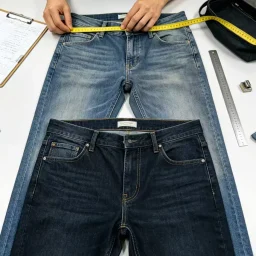
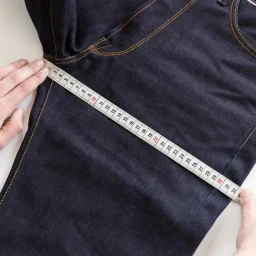
A standardized Points of Measure (POM) system provides an objective way to control denim sizing.
Typical denim POMs include:
- Waist
- Hip
- Front rise
- Back rise
- Thigh
- Knee
- Leg opening
- Inseam
- Outseam
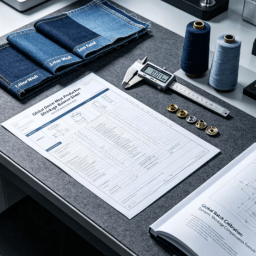
Each measurement should have a clearly defined measuring method and an approved tolerance in the technical specification.
Rather than applying one universal tolerance to every denim product, brands and manufacturers should establish tolerances according to the garment design, fabric characteristics, construction, and buyer requirements.
Finished-garment measurements should ultimately be checked against the approved post-wash standard.
Batch-to-Batch Variance Reduction
A customer who purchases the same style twice expects the sizing to remain consistent.
If one production batch fits differently from another batch of the same style, customers may lose confidence in the brand’s size chart.
Consistent master patterns, grading rules, approved specifications, fabric standards, and measurement procedures can help reduce this problem.
Production measurement data can also be analyzed by size and batch to identify gradual size drift before it becomes a larger customer issue.
Post-Wash Dimensional Stabilization
Denim quality control should focus on the finished garment, not only the pre-wash product.
A manufacturer can test how a selected fabric behaves under the intended wash and finishing process and then use the results to establish the finished measurement target.
This is especially important for stretch denim, where static measurements alone may not fully describe the wearing experience.
Stretch and recovery should therefore be considered alongside finished garment measurements when developing and approving a denim style.
3. Colour and Wash Expectations
When customers buy denim online, product photography is often their primary reference for color and wash appearance.
If the delivered garment looks significantly different from the approved online presentation, customers may describe the product as “different from the picture,” even when the garment has no obvious construction defect.
Shade Band Control
Some variation is inherent in denim production, particularly with indigo fabrics and garment-washing processes.
The objective of quality control is therefore not necessarily to make every garment visually identical under every lighting condition.
Instead, brands can establish an approved physical wash standard and define acceptable variation around that standard.
Production garments can then be reviewed against the approved reference before packing and shipment.
This helps prevent significant shade outliers from entering the e-commerce distribution network.
D65 Standardized Light Box Matching
Color evaluation should be performed under controlled lighting conditions.
A standardized D65 light source can provide a consistent environment for comparing production garments with approved color standards.
This is particularly useful because denim can appear different under different lighting environments.
A controlled light-box process can help quality teams identify shade differences more consistently and reduce subjective color judgments during bulk inspection.
Dry Process Reproducibility
The visual character of denim is often created through processes such as whiskering, hand scraping, laser effects, grinding, resin treatment, and localized abrasion.
Some of these operations can be highly process-sensitive.
Approved physical samples, defined process parameters, machine settings, operator instructions, and visual inspection standards can help maintain consistency across production batches.
For e-commerce brands, this is important because product photography normally represents a specific approved wash appearance. Significant differences between the approved sample and bulk production can contribute to customer dissatisfaction.
4. Workmanship and Durability
Accurate measurements and an approved wash do not guarantee a successful product.
A pair of jeans must also withstand normal wear and repeated movement. Denim garments experience considerable stress around areas such as the crotch, inseam, waistband, pockets, belt loops, and fly.
High-Stress Seam Reinforcement
Construction specifications should take fabric weight, garment design, intended use, and washing conditions into account.
Important areas may require appropriate seam construction, stitch density, seam allowance, and bartacking.
Common high-stress areas include:
- Inseams
- Crotch areas
- Pocket openings
- Belt loops
- Waistband attachments
- Fly construction
Inspecting these areas during production can help identify potential seam slippage, broken stitches, and structural weaknesses before finished goods are shipped.
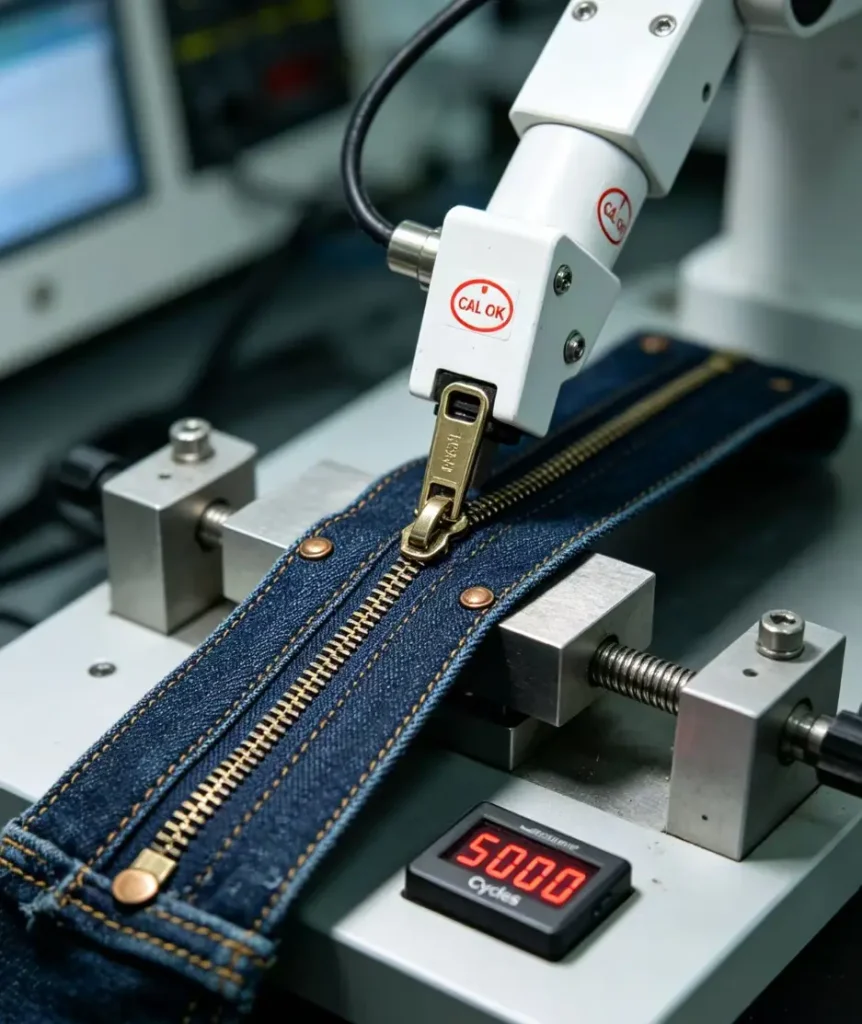
Hardware Pull-Strength Testing
Buttons, rivets, snaps, and other hardware components should be securely attached and appropriate for the garment construction.
Pull testing can provide an objective assessment of attachment strength.
However, the appropriate test method and force should be determined according to the specific garment, hardware specification, buyer requirement, and applicable testing standard rather than applying one fixed value to every denim product.
Thread Tensile Integrity
Thread performance is another factor in denim durability.
Appropriately specified polyester or other sewing threads can provide the strength required for structural seams and topstitching.
However, thread strength alone does not determine seam performance. Needle selection, stitch type, stitch density, machine tension, seam construction, and fabric thickness also need to be controlled.
Effective quality control therefore evaluates the complete sewing system rather than one component in isolation.
5. Accurate Product Data
Quality control can also improve e-commerce performance by generating reliable product information.
Online shoppers make purchasing decisions based on measurements, photographs, descriptions, fabric information, stretch claims, and care instructions.
If these details do not accurately represent the finished garment, customer expectations can be misaligned before the order is even placed.
Empirical Fabric Stretch and Recovery Rates
Stretch claims should be supported by actual testing rather than estimated only from fiber composition.
For example, the presence of elastane does not automatically indicate a specific level of stretch or recovery.
Fabric construction, finishing, garment washing, and test conditions can all affect the final result.
Documented stretch and recovery data can therefore help e-commerce teams create more useful sizing recommendations.
True-to-Life Wash Descriptions
Wash descriptions should reflect the approved physical product.
Terms such as “light wash,” “medium vintage,” or “dark indigo” can be interpreted differently by different customers.
Combining standardized references with approved physical samples helps product teams create more consistent descriptions and reduces the gap between marketing language and the delivered product.
Detailed Garment Care Labeling
Care instructions should also be based on the actual characteristics of the finished garment.
Wash temperature, drying method, and laundering frequency can influence denim shrinkage, color, hand feel, and appearance.
Factory testing and product-development data can therefore help brands create more accurate care instructions and reduce avoidable post-purchase problems.
6. Traceability for Quality Claims
When a brand begins receiving an unusual number of returns, identifying the defective garment is only the beginning.
The more important question is:
Where did the problem originate?
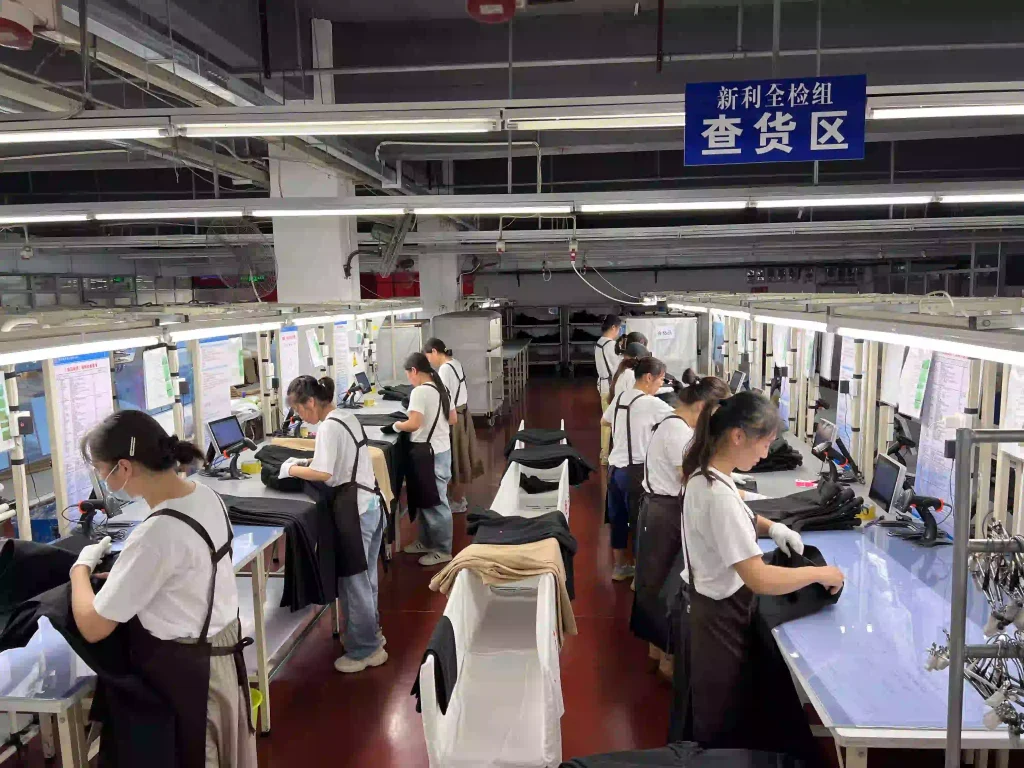
Traceability systems help connect finished garments with their relevant production information.
Garment Roll and Line Tracking
Depending on the manufacturer’s production system, traceability may include:
- Fabric roll number
- Cutting batch
- Sewing line
- Production date
- Washing lot
- Finishing process
- Inspection batch
Garment-level barcodes and production records can make it easier to investigate problems affecting specific batches.
Root-Cause Defect Isolation
Consider a situation in which a brand receives multiple complaints that a particular jeans style is shorter than expected.
Without production traceability, the investigation may involve the entire supply chain.
With detailed production records, quality teams can compare affected garments against fabric lots, cutting batches, sewing lines, and wash lots.
The investigation can then focus on the most likely source of the dimensional variation.
This transforms return information from a customer-service problem into a manufacturing improvement tool.
Supplier Accountability
Traceability also improves communication with suppliers and subcontractors.
If a problem is linked to a particular fabric lot, hardware supplier, washing batch, or production process, inspection records provide objective evidence for corrective action.
This creates a more structured approach to supplier management and quality improvement.
7. Pre-Shipment Prevention Loop
The best time to identify a manufacturing problem is before the product leaves the factory.
Once defective goods enter an international distribution network, the cost of correction can increase substantially.
Potential costs include:
- Reverse logistics
- International shipping
- Warehouse handling
- Customer service
- Refund processing
- Replacement shipments
- Rework
- Disposal
A structured Pre-Shipment Inspection (PSI) provides an important final quality checkpoint.
AQL 2.5 Inspection Standard
AQL-based inspection uses statistical sampling to evaluate whether a production lot meets an agreed acceptance plan.
An AQL 2.5 level is commonly referenced in apparel inspection programs, but it should not be treated as a universal guarantee of defect-free production.
The appropriate inspection plan should be determined according to order quantity, product risk, buyer requirements, defect classifications, and the agreed quality specification.
Critical, major, and minor defects should also be defined clearly before inspection.
Packaging and Folding Compliance
Final QC should not focus only on the garment itself.
Packaging errors can also create customer complaints and fulfillment problems.
Inspection may include:
- Polybag specifications
- Barcode readability
- Hangtag placement
- Size labels
- Carton markings
- Folding method
- Assortment accuracy
- Quantity per carton
- Packaging configuration
These checks help prevent fulfillment errors that may otherwise be mistaken for product-quality problems.
Factory Execution Excellence
A capable denim manufacturing partner can help brands integrate quality control into the complete production process rather than treating QC as an isolated final step.
New Asia Garment’s denim manufacturing operation covers fabric selection, fit development, pattern making, cutting, sewing, washing, finishing, quality control, and bulk production. Its published denim QC process also includes material inspection, shrinkage and fabric-behavior evaluation, measurement review, sewing and reinforcement checks, hardware verification, wash consistency, traceability, and final inspection.
For brands developing jeans for e-commerce, this integrated approach is important because fit, fabric behavior, washing, construction, and finished measurements are closely connected.
8. How Brands Feed Return Data Back into Production
Factory QC becomes even more valuable when it is connected to real-world customer feedback.
A returned garment should not be viewed only as a completed transaction. It can also provide information about how the product performs in the market.
Customer Return Reason Tagging
E-commerce brands should convert general return reasons into more specific technical categories.
For example:
- Too tight in thigh
- Waist too loose
- Inseam too short
- Different color from photo
- Zipper malfunction
- Button detached
- Stretch not as expected
- Fabric feels too stiff
- Wash effect different from image
This creates a more useful dataset for product-development and manufacturing teams.
Iterative Tech Pack Updates
When the same problem appears repeatedly, the information should be reviewed by the technical team.
For example, if customers consistently report that the thigh area feels too tight, the team can investigate:
- Thigh POM
- Pattern shape
- Grading rules
- Fabric stretch
- Recovery
- Wash shrinkage
- Garment construction
If the evidence supports a specification change, the relevant tech-pack measurements or construction requirements can be updated for the next production cycle.
Continuous Quality Improvement (CQI)
Quality control should be treated as an ongoing improvement process rather than a single inspection event.
Regular quality reviews can evaluate:
- Customer return reasons
- Factory defect rates
- Measurement deviations
- Wash consistency
- Hardware failures
- Customer complaints
- Inspection results
- Corrective actions
- Repeat-production performance
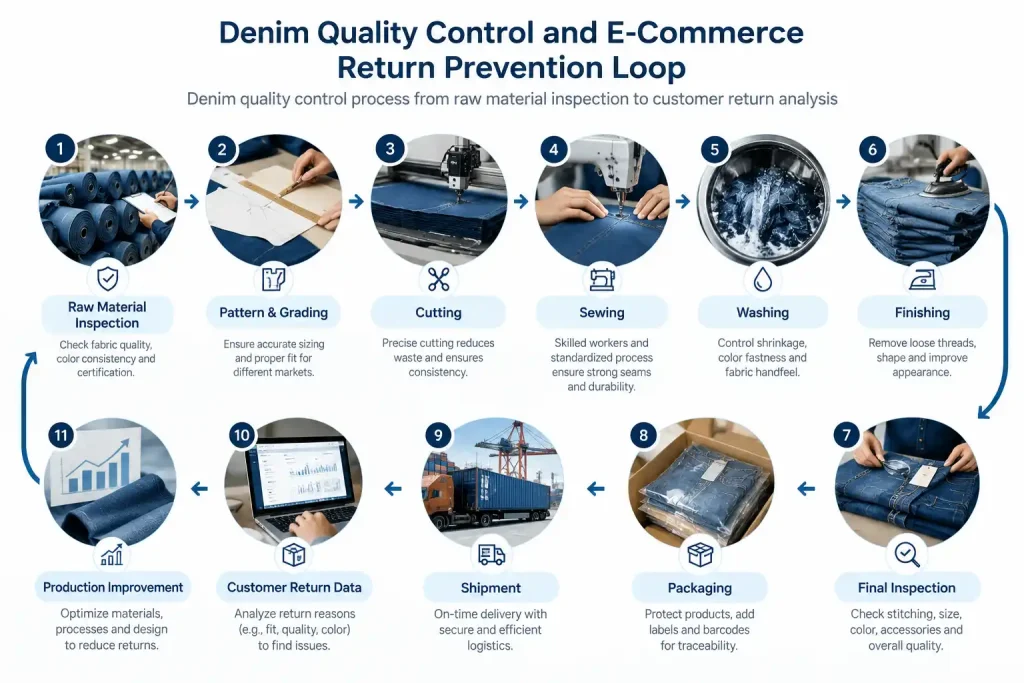
This creates a feedback loop:
Customer Returns → Root-Cause Analysis → Factory Corrective Action → Tech Pack / Process Update → New Production → QC Verification
Over time, this approach can help brands reduce recurring manufacturing problems and improve product consistency.
Conclusion
For global fashion e-commerce brands, denim quality control is much more than a final inspection before shipment.
The quality of a pair of jeans is influenced by fabric behavior, pattern development, grading, cutting, sewing, washing, finishing, hardware, measurements, packaging, and the consistency of the approved production standard.
When these factors are controlled systematically, manufacturers can reduce the likelihood of products arriving with unexpected sizing, wash variation, construction defects, or other quality problems.
The next step is connecting factory QC with customer return data.
Instead of treating returns simply as a cost of doing business, brands can analyze return reasons, identify recurring technical problems, update product specifications, and work with manufacturing partners to prevent those problems from appearing again.
For denim brands selling through e-commerce, this creates a more complete quality-management cycle:
Develop → Test → Produce → Inspect → Ship → Analyze Returns → Improve
That connection between manufacturing quality and customer feedback can help brands build more consistent products, create more accurate online product information, and deliver a better customer experience.
Frequently Asked Questions About Denim Quality Control
What is denim quality control?
Denim quality control is the systematic inspection and testing of denim garments throughout the manufacturing process. It can include fabric inspection, measurement checking, pattern and grading verification, sewing inspection, wash evaluation, color matching, hardware testing, and final pre-shipment inspection.
Why is quality control important in denim manufacturing?
Quality control helps manufacturers identify problems before finished garments reach customers. Consistent inspection can reduce issues related to fit, measurements, wash appearance, construction, hardware, and packaging.
How does denim quality control reduce e-commerce returns?
Effective denim QC can reduce manufacturing-related returns by improving size consistency, wash accuracy, garment durability, and product conformity. When production specifications are accurately controlled, the physical product is more likely to match the information and images presented on the e-commerce product page.
What measurements should be checked when inspecting jeans?
Common denim Points of Measure (POM) include waist, hip, front rise, back rise, thigh, knee, leg opening, inseam, and outseam. The exact measurement points and tolerances should be defined in the approved technical specification or tech pack.
How is denim wash consistency controlled?
Wash consistency can be controlled through approved wash recipes, standardized process parameters, reference samples, shade-band classification, controlled drying procedures, and final visual inspection. Production samples should be compared with approved standards before bulk shipment.
What is AQL 2.5 in garment inspection?
AQL 2.5 refers to an Acceptable Quality Limit used within a statistical sampling inspection system. In apparel production, an AQL-based inspection plan can be used to determine sample sizes and acceptance criteria for a production lot. The appropriate inspection plan should be agreed upon according to product requirements and defect classifications.
Can factory QC data improve e-commerce product descriptions?
Yes. Factory testing can provide useful information about actual garment measurements, fabric stretch and recovery, wash characteristics, shrinkage, and care requirements. This information can help e-commerce teams create more accurate product descriptions and sizing guidance.
How can denim manufacturers help brands reduce returns?
A denim manufacturer can help reduce manufacturing-related returns by controlling materials, patterns, measurements, sewing quality, washing, finishing, packaging, and final inspection. Combining factory QC records with customer return data can also help identify recurring problems and improve future production.
Read more