
Placing a bulk garment order without a structured testing plan can expose apparel brands, retailers, wholesalers, and importers to significant quality and production risks.
A pre-production sample may look perfect, but problems with fabric performance, sizing, stitching, colorfastness, construction, or compliance may not become visible until garments enter mass production. When these issues affect thousands of pieces, the result can be costly rework, product returns, shipment delays, customer complaints, and inventory losses.
A well-designed garment testing plan helps identify potential quality issues before bulk production begins. By checking materials, workmanship, measurements, performance, compliance, and packaging at the right stages, brands can reduce production risks and maintain consistent product quality.
At Newasia Garment, a professional garment manufacturer in China, we support customers with quality control from product development and sample approval through bulk production and final inspection.
Why Do You Need a Garment Testing Plan Before Mass Production?
Approving a garment sample based only on appearance is not enough.
The purpose of a garment testing plan is to determine whether the approved sample, materials, construction methods, and specifications can be consistently reproduced during large-scale production.
Without appropriate testing and inspection, apparel businesses may encounter:
- High product return rates
- Fabric shrinkage after washing
- Color fading or poor colorfastness
- Incorrect garment measurements
- Weak seams and stitching defects
- Poor print or embroidery quality
- Safety or regulatory compliance issues
- Packaging problems
- Production delays
- Customer complaints
- Inventory losses
A structured testing process allows manufacturers and buyers to identify problems earlier, when they are easier and less expensive to correct.
What Is a Garment Testing Plan?
A garment testing plan is a documented quality control framework that defines what needs to be tested, how it should be tested, when testing should take place, and what acceptance criteria must be met before production or shipment.
A typical garment test plan may include:
- Product specifications
- Fabric composition
- Fabric GSM
- Fabric construction
- Garment measurements
- Measurement tolerances
- Color standards
- Trims and accessories
- Printing and embroidery requirements
- Fabric performance tests
- Garment performance tests
- Safety and compliance requirements
- Inspection checkpoints
- Sampling procedures
- Acceptance criteria
- Testing frequency
- Quality control responsibilities
Think of it as a quality roadmap that connects product development, manufacturing, inspection, and final shipment.
Step 1: Define Garment Specifications Clearly
Every effective garment testing plan starts with clear product specifications.
Before approving a pre-production sample, buyers and manufacturers should confirm:
- Fabric composition
- Fabric GSM
- Fabric construction
- Garment measurements
- Size specifications
- Measurement tolerances
- Color references
- Trims and accessories
- Print or embroidery specifications
- Label requirements
- Packaging requirements
- Carton specifications
The more detailed the product specification is, the easier it is for the factory to reproduce the approved garment consistently during bulk production.
A clear tech pack, measurement chart, approved sample, and material specification can significantly reduce misunderstandings between buyers and manufacturers.
Step 2: Inspect Fabric Quality
Fabric is one of the most important factors affecting final garment quality.
Before cutting begins, fabric should be inspected against the approved specification.
Fabric Composition
Verify that the fabric composition matches the agreed requirement.
For example:
- 100% Cotton
- Cotton/Polyester Blend
- Cotton/Elastane
- Polyester/Elastane
- Recycled Polyester
The actual composition should be consistent with the product specification and applicable labeling requirements.
Fabric Hand Feel
The fabric should have the appropriate softness, flexibility, weight, drape, and surface characteristics for the intended garment.
The bulk fabric should also be compared with the approved fabric standard or sample.
GSM Verification
Fabric weight should be checked against the approved specification.
Examples include:
- 160 GSM Cotton Jersey
- 180 GSM Cotton Interlock
- 240 GSM Fleece
Incorrect GSM can affect garment weight, appearance, durability, comfort, and overall product performance.
Fabric Consistency
Inspect multiple areas and rolls of fabric for:
- Uneven thickness
- Inconsistent texture
- Knitting or weaving defects
- Color variation
- Stains
- Holes
- Surface defects
- Uneven finishing
For larger orders, fabric inspection should be performed before production rather than waiting until finished garments are available.
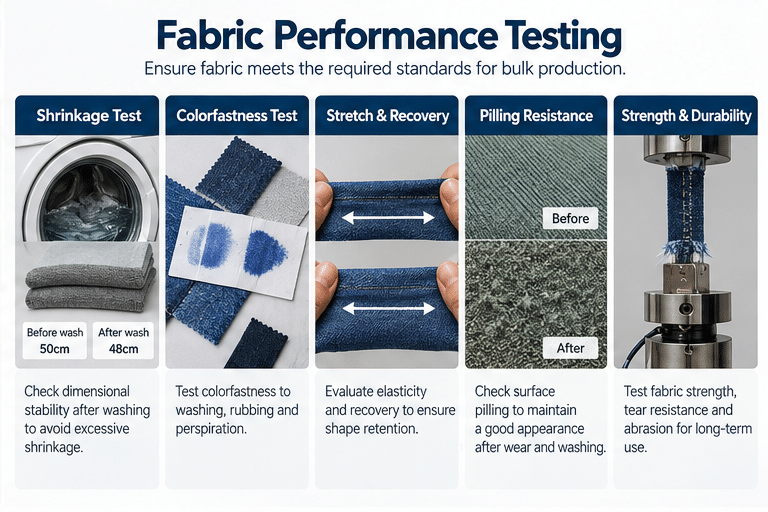
Step 3: Conduct Fabric Performance Tests
Visual inspection alone cannot determine how fabric will perform during washing and everyday use.
Depending on the garment and target market, appropriate fabric tests may include the following.
Shrinkage Test
Wash the fabric or garment according to the specified care instructions and measure the dimensions before and after washing.
The acceptable shrinkage level should be established according to:
- Fabric construction
- Fiber composition
- Finishing process
- Garment design
- Customer requirements
Uncontrolled shrinkage can cause garments to fall outside measurement tolerances after washing.
Colorfastness Testing
Colorfastness should be evaluated according to the intended use and applicable testing requirements.
Relevant tests may include resistance to:
- Washing
- Dry rubbing
- Wet rubbing
- Perspiration
- Water
- Light
Poor colorfastness can cause fading, staining, and customer complaints.
Stretch and Recovery Testing
For knitwear and stretch fabrics, evaluate how well the material returns to its original dimensions after stretching.
Good stretch recovery helps garments maintain their shape after repeated wear.
Pilling Resistance
For fabrics where pilling may be a concern, pilling resistance testing can help determine how the surface is likely to perform during repeated use and washing.
Fabric Strength and Durability
Depending on the product, additional testing may include:
- Tensile strength
- Tear strength
- Abrasion resistance
- Seam slippage
- Dimensional stability
- Water resistance
- Moisture management
The specific test requirements should always be determined according to the garment category, fabric type, customer specification, and target market.
Step 4: Evaluate Garment Construction
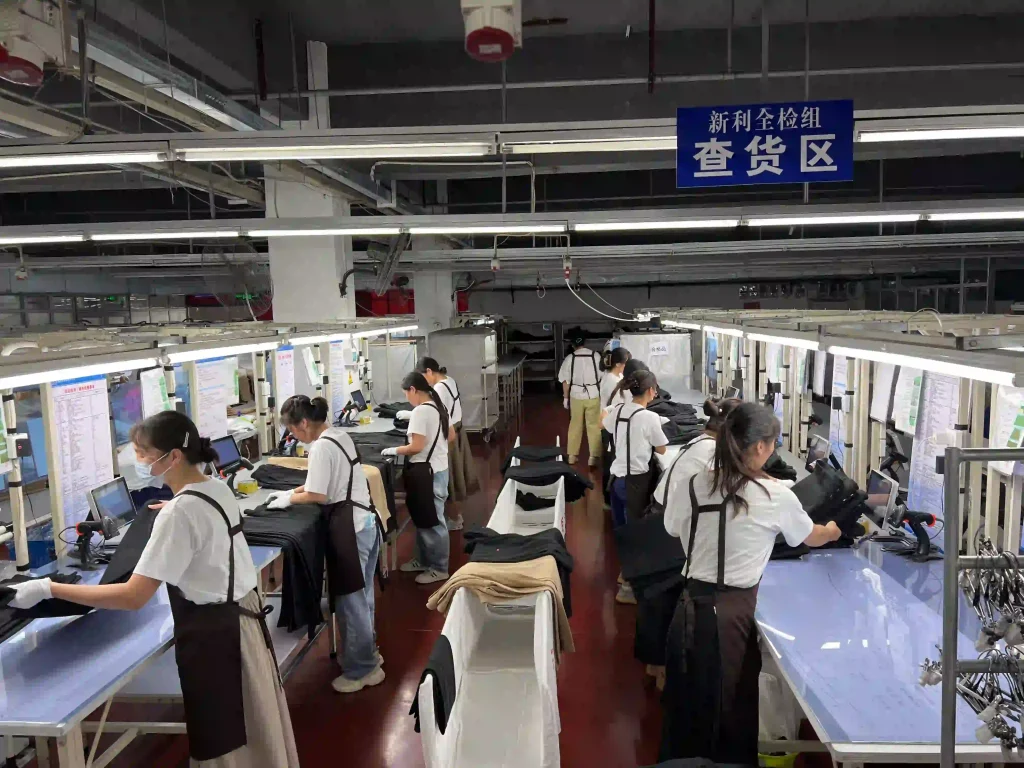
Good fabric quality alone does not guarantee a durable garment.
The construction of the garment must also be evaluated.
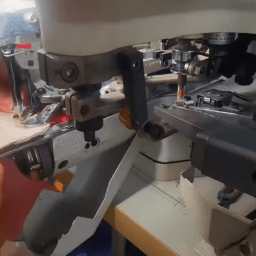
Stitching Quality
Inspect stitching for:
- Consistent stitch density
- Straight seams
- Loose threads
- Broken stitches
- Skipped stitches
- Uneven thread tension
- Seam puckering
- Unsecured thread ends
Seam Strength
Pay particular attention to areas exposed to stress, including:
- Shoulder seams
- Armholes
- Side seams
- Crotch seams
- Necklines
- Waistbands
- Pocket openings
- Zipper areas
Weak seams can result in garment failure during normal use.
Construction Consistency
Compare bulk production garments with the approved sample to ensure that:
- Seam construction is consistent
- Stitching methods are consistent
- Panels are correctly assembled
- Trims are correctly positioned
- Labels are correctly attached
- Garment shape matches the approved sample
Step 5: Verify Garment Measurements and Fit
Incorrect sizing is one of the most common causes of apparel returns.
Measurements should be taken according to a standardized measurement method.
Depending on the garment, key points of measurement may include:
- Chest
- Waist
- Hip
- Shoulder width
- Sleeve length
- Body length
- Neck opening
- Armhole
- Inseam
- Outseam
- Bottom opening
Each measurement should be compared against the approved size chart.
Check Measurement Tolerances
Not every garment will measure exactly the same.
Manufacturers and buyers should agree on acceptable measurement tolerances before production begins.
For example, the specification may define acceptable tolerances for:
- Body length
- Chest width
- Sleeve length
- Waist width
- Shoulder width
Clear tolerances help both the factory and buyer determine whether a garment is within specification.
Check Size Grading
It is also important to verify grading across all sizes.
A garment may fit correctly in the sample size but still have incorrect grading between sizes.
Step 6: Check Garment Safety and Compliance
Safety and regulatory requirements depend on the garment category, materials, components, and target market.
A garment testing plan should identify applicable requirements before bulk production.
Potential inspection areas include:
Buttons and Trims
Buttons, snaps, buckles, decorative components, and other trims should be securely attached and suitable for normal use.
Zipper Performance
Check whether zippers:
- Open and close smoothly
- Remain securely attached
- Function correctly
- Show no obvious damage
- Meet the required specification
Sharp Edge Inspection
Inspect metal components, zippers, snaps, buckles, and decorative accessories for sharp edges or other defects that could cause injury during normal use.
Drawcords and Functional Components
Where garments contain drawcords, cords, toggles, or similar components, their design and construction should be reviewed against the requirements applicable to the target market.
Chemical and Regulatory Requirements
Depending on the destination market, garments may also need to meet applicable requirements relating to:
- Restricted substances
- Flammability
- Product safety
- Fiber composition
- Care labeling
- Country-of-origin labeling
- Other applicable regulations
Compliance requirements should be confirmed before production rather than after the goods have been manufactured.
Step 7: Check Printing and Embroidery Quality
Printing and embroidery can have a major impact on the perceived quality of a garment.
Inspect:
- Artwork accuracy
- Print position
- Print size
- Color accuracy
- Registration
- Print adhesion
- Crack resistance
- Embroidery density
- Thread quality
- Thread trimming
- Backing quality
All decoration should match the approved artwork and pre-production sample.
For branded apparel, even small differences in logo position, size, or color can affect the final appearance.
Step 8: Perform Wearability and Fit Evaluation
A garment should not only look good. It should also perform comfortably during normal use.
Evaluate:
- Overall fit
- Freedom of movement
- Collar comfort
- Seam comfort
- Label placement
- Fabric flexibility
- Garment weight
- Ease of movement
- Overall appearance after wear
The evaluation should reflect the intended use of the product.
For example, activewear may require greater freedom of movement and stretch recovery, while outerwear may require greater durability and protection.
Step 9: Review Garment Packaging
Packaging is often overlooked during product development, but it can affect product presentation, warehouse handling, and transportation.
Check:
- Folding method
- Polybag size and quality
- Barcode placement
- Size stickers
- Care labels
- Hangtags
- Carton markings
- Shipping marks
- Carton quantity
- Packing ratio
Packaging specifications should be approved before bulk packing begins.
Incorrect packaging can lead to warehouse problems, barcode scanning issues, shipping mistakes, or damage during transportation.
Step 10: Document Every Test and Inspection Result
A garment testing plan should not rely on verbal approvals.
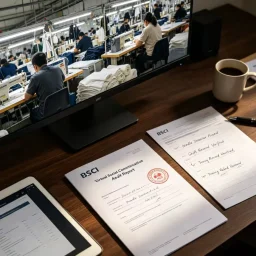
Every important test and inspection should be documented.
A basic quality checklist may include:
| Inspection Area | Result |
|---|---|
| Fabric Quality | Pass / Fail |
| Fabric GSM | Pass / Fail |
| Shrinkage | Pass / Fail |
| Colorfastness | Pass / Fail |
| Stitching Quality | Pass / Fail |
| Seam Construction | Pass / Fail |
| Measurements | Pass / Fail |
| Size Grading | Pass / Fail |
| Safety & Compliance | Pass / Fail |
| Print / Embroidery | Pass / Fail |
| Fit & Wearability | Pass / Fail |
| Packaging | Pass / Fail |
Documented inspection results provide a clear reference for both the manufacturer and buyer.
They can also help prevent misunderstandings when quality issues arise during bulk production or shipment.
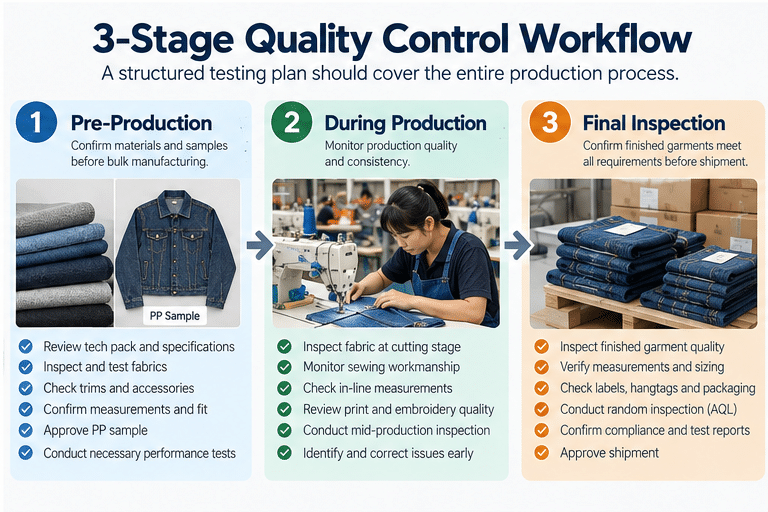
When Should Garment Testing Take Place?
Testing should not be treated as a single inspection at the end of production.
A stronger quality control system uses several checkpoints.
1. Pre-Production
Before bulk production:
- Confirm fabric specifications
- Approve materials
- Test fabric performance
- Confirm measurements
- Approve the pre-production sample
- Confirm trims and accessories
- Review applicable compliance requirements
2. During Production
During manufacturing:
- Inspect cutting
- Monitor sewing quality
- Check measurements
- Monitor workmanship
- Check printing and embroidery
- Identify production defects early
3. Final Inspection
Before shipment:
- Inspect finished garments
- Check measurements
- Review workmanship
- Verify labeling
- Check packaging
- Confirm carton quantities
- Conduct final quality inspection according to the agreed inspection standard
This multi-stage approach reduces the chance that a problem will remain undetected until the entire order has been completed.
Common Garment Quality Control Mistakes
Many quality problems begin with incomplete sample approval or unclear specifications.
Common mistakes include:
| Mistake | Potential Risk |
|---|---|
| Approving a sample based only on appearance | Hidden performance problems |
| Skipping fabric testing | Shrinkage, fading, or durability issues |
| Not defining measurement tolerances | Size inconsistencies |
| Ignoring size grading | Poor fit across different sizes |
| Not checking trims | Component failures |
| Skipping compliance checks | Regulatory problems |
| Not monitoring production | Large quantities of defective goods |
| Overlooking packaging | Warehouse and shipping problems |
| Rushing final approval | Costly rework and returns |
A structured garment testing plan helps reduce these risks before they become expensive production problems.
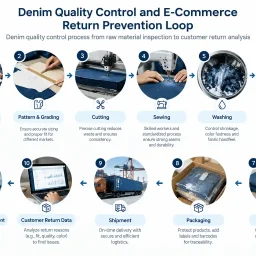
How a Professional Garment Manufacturer Supports Quality Control
An experienced garment manufacturer can help buyers establish quality control procedures from product development through final shipment.
At Newasia Garment, our quality control process can include:
- Fabric inspection before cutting
- Fabric GSM verification
- Material and trim inspection
- Shrinkage testing
- Colorfastness testing
- Pre-production sample approval
- In-line production inspection
- Measurement verification
- Workmanship inspection
- Print and embroidery inspection
- Safety and compliance checks
- Final garment inspection
- Packaging inspection before shipment
Our goal is to help ensure that bulk production follows the approved specifications and sample as closely as possible.
Garment Testing Plan Checklist Before Bulk Production
Before approving a garment for mass production, review the following checklist:
| Category | Key Inspection Points |
|---|---|
| Fabric | Composition, GSM, hand feel, consistency |
| Fabric Performance | Shrinkage, colorfastness, pilling, stretch recovery |
| Construction | Stitching, seams, thread quality, workmanship |
| Measurements | Size accuracy, grading, tolerances |
| Safety & Compliance | Trims, zippers, components, applicable regulations |
| Decoration | Print position, color, adhesion, embroidery |
| Fit & Comfort | Fit, movement, seams, labels |
| Packaging | Folding, polybags, labels, barcodes, cartons |
| Documentation | Test reports, inspection reports, approvals |
Conclusion
A comprehensive garment testing plan before bulk production is an important part of professional apparel quality control.
Testing fabric performance, garment construction, measurements, fit, workmanship, decoration, compliance, and packaging before mass production helps brands identify potential problems while there is still time to make corrections.
For apparel retailers, wholesalers, importers, and private-label brands, this proactive approach can reduce production risks, improve consistency, minimize avoidable returns, and create a more reliable supply chain.
The key is not simply to test the finished garment. Quality should be controlled throughout the entire production process—from material selection and sample development to bulk manufacturing and final inspection.
At Newasia Garment, we work with retailers, distributors, wholesalers, and private-label brands to establish practical quality control procedures for their apparel production.
If you are preparing a new apparel collection or planning your next bulk garment order, our team can help you develop a testing and inspection process based on your product specifications, target market, and production requirements.
Frequently Asked Questions About Garment Testing
1. What is a garment testing plan?
A garment testing plan is a structured quality control process used to evaluate fabric, construction, measurements, performance, safety, compliance, and packaging before and during bulk production.
Its purpose is to identify potential quality issues early and ensure the finished garments meet the agreed specifications.
2. Why is garment testing important before bulk production?
Garment testing helps identify problems before thousands of garments are manufactured.
Testing can reduce the risk of:
- Production defects
- Fabric shrinkage
- Color fading
- Incorrect sizing
- Poor workmanship
- Compliance issues
- Product returns
- Customer complaints
3. What tests should be included in a garment testing plan?
Testing requirements depend on the garment and target market, but common tests include:
- GSM
- Shrinkage
- Colorfastness
- Pilling resistance
- Stretch and recovery
- Fabric strength
- Seam strength
- Seam slippage
- Abrasion resistance
- Dimensional stability
Additional tests may be required depending on the product specification and destination market.
4. How can buyers check garment quality before production?
Buyers should review the fabric specification, approved sample, measurement chart, workmanship standards, trims, decoration, packaging, and applicable compliance requirements.
A standardized inspection checklist can help ensure that important quality points are not overlooked.
5. What should be checked during garment production?
During bulk production, manufacturers should monitor fabric quality, cutting, sewing, measurements, workmanship, printing, embroidery, trims, and overall consistency.
In-line inspections allow problems to be identified before large quantities of defective garments are completed.
6. What should be checked during the final garment inspection?
A final inspection may include:
- Appearance
- Workmanship
- Measurements
- Fabric defects
- Stitching
- Trims
- Printing and embroidery
- Labels
- Packaging
- Carton quantity
The inspection should follow the quality standards and acceptance criteria agreed between the buyer and manufacturer.
7. What should I ask a garment manufacturer before placing a bulk order?
Before approving bulk production, buyers should ask about:
- Fabric test reports
- Material specifications
- Pre-production sample approval
- Measurement standards
- Quality control procedures
- In-line inspection
- Final inspection
- AQL or other agreed acceptance criteria
- Compliance documentation
- Packaging standards
- Pre-shipment inspection
Clear quality requirements should be agreed before production begins.
8. Can a garment manufacturer help create a testing plan?
Yes. An experienced garment manufacturer can help identify appropriate inspection points and testing requirements based on the garment type, fabric, construction, target market, and customer specifications.
Working with the manufacturer during the development stage can help identify potential production risks before bulk manufacturing begins.
Read more
- Activewear Fabric Approval Before Bulk: Opacity, Stretch, Recovery and Breathability
- How to Build a Garment Test Plan Before Bulk Production (Complete Guide)
- Apparel Change Control: How to Approve BOM, Material and Construction Revisions
- Denim Quality Control: Testing Methods, Common Defects & Quality Standards
- How Denim Quality Control Reduces E-Commerce Returns