
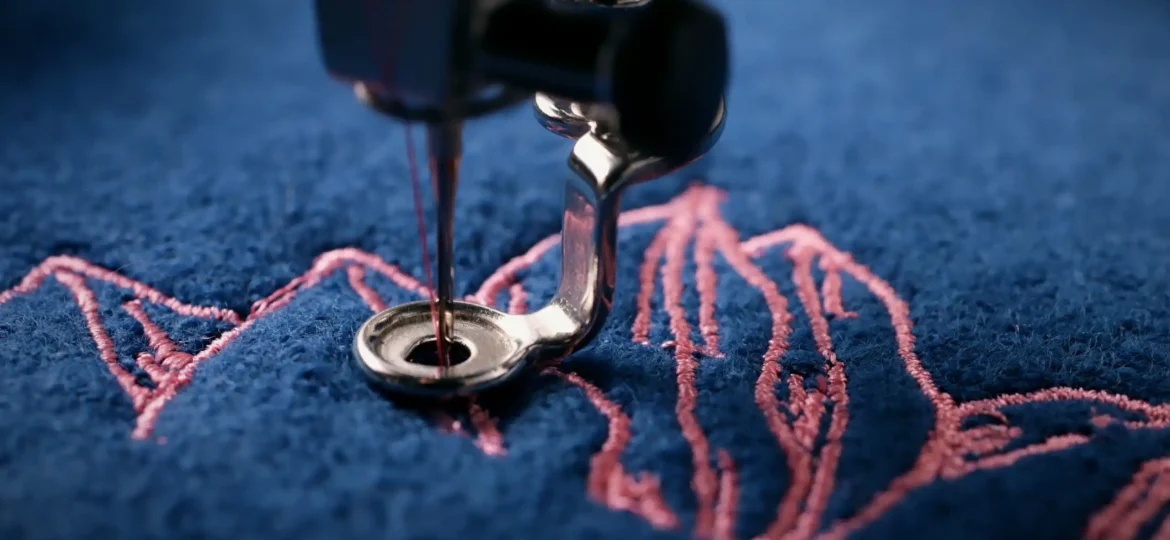
For apparel brands scaling bulk custom apparel production across global supply chains, maintaining consistent decoration quality is essential for delivering durable, retail-ready garments. Whether producing streetwear, corporate merchandise, sportswear, or private-label fashion collections, the quality of screen printing, DTF transfers, heat transfers, and embroidery can directly affect the final appearance, durability, and customer experience.
A digital artwork file may look perfect on a computer screen, but translating that artwork onto physical textiles introduces many variables. Screen printing can crack or fade, DTF transfers can peel, polyester fabrics can experience dye migration, and dense embroidery can cause puckering or fabric distortion.
Effective bulk print and embroidery quality control bridges the gap between creative design and consistent mass production. By controlling artwork compatibility, decoration parameters, machine settings, fabric behavior, testing procedures, and final inspections, apparel brands can significantly reduce production defects and maintain consistent quality across thousands of garments.
This guide explains the key quality-control requirements for bulk apparel printing and embroidery, from pre-production artwork review to final production approval.
Why Quality Control Matters in Bulk Custom Apparel Production
Bulk apparel decoration involves significantly more variables than producing a single sample. Once production moves from a controlled sample environment to hundreds or thousands of garments, even a small process variation can create large quantities of defective products.
From Digital Artwork to Physical Garments
Digital artwork does not automatically translate into an identical physical result.
The final appearance depends on factors such as:
- Fabric composition
- Fabric weight and surface texture
- Garment color
- Printing or embroidery method
- Ink or thread selection
- Print and embroidery dimensions
- Stitch density
- Curing temperature
- Heat-press settings
- Machine calibration
- Operator technique
For this reason, artwork should be evaluated together with the intended garment and decoration method before bulk production begins.
Common Decoration Defects in Bulk Production
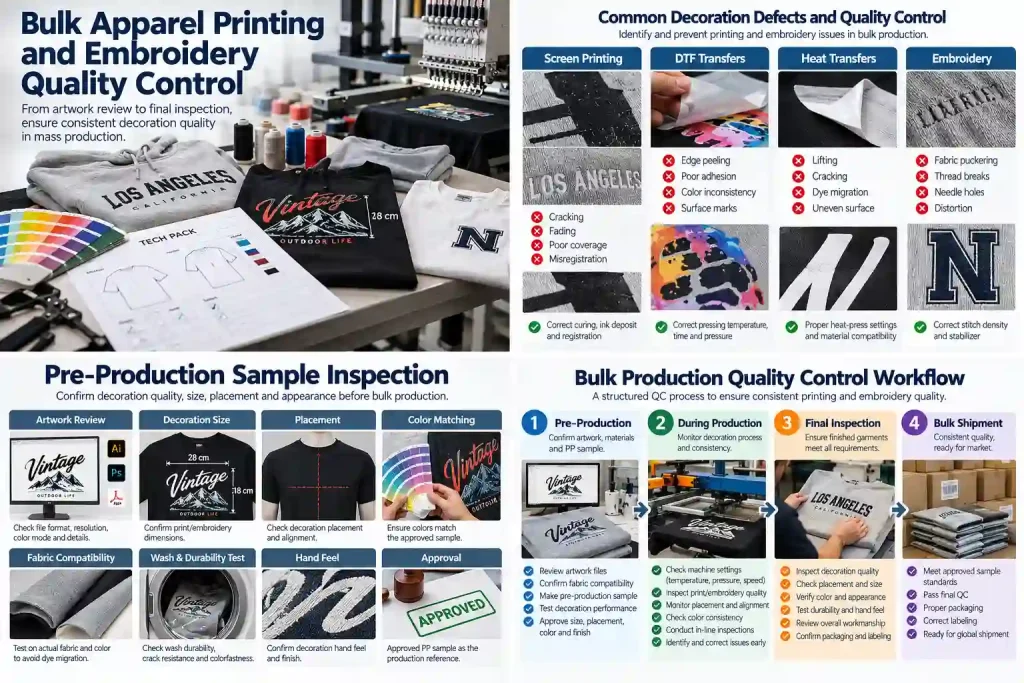
Common quality problems include:
- Screen-print cracking
- Print fading
- DTF edge peeling
- Heat-transfer lifting
- Polyester dye migration
- Embroidery puckering
- Thread breaks
- Needle holes
- Misregistration
- Incorrect decoration placement
- Inconsistent colors
- Excessive embroidery stiffness
- Fabric distortion
Identifying these risks during product development is considerably easier and less expensive than correcting them after bulk production has started.
Why Pre-Production Quality Control Reduces Manufacturing Risks
A properly approved pre-production sample establishes a physical benchmark for the factory.
The approved sample should define the expected:
- Color
- Print or embroidery size
- Placement
- Stitch density
- Fabric appearance
- Decoration hand feel
- Finish
- Durability
Once the PP sample is approved, production teams can use it as the master reference throughout the garment manufacturing process and final inspection.
1.Screen Print Cracking and Fading
Screen printing remains one of the most widely used decoration methods for high-volume apparel production, particularly when brands require consistent results from professional Screen Printing Services. It offers strong color coverage, excellent scalability, and good durability when the printing process is correctly controlled.
However, bulk production can introduce variations in curing, ink deposit, registration, and fabric compatibility that may result in cracking or fading.
Control Screen Print Cure Temperature and Dryer Speed
Curing is one of the most important stages in screen-printing quality control.
Plastisol and water-based inks require specific curing conditions to form a durable print film. Plastisol is commonly cured at temperatures around 160°C, but the exact requirements depend on the ink system and manufacturer’s technical specifications.
The actual ink-film temperature, dryer temperature, belt speed, and dwell time should be monitored rather than relying solely on the machine’s displayed temperature.
If the ink is under-cured, the print may have poor wash durability and can crack or deteriorate prematurely.
Maintain the Correct Ink Deposit Thickness
Ink deposit thickness is influenced by mesh count, stencil thickness, squeegee pressure, squeegee angle, printing speed, and the number of print strokes.
An excessively thick ink layer can create a rigid print film that is more susceptible to cracking when the garment stretches.
An insufficient deposit, on the other hand, can result in poor opacity, weak color density, and premature fading.
The correct balance depends on the artwork, fabric, ink system, and desired visual effect.
Conduct Wash Durability Testing
Wash testing should be part of the quality-control process for bulk printed apparel.
Representative production samples can be tested for:
- Cracking
- Peeling
- Color loss
- Print adhesion
- Surface changes
- Overall appearance
Where appropriate, brands and manufacturers can use recognized textile testing procedures, including relevant AATCC methods, to establish repeatable durability requirements.
Inspect Print Appearance During Bulk Production
Quality control should not take place only at the end of production.
Inline inspections should monitor:
- Color consistency
- Print opacity
- Registration
- Placement
- Print edges
- Surface defects
- Curing consistency
Early detection allows production teams to correct process problems before large quantities of garments are affected.
2.DTF and Heat-Transfer Edge Peeling
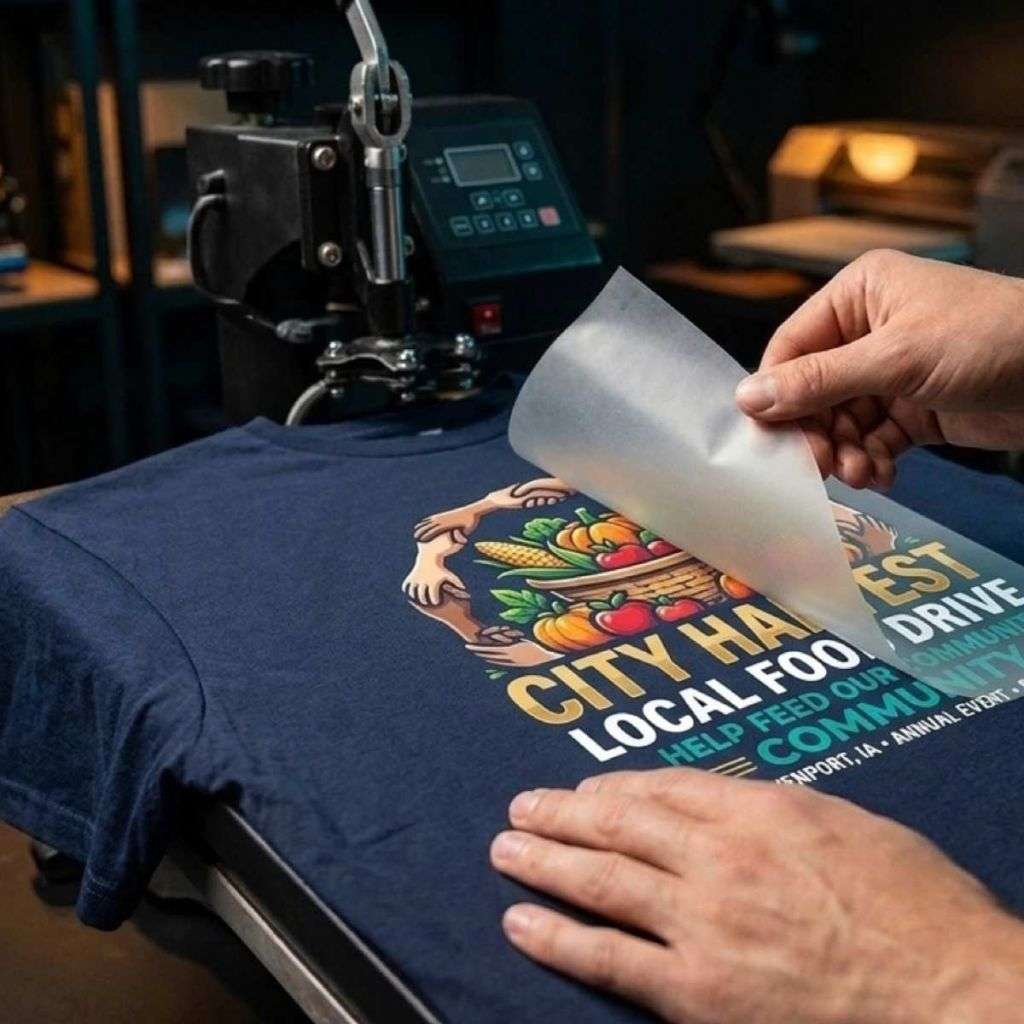
Direct-to-Film (DTF) and other heat-transfer technologies allow apparel brands to produce detailed, multi-color graphics without traditional screen setup requirements.
However, poor adhesive application, incorrect heat-press settings, or improper peeling can result in edge lifting and premature peeling.
Ensure Consistent DTF Adhesive Powder Fusion
DTF transfers use thermoplastic adhesive powder to bond the printed graphic to the garment.
The adhesive powder needs to be distributed evenly and properly fused. Areas with insufficient adhesive or incomplete melting may create weak bonding points.
This is particularly important around:
- Fine graphic details
- Corners
- Narrow edges
- Small lettering
- Large solid areas
Powder application and curing should follow the specifications provided by the transfer system manufacturer.
Calibrate Heat Press Temperature, Pressure, and Time
The three fundamental variables in heat-transfer application are:
Temperature + Pressure + Dwell Time
All three need to be controlled consistently.
The heat press should be calibrated regularly, and the entire platen should provide reasonably uniform heat and pressure.
Insufficient pressure or heat can leave weakly bonded areas, while excessive heat can damage sensitive fabrics or affect the appearance of the transfer.
Follow the Correct Hot-Peel or Cold-Peel Process
Different transfer systems require different peeling procedures.
Some materials are designed for hot peeling, while others require the film to cool before removal.
Following the correct peel temperature and timing helps preserve the adhesive layer and reduces the risk of lifting the transfer away from the garment.
Test Transfer Adhesion Before Bulk Production
Before production approval, representative samples should be tested for:
- Edge lifting
- Peeling
- Cracking
- Stretch resistance
- Wash durability
- Surface adhesion
Testing should replicate the expected use and laundering conditions of the finished garment.
3.Preventing Dye Migration on Polyester
Dye migration is a common concern when printing onto polyester and polyester-blend garments.
Polyester fabrics often contain disperse dyes that can migrate under elevated temperatures and contaminate lighter-colored prints.
Use Low-Bleed Underbase Inks
For light-colored graphics on polyester, suitable low-bleed ink systems and underbases can help reduce the risk of dye migration.
A properly selected underbase creates a barrier between the fabric dye and the visible print layer.
The exact ink system should be selected according to:
- Fabric composition
- Fabric color
- Dye type
- Printing method
- Curing requirements
Control Heat Exposure During Curing
Excessive heat exposure can increase the risk of dye migration in susceptible polyester fabrics.
Rather than relying only on a nominal dryer temperature, manufacturers should validate the actual curing profile, including ink-film temperature and dwell time.
The goal is to achieve sufficient ink curing while minimizing unnecessary heat exposure to the garment.
Test Polyester Fabric Before Bulk Production
Fabric testing should take place before bulk cutting and decoration whenever there is a meaningful risk of dye migration.
Testing is particularly important for:
- Dark polyester garments
- Performance sportswear
- Sublimated fabrics
- Polyester blends
- Brightly dyed materials
A small production trial can identify migration problems before thousands of garments enter the printing process.
Monitor Dye Migration During Production
Dye migration should also be monitored after curing and during subsequent quality inspections.
A print that looks acceptable immediately after decoration may develop discoloration after additional heat exposure or storage.
For this reason, production approval should consider both immediate appearance and potential color migration over time.
4.Preventing Embroidery Puckering
Custom embroidery provides a premium, tactile finish, but the mechanical action of stitching can place significant tension on the fabric.
Puckering occurs when the fabric is pulled or compressed around the embroidery area, creating unwanted wrinkles or distortion.
Select the Correct Embroidery Backing and Stabilizer
Backing supports the fabric during embroidery and helps resist the pulling force generated by dense stitches.
Common backing options include:
- Tear-away backing
- Cut-away backing
- Water-soluble stabilizers
- Specialty stabilizers
The appropriate choice depends on:
- Fabric weight
- Fabric stretch
- Knit or woven construction
- Stitch density
- Embroidery size
- Garment structure
Maintain Proper Hoop Tension
Correct hooping is essential for consistent embroidery.
The garment should be secured firmly without stretching the fabric beyond its natural condition.
If the fabric is too loose, it may move during stitching. If it is stretched excessively, it can contract after being removed from the hoop and create distortion or puckering.
Optimize Stitch Density and Underlay
Embroidery digitization has a major influence on final quality.
Important settings include:
- Stitch density
- Underlay
- Stitch direction
- Pull compensation
- Stitch sequencing
- Satin-stitch width
- Fill structure
Dense designs should be carefully optimized for the specific fabric rather than using a generic digitization profile.
Adjust Pull Compensation for Different Fabrics
Different fabrics react differently to embroidery tension.
Stretch fabrics generally require different digitization strategies from stable woven fabrics.
Pull compensation can help account for the natural movement of fabric during stitching and improve the dimensional accuracy of the final embroidery.
5.Preventing Thread Breaks and Needle Holes
Industrial embroidery machines operate at high speeds and may run continuously across thousands of garments.
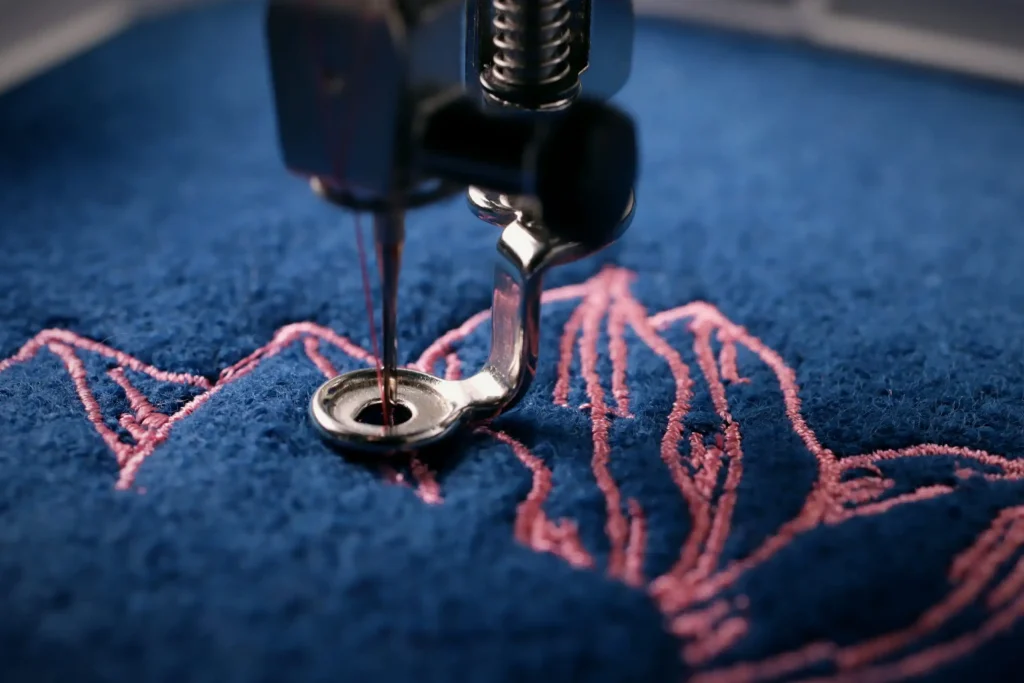
Incorrect needle selection, thread tension, or machine calibration can result in thread breaks, needle holes, bird-nesting, and fabric damage.
Choose the Correct Embroidery Needle Size and Point
Needle selection should match the fabric construction and thread.
Ballpoint needles are commonly used for knitted fabrics because their rounded points can move between yarns rather than cutting through them.
Sharp-point needles are generally suitable for many woven fabrics where clean penetration is required.
Needle size should also be appropriate for the thread weight and material thickness.
Balance Upper and Bobbin Thread Tension
Correct tension is necessary for balanced stitch formation.
Improper tension can lead to:
- Thread breaks
- Loose stitches
- Bird-nesting
- Uneven stitch appearance
- Excessive bobbin visibility
Production teams should establish appropriate tension settings during sampling and monitor them during bulk runs.
Use Suitable Embroidery Thread
High-quality polyester and rayon embroidery threads are commonly used for commercial embroidery.
Thread selection should consider:
- Fabric type
- Design density
- Required appearance
- Colorfastness
- Machine speed
- End-use requirements
Consistent thread quality helps reduce unnecessary production interruptions.
Maintain Machine Speed and Mechanical Calibration
Embroidery machines require regular maintenance and calibration.
Production teams should monitor:
- Needle timing
- Hook timing
- Thread paths
- Tension systems
- Lubrication
- Needle condition
- Machine speed
Highly detailed or dense designs may require slower machine speeds to reduce friction, heat, and thread breakage.
6.Maintaining Multi-Color Print and Embroidery Registration
Precise registration is essential when producing multi-color prints and repeatable embroidery across large production quantities.
Even small alignment errors can become highly visible when multiple colors or design elements need to line up precisely.
Control Screen Printing Pallet Alignment
Screen-printing pallets should be accurately positioned and secured.
Micro-registration systems and standardized setup procedures can help maintain consistent alignment between screens.
Before production begins, registration should be checked against the approved sample.
Standardize Embroidery Hooping and Placement
Embroidery placement should be based on standardized measurements and physical guides.
Reference points may include:
- Center front
- Collar seam
- Shoulder seam
- Pocket edge
- Side seam
- Armhole
Consistent placement procedures help reduce variation between operators and production lines.
Control Fabric Stretch and Movement
Stretch fabrics can move during printing and embroidery.
For screen printing, suitable pallet adhesives can help minimize garment movement.
For embroidery, appropriate backing, hooping, and machine settings help stabilize the fabric.
The objective is to maintain consistent design geometry without unnecessarily distorting the garment.
Use Inline Inspection Gates
Inspection checkpoints should be placed throughout production.
Rather than discovering defects during final packing, factories should identify problems during:
- Setup
- First-piece approval
- Initial production
- Mid-production inspection
- Final inspection
This approach allows defects to be corrected before large quantities are completed.
7.Match Artwork With the Right Garment Blank
Decoration quality is strongly influenced by the garment itself.
An artwork file that works perfectly on a smooth cotton T-shirt may not produce the same result on a textured knit, fleece hoodie, or performance polyester garment.
Match Printing Methods to Fabric Characteristics
Different fabrics have different surface characteristics.
For example:
- Smooth cotton can provide a clean surface for detailed screen printing.
- Textured fabrics can reduce fine-detail clarity.
- Ribbed fabrics can make small graphics appear distorted.
- Polyester requires special consideration for dye migration.
- Stretch fabrics require decoration methods that can accommodate movement.
The decoration process should therefore be selected together with the garment rather than independently.
Match Embroidery Stitch Density to Garment Weight
Heavy embroidery can place substantial stress on lightweight fabrics.
A dense design may cause a lightweight jersey T-shirt to sag, distort, or lose its natural drape.
Heavier hoodies, jackets, and structured garments can generally accommodate more substantial embroidery.
Consider Fabric Texture, Stretch, and Composition
Before approving artwork, technical teams should consider:
- Fiber composition
- GSM
- Fabric construction
- Stretch percentage
- Surface texture
- Garment color
- Garment structure
These factors influence both decoration quality and final wearer experience.
Conduct an Artwork and Decoration Review Before Production
Artwork should be technically reviewed before bulk production.
An experienced apparel manufacturing partner such as New Asia Garment can help evaluate:
- Artwork complexity
- Print method
- Embroidery method
- Stitch density
- Graphic dimensions
- Fabric compatibility
- Placement
- Production limitations
Resolving technical problems at this stage is generally much more efficient than correcting them after bulk production begins.
8.Large-Area Embroidery: Quality, Cost, and Comfort Trade-Offs
Oversized embroidery can create a distinctive premium appearance, especially on jackets, hoodies, and streetwear garments.
However, large embroidery designs also create additional challenges related to stitch count, garment stiffness, production time, and cost.
How Stitch Count Affects Garment Stiffness
Large designs can require tens of thousands of stitches.
As stitch density increases, the embroidered area can become significantly heavier and more rigid than the surrounding fabric.
This may affect:
- Garment drape
- Flexibility
- Comfort
- Weight
- Overall hand feel
Designers should therefore consider the physical characteristics of embroidery during the artwork development stage.
How Large Embroidery Affects Production Cost and Lead Time
Embroidery machine time is directly influenced by stitch count.
A large design requires more:
- Thread
- Machine time
- Operator capacity
- Production resources
For high-volume programs, stitch count should therefore be considered both a design parameter and a manufacturing-cost parameter.
When to Use Appliqué or Screen Printing Instead
Large graphics do not always need to be produced entirely through embroidery.
Depending on the desired visual effect, appliqué or screen printing may provide a lighter and more cost-effective foundation.
Embroidery can then be added selectively to create texture and dimensional detail.
Using Hybrid Decoration for Large Graphics
Hybrid decoration can combine different technologies within one design.
For example:
Screen print + embroidery
or
Appliqué + embroidery
can create a premium visual effect while reducing the total embroidery stitch count.
This approach can help maintain garment flexibility while preserving the desired design impact.
9.Bulk Print and Embroidery Quality Control Checklist
A standardized quality-control checklist helps factories and apparel brands evaluate production consistently.
Color Standard Verification
Before production approval, verify:
- Pantone/PMS references where applicable
- Physical color standards
- Ink colors
- Embroidery thread colors
- Fabric color
- Print-to-sample consistency
Color evaluation should ideally be performed under controlled lighting conditions, such as D65 daylight simulation.
Placement and Proportion Verification
Measure decoration placement against the approved tech pack.
Important measurements may include:
- Collar-to-print distance
- Shoulder-to-print distance
- Armhole-to-print distance
- Pocket-to-logo distance
- Side-seam placement
- Sleeve placement
- Embroidery center position
Size grading should also be considered so that the decoration maintains the intended visual relationship across different garment sizes.
Durability and Finish Testing
Depending on the product and decoration method, quality testing may include:
- Wash testing
- Stretch testing
- Print adhesion testing
- Peel resistance
- Embroidery pull testing
- Dye migration testing
- Colorfastness testing
- Visual appearance inspection
The testing protocol should reflect the expected use and care conditions of the finished garment.
Pre-Production Sample Approval
The PP sample should not be treated as a simple visual sample.
It should represent the approved production standard for:
- Fabric
- Color
- Decoration method
- Decoration size
- Placement
- Stitch density
- Print appearance
- Hand feel
- Finish
Once approved, the sample should be retained by the production and quality-control teams as a master reference.
How to Establish a Reliable Bulk Apparel Decoration QC Process
A reliable quality-control system should follow a defined sequence rather than relying on final inspection alone.
Step 1: Review Artwork and Garment Compatibility
Before sampling, evaluate whether the artwork is appropriate for the selected garment and fabric.
Consider:
- Print size
- Graphic detail
- Stitch count
- Fabric stretch
- Fabric weight
- Decoration location
Step 2: Approve the Decoration Method and Technical Parameters
Determine the appropriate production method:
- Screen printing
- DTF
- Heat transfer
- Embroidery
- Appliqué
- Hybrid decoration
Establish the relevant technical parameters before production begins.
Step 3: Produce and Test PP Samples
Produce representative samples using the intended bulk-production process.
Evaluate:
- Appearance
- Color
- Placement
- Durability
- Fabric interaction
- Hand feel
Step 4: Establish the Master Production Standard
Once approved, the PP sample becomes the production benchmark.
The factory should retain the relevant:
- Artwork
- Tech pack
- Color standards
- Decoration specifications
- Measurement requirements
- Testing requirements
- Approved physical sample
Step 5: Conduct Inline Quality Inspections
Inspect garments during production rather than waiting until the end.
Inline inspections should check:
- Registration
- Placement
- Color
- Print quality
- Embroidery quality
- Fabric damage
- Machine consistency
Step 6: Perform Final Inspection Before Shipment
Final inspection should verify that finished garments meet the approved production standard.
Defective garments should be identified and separated before packing and shipment.
Frequently Asked Questions About Apparel Print and Embroidery Quality Control
Q1:What causes screen printing to crack after washing?
Screen printing can crack after washing when the ink has not been fully cured, the ink deposit is too thick, or the print system is not suitable for the fabric. Incorrect dryer temperature, belt speed, or insufficient curing time can reduce wash durability. Production samples should be tested before bulk manufacturing is approved.
Q2:How can DTF transfers be prevented from peeling?
DTF peeling can be reduced by maintaining consistent adhesive powder coverage, properly fusing the powder, and controlling heat-press temperature, pressure, and dwell time. The correct hot-peel or cold-peel procedure must also be followed according to the transfer manufacturer’s specifications.
Q3:What causes embroidery puckering?
Embroidery puckering can result from insufficient stabilization, incorrect hoop tension, excessive stitch density, or unsuitable digitization. Lightweight and stretch fabrics are particularly sensitive to dense embroidery. Proper backing, hooping, underlay, stitch density, and pull compensation can help reduce fabric distortion.
Q4:How do you prevent dye migration on polyester?
Dye migration can be reduced by using suitable low-bleed ink systems, controlling heat exposure, and testing the polyester fabric before bulk decoration. Dark polyester garments and sublimated fabrics require particular attention because their dyes can migrate into light-colored decoration layers.
Q5:How do you prevent thread breaks during embroidery?
Thread breaks can be caused by incorrect needle selection, unsuitable thread, excessive machine speed, incorrect tension, poor lubrication, or mechanical timing problems. Matching the needle and thread to the fabric and maintaining the embroidery machine properly can significantly reduce thread-break frequency.
Q6:What should be checked before bulk apparel production?
Before bulk production, brands should verify the fabric, garment color, decoration method, artwork, print or embroidery size, placement, color standards, durability, and overall appearance. The approved PP sample should then become the master reference for bulk production.
Q7:How can brands maintain consistent decoration quality across different garment sizes?
Decoration placement should be defined using measurable reference points rather than visual positioning alone. Tech packs should specify placement measurements and grading rules for different sizes. Production teams should use standardized templates and inspection procedures to maintain consistency.
Q8:What is a PP sample in apparel manufacturing?
A PP, or pre-production, sample is a production-intent sample approved before bulk manufacturing begins. It should represent the intended fabric, construction, color, decoration, placement, and finishing standards. Once approved, it becomes an important reference for production and quality control.
Conclusion
Consistent bulk apparel decoration starts long before the production line.
High-quality screen printing and embroidery require coordinated control over artwork, fabric, decoration method, machine settings, production parameters, testing, and inspection.
For screen printing, curing conditions, ink deposit, registration, and wash durability are critical. For DTF and heat transfers, adhesive fusion and heat-press calibration determine bonding performance. Polyester requires careful control of dye migration, while embroidery depends heavily on stabilization, hooping, digitization, needle selection, and thread tension.
The most reliable approach is to establish quality requirements before bulk production begins:
Artwork → Fabric Compatibility → Decoration Method → PP Sample → Testing → Production Control → Final Inspection
When these steps are consistently implemented, apparel brands can reduce production defects, improve decoration durability, and achieve greater consistency across large manufacturing programs.
For brands developing custom apparel at scale, working with an experienced manufacturing partner can also simplify the technical process. New Asia Garment can support brands with garment development, artwork evaluation, fabric selection, custom printing, embroidery, sampling, and bulk apparel production.
A strong quality-control system does more than prevent defects. It helps transform digital designs into consistent, durable, and retail-ready garments that meet the expectations of both brands and end customers.
Read more
- Bulk Print and Embroidery Quality Control for Custom Apparel
- Activewear Fabric Approval Before Bulk: Opacity, Stretch, Recovery and Breathability
- How to Build a Garment Test Plan Before Bulk Production (Complete Guide)
- Apparel Change Control: How to Approve BOM, Material and Construction Revisions
- Denim Quality Control: Testing Methods, Common Defects & Quality Standards