
Strategic Negotiation with Clothing Factory Partners: A Global Apparel Brand Guide
For fashion brand founders, sourcing directors, and apparel procurement managers operating in today’s global market, mastering negotiation with clothing factory partners is the single most decisive factor governing commercial success. While creative aesthetics, digital marketing campaigns, and retail placement drive initial brand interest, your supplier negotiation strategy dictates your gross profit margins, working capital efficiency, and product defect rates.
Navigating cross-border supplier negotiations involves much more than driving down unit prices. An aggressive pursuit of the lowest FOB (Free on Board) quotation often backfires—leading factories to substitute inferior yarns, skip critical seam stabilization, or outsource bulk cutting to unvetted third-party workshops. Effective negotiations align commercial incentives, establish transparent cost breakdowns, and lock in non-negotiable structural quality standards before contracts are signed.
This operational guide details how international apparel brands approach garment factory negotiations, leverage cost-breakdown transparency, mitigate minimum order quantity (MOQ) constraints, and mandate structural garment integrity to protect brand equity.
1. Understanding the Factory’s Cost Structure: Open-Cost Negotiation
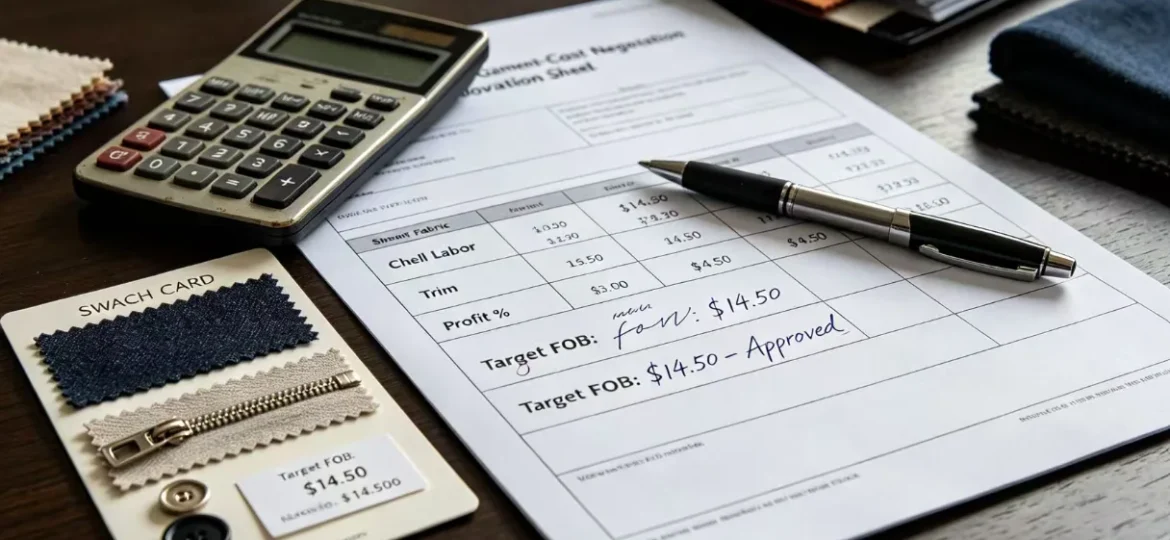
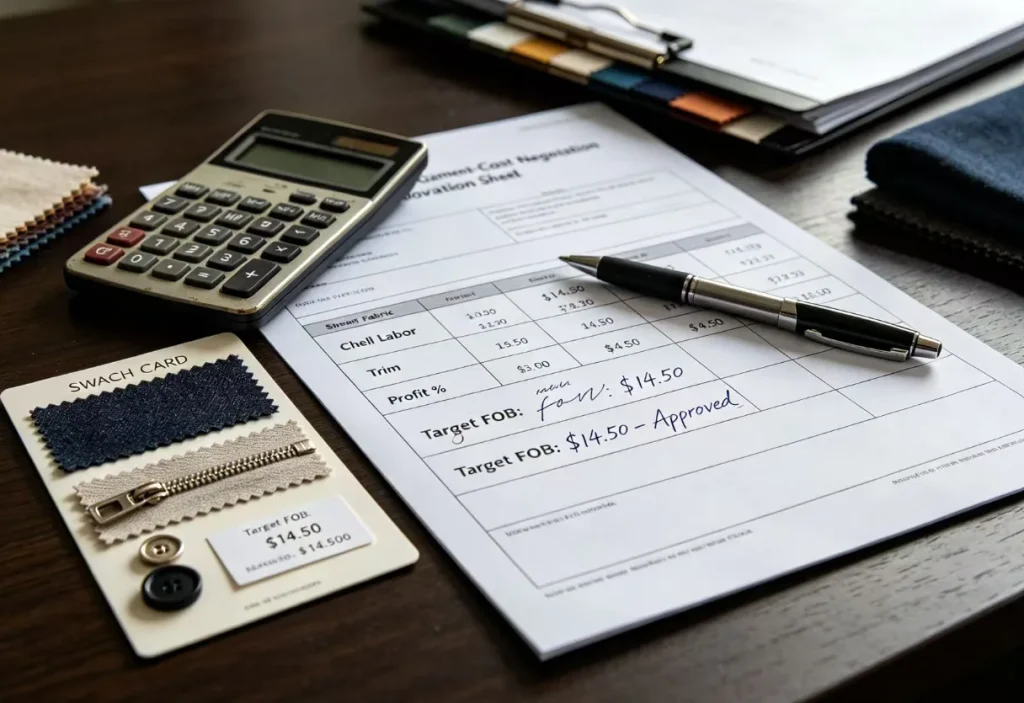
Successful negotiations begin with a clear understanding of garment production economics. Professional apparel buyers never negotiate based on flat unit quotes alone; they request itemized Open-Cost Sheets breaking down the true manufacturing expense structure:
- Raw Material Costs (Fabric & Trims): Shell textiles, linings, pocketing, ribbing, zippers, buttons, woven labels, and polybags typically account for 50% to 65% of total garment FOB costs.
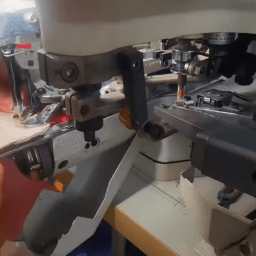
- Cut-Make-Trim (CMT) Labor Minutes: Sewing line labor calculated by standard allowed minutes (SAM) required to assemble, press, and package a single garment based on factory efficiency rates.
- Overhead & Machinery Amortization: Factory operating overheads—including facility electricity, machine maintenance, compliance auditing fees, and management salaries—usually add 10% to 15% to CMT labor costs.
- Factory Profit Margin: Sustainable export manufacturers target a healthy 8% to 15% net profit margin to reinvest in modern machinery, skilled labor retention, and facility compliance.
By dissecting open-cost matrices during initial talks, brand managers can target specific cost drivers—such as optimizing fabric marker efficiency to reduce yardage waste—rather than forcing factories to sacrifice sewing labor quality or material standards.
2. Overcoming Minimum Order Quantity (MOQ) Barriers Without Sacrificing Margins
The primary point of friction between emerging labels and Tier-1 manufacturers is Minimum Order Quantity (MOQ). High-capacity export factories set strict MOQs to offset setup costs for cutting tables, screen-printing carousels, and automated sewing lines.
- Consolidating Shell Fabrics Across Styles: Instead of ordering unique fabrics for every garment, specify a single core fabric (such as a 400 GSM heavyweight French terry) across hoodies, crewnecks, and sweatpants. Meeting the fabric mill’s dyeing MOQ (e.g., 300 kg) enables the factory to lower per-style garment MOQs.
- Offering Pre-Booked Production Windows: Factories face seasonal lulls between major retail production cycles. Negotiating trial orders during factory off-peak months gives suppliers an incentive to accept lower MOQs to keep assembly lines running.
- Establishing Multi-Season Commitment Frameworks: Rather than negotiating single transactional purchase orders, present a rolling 12-month sourcing forecast. Factories readily lower initial MOQs when backed by a clear roadmap for growing seasonal order volumes.
3. The Internal Skeleton: Negotiating Structural Integrity to Prevent Post-Wash Distortion
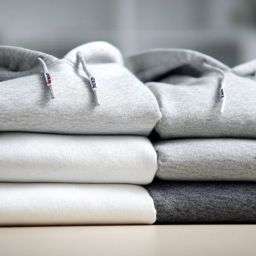
A primary trap in unit price negotiations occurs when a factory quietly reduces internal material specifications to match a buyer’s target price. Budget-focused apparel suppliers frequently replace high-grade cotton stabilization tapes with cheap synthetic threads or completely omit internal seam reinforcement inside high-stress zones—such as rear necklines, shoulder tracks, hood attachment seams, and pocket channels.
Under the kinetic friction of washing machines and home drying cycles, unreinforced seams stretch and collapse. Outer fabrics buckle, causing wavy collar edges, sagging shoulder lines, and seam tears that trigger high consumer return rates and ruin brand reputation across global markets.
To protect your brand’s capital and maintain dimensional stability across your collection, technical specification packages must mandate high-density cotton internal structural components. Partnering with a digitally transparent global manufacturer like Newasia Garment Supply Chain Solutions provides an unyielding internal skeleton for your apparel line.
Integrating tight, high-density cotton bias tape, combed cotton neck reinforcement, and stabilized seam tracks anchors structural seams securely. Mandating these premium structural components during initial sample reviews ensures your production meets the luxury hand-feel, wash durability, and exact sizing consistency that modern international consumers demand.
4. Structuring Financial Terms, Payment Schedules, and AQL Quality Gates
Financial leverage during factory negotiations relies entirely on payment terms and quality control gating. Never release final payments based on factory verbal assurances or pre-shipment photos alone.
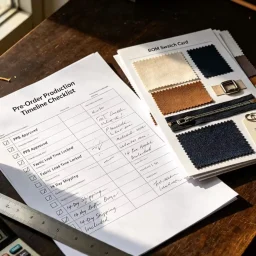
- Standard Deposit Frameworks (30/70 Terms): Negotiate a standard 30% deposit upon Pre-Production (PP) sample sign-off, with the remaining 70% balance payable only after passing an independent final quality audit.
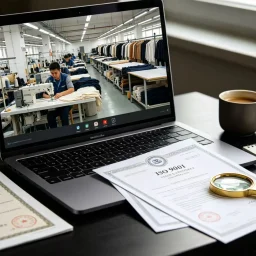
- Tying Balance Release to AQL 2.5 Auditing: Mandate in your manufacturing agreement that final balance payments will be released only upon receipt of a passing Acceptable Quality Limit (AQL 2.5) inspection report conducted by an accredited third-party inspector at the factory gate.
- Defect Penalty and Rework Clauses: Explicitly stipulate that if bulk orders fail AQL inspection due to measurement variance, structural stitching flaws, or shade band discrepancies, the factory must perform 100% sorting, re-works, or issue financial credit notes at their sole expense.
5. Protecting Intellectual Property and Negotiating Non-Circumvention
In global manufacturing, protecting original garment patterns, custom fabric prints, and tech pack specifications is vital before sending proprietary files overseas.
- Enforcing NNN Agreements: Execute a comprehensive Non-Disclosure, Non-Use, and Non-Circumvention (NNN) agreement under enforceable jurisdiction prior to sharing Tech Packs or custom artwork.
- Restricting Unauthorized Subcontracting: Contractually prohibit factories from farming out your production to unvetted secondary workshops. Mandate that all cutting, sewing, and inspection must occur within the audited primary facility.
- Pattern & Mould Ownership Clauses: Explicitly state that all physical pattern blocks, grading rules, custom print screens, and hardware moulds created during sampling remain the exclusive intellectual property of your brand.
To build your fashion label on a foundation of transparent supply chain negotiations, superior structural engineering, and direct-factory execution, visit Newasia Garment to start your factory evaluation and secure production today.
Read more