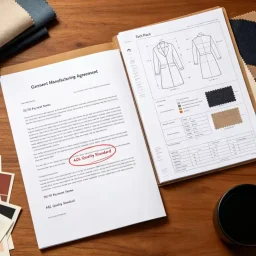

In global apparel manufacturing, a denim product specification sheet—commonly referred to as a Tech Pack—serves as the ultimate blueprint between brands, sourcing agencies, and offshore garment factories. Because denim production involves intricate wet processing, fabric shrinkage dynamics, and heavy-duty hardware assembly, vague design descriptions can lead to costly production errors, inconsistent wash shades, and significant measurement variances.
Creating a precise, standardized denim tech pack eliminates ambiguity, streamlines pre-production sampling, and helps protect profit margins across international supply chains. The following guide explains how to write accurate denim product specifications that support consistent bulk production results globally.
1. Style Identification
The header section of your specification sheet establishes the administrative foundation for the entire garment lifecycle. Clear style identification ensures seamless tracking across multinational supply chains, customs documentation, and enterprise resource planning (ERP) systems.
Essential Style Metadata
Include the official style name, unique style number, product category, gender, seasonal collection, and initial release date. Using consistent style information makes it easier for brands, sourcing teams, patternmakers, and factories to identify the correct product throughout development and production.
Visual Reference Standards
Include high-resolution front, back, and detail line art or technical sketches showing the garment in a flat, unstylized view. These drawings should clearly communicate the intended proportions and construction details.
Key Construction Callouts
Highlight important design features directly on the technical flats using callout arrows. These may include pocket configurations, leg silhouettes, rise height, waistband construction, yoke structures, fly details, and other defining design elements.
2. Fabric Composition, Weight, and Stretch
Fabric is one of the most important cost and performance variables in denim manufacturing. Precise fabric specifications help prevent substitutions that may affect garment fit, drape, durability, and wash results.
Fiber Blend and Weave Construction
Specify the complete fiber composition, such as 98% Cotton and 2% Elastane or 100% Organic Regenerative Cotton.
The tech pack should also identify the yarn and weave characteristics, including slub, ring-spun, or open-end yarn and the applicable twill construction, such as 3×1 right-hand twill, left-hand twill, or broken twill.
Fabric Weight Range
Define the target fabric weight in ounces per square yard (oz/yd² or oz). Clearly state whether the weight refers to loomstate/raw fabric or finished fabric after washing.
For example, a specification may state a target of 13.5 oz for raw, unwashed denim.
Elastane Stretch and Recovery Targets
For stretch denim, specify measurable performance requirements rather than simply describing the fabric as “stretch.”
Relevant specifications may include stretch percentage, growth limits, and recovery performance after a defined period. For example, a tech pack may specify 25%–30% dynamic stretch together with a 30-minute recovery requirement.
These parameters help control problems such as sagging knees, waist growth, and loss of garment shape during wear.
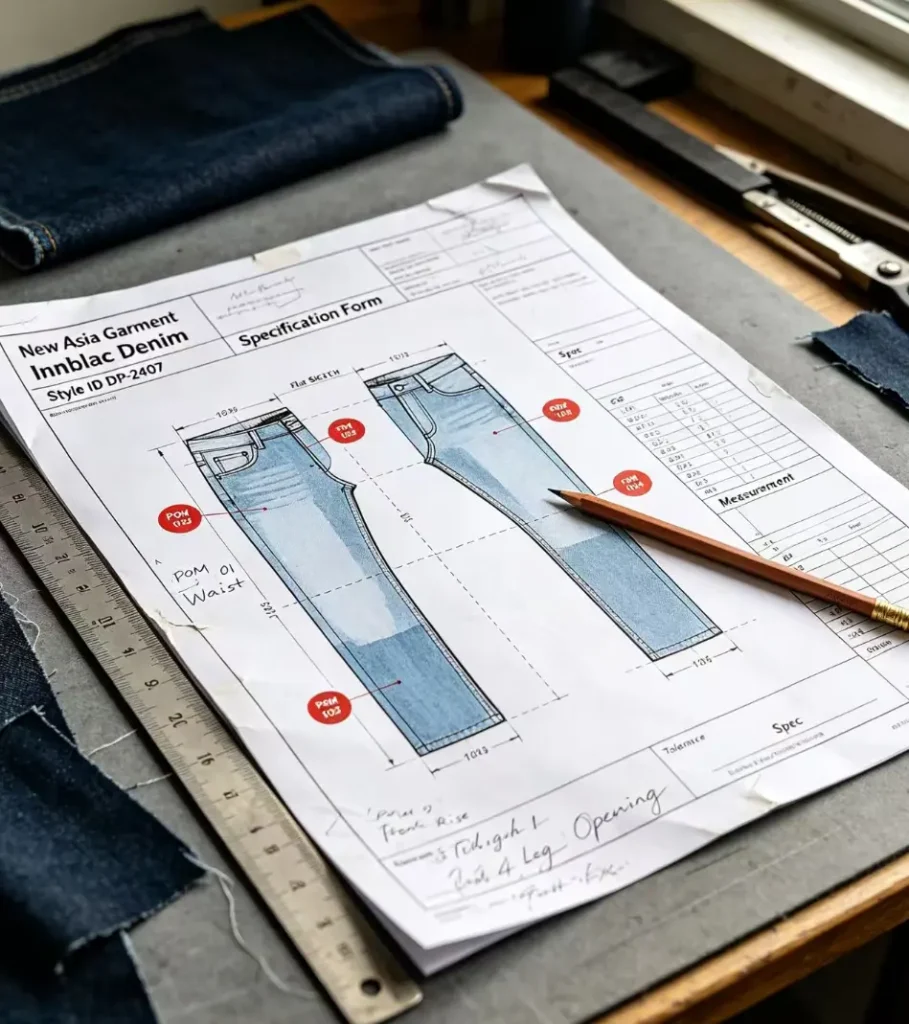
3. Measurement Specifications and Points of Measure (POM)
Denim measurement specifications require careful control because washing, shrinkage, heavy construction, and pressing can all influence the final garment dimensions.
Standardized Points of Measure (POM) ensure that factory QC teams, patternmakers, and brand teams measure garments using the same methodology.
Core POM Identification
Define every critical measurement point with a clear industrial description and measurement method.
Typical denim POMs include:
- Waist, measured relaxed and extended
- Front Rise
- Back Rise
- Thigh, typically measured 1 inch below the crotch
- Knee Width
- Inseam
- Leg Opening
- Outseam
- Hip
- Waistband Height
Each POM should include a clear measurement diagram so the factory understands exactly where and how the measurement should be taken.
Shrinkage Allowance Calculations
Clearly distinguish between final garment specifications and pattern specifications.
Garment specs represent the desired dimensions of the finished garment, while pattern specs may be adjusted to account for expected warp and weft shrinkage during washing.
The tech pack should document the applicable shrinkage assumptions and identify whether measurements are taken before or after the final wash process.
Measurement Tolerance Boundaries
Assign an acceptable tolerance to every POM based on the importance and construction of the measurement.
For example, a specification may allow ±0.5 cm for knee width and ±1.0 cm for inseam.
Critical measurements should generally receive tighter tolerances than less sensitive dimensions. Consistent tolerances help minimize size distortion across bulk production.
4. Wash and Shade Standards
Denim wet and dry processing transforms raw indigo fabric into the final garment. Because washing and finishing can significantly affect both color and dimensions, wash standards must be documented in detail.
Master Target Reference
Reference an approved physical master swatch or approved wash sample as the primary shade standard.
The specification should define the acceptable shade range, including lighter and darker limits, so the factory has a clear visual benchmark for bulk production.
Wet and Dry Processing Requirements
Document all required wash and finishing treatments, including:
- Stonewashing
- Enzyme washing
- Ozone treatment
- Bleaching
- Hand-scraping
- Whiskers or cat-scratch effects
- Tacking
- Laser distressing
- Grinding
- Localized abrasion
Where applicable, include reference images or approved samples to communicate the intended appearance and intensity of each treatment.
Color Fastness Standards
Specify the required performance standards for color fastness, including wash fastness, dry and wet crocking, and light fastness.
These requirements help ensure that the finished denim meets applicable buyer quality standards and performs consistently during consumer use.
5. Trim and Hardware Bill of Materials (BOM)
The Bill of Materials (BOM) should identify every component required to manufacture the garment. Denim hardware must be selected with consideration for both appearance and resistance to high-tensile stress and industrial laundering.
Metal Hardware Specifications
List the exact specifications for each hardware component, including size, material, finish, color, supplier or approved code where applicable, and placement.
Typical denim hardware includes:
- Shank buttons
- Rivets
- Fly zippers
- Snaps
- Buckles
- Eyelets
Finishes may include antique brass, matte black, shiny nickel, or other approved finishes.
Thread Specifications
Specify thread construction, fiber content, ticket size, color, and application.
Common requirements may include core-spun polyester or 100% cotton thread for different construction and topstitching applications.
Clearly identify thread requirements for:
- Topstitching
- Flat-felled seams
- Bartacks
- Lockstitch seams
- Overlock seams
Pocketing and Internal Trim
Document pocketing fabric specifications, including fiber composition, construction, weight, color, and approved supplier where applicable.
For example, a specification may call for 65/35 TC poplin pocketing at approximately 120 gsm.
Also specify zipper tape materials, waistband stiffeners, interlinings, labels, and other internal components required for production.
6. Label and Packaging Requirements
Accurate labeling and packaging specifications help maintain brand consistency, regulatory compliance, and efficient distribution across international markets.
Regulatory Label Placement
Define the required placement and artwork for care labels, fiber content labels, country-of-origin statements, and other market-specific compliance information.
Requirements should be reviewed according to the destination market and applicable regulations rather than assuming that one labeling standard applies globally.
Branding Labels and Patches
Specify the material, dimensions, artwork, placement, and attachment method for branded components.
Common denim branding elements include:
- Jacron patches
- Leather or paper patches
- Woven waistband labels
- Pocket tabs
- Branded buttons
- Hangtags
Polybag and Master Carton Specifications
Document the complete packaging method, including folding instructions, hangtag attachment, individual polybag requirements, barcode sticker placement, carton dimensions, carton markings, and assortment instructions.
If ventilation holes or other packaging requirements apply, these should also be clearly documented.
7. Revision Control
A denim tech pack is a dynamic document that can change throughout product development. Strict revision control prevents factories from accidentally working from outdated specifications.
Version History Tracking
Include a prominent revision block on every page.
The revision block should identify:
- Revision date
- Version number
- Author
- Approved by
- Description of changes
For example, versions may be identified as v1.0, v1.1, and v2.0.
Change Log Documentation
Clearly identify every modification made between revisions.
Changes may include updated POM measurements, revised hardware codes, fabric changes, construction adjustments, or modified wash targets.
Highlighting changes helps patternmakers, factory merchandisers, and production teams quickly identify what has been updated.
Archiving Outdated Tech Packs
Establish a formal process for decommissioning obsolete versions.
Only the latest approved tech pack should be authorized for production. Previous versions should be archived and clearly marked as obsolete to prevent confusion between development samples and bulk-production requirements.
8. Pre-Production Approval Checklist
The Pre-Production (PP) sample approval is a critical checkpoint before bulk fabric cutting and production.
A systematic PP checklist ensures that the final sample reflects the approved design, measurements, construction, wash, and hardware requirements.
Fit and POM Sign-Off
Measure the PP sample after final washing and pressing and compare every critical POM against the approved specification and tolerance.
Confirm that the garment maintains the required fit, silhouette, proportions, and size grading.
Hardware Pull-Test Verification
Verify that buttons, rivets, snaps, and other applicable hardware meet the required pull-strength and safety requirements.
This testing helps reduce the risk of hardware detachment during normal wear and ensures the finished garment meets the applicable quality requirements.
Factory Execution Authorization
Once the PP sample, measurements, construction, wash appearance, trims, hardware, labeling, and packaging have been approved, document formal authorization for bulk production.
Partnering with established denim manufacturers such as New Asia Garment can provide access to technical engineering support, automated pattern grading, and quality assurance systems.
A complete PP approval process gives the factory a clear production reference and reduces ambiguity before bulk manufacturing begins.
Conclusion
Accurate denim product specifications bridge the gap between creative design and global manufacturing execution.
A well-structured denim tech pack should clearly define the style identity, fabric composition and weight, stretch performance, measurement POMs, shrinkage allowances, wash and shade standards, hardware BOM, labeling, packaging, and revision history.
By standardizing these requirements and completing a thorough PP approval process, apparel brands can reduce production risks, improve sizing consistency, minimize communication errors, and establish a scalable foundation for international denim manufacturing.
Read more