
Placing a bulk garment order without a structured testing plan can expose apparel brands, retailers, wholesalers, and importers to significant quality and production risks.
A pre-production sample may look perfect, but problems with fabric performance, sizing, stitching, colorfastness, construction, or compliance may not become visible until garments enter mass production. When these issues affect thousands of pieces, the result can be costly rework, product returns, shipment delays, customer complaints, and inventory losses.
A well-designed garment testing plan helps identify potential quality issues before bulk production begins. By checking materials, workmanship, measurements, performance, compliance, and packaging at the right stages, brands can reduce production risks and maintain consistent product quality.
However, testing is only useful when the results apply to the product being manufactured. A report for a development fabric, an earlier colorway, or a previous production batch should not automatically be treated as proof that the current bulk order meets the same requirements.
At Newasia Garment, we support customers with quality control from product development and sample approval through bulk production and final inspection.
This guide explains how to build a practical garment testing plan, select appropriate tests, review test reports, and verify whether existing testing evidence applies to a specific bulk order.
Why Do You Need a Garment Testing Plan Before Mass Production?
Approving a garment sample based only on appearance is not enough.
The purpose of a garment testing plan is to determine whether the approved sample, materials, construction methods, and specifications can be consistently reproduced during large-scale production.
Without appropriate testing and inspection, apparel businesses may encounter:
- High product return rates
- Fabric shrinkage after washing
- Color fading or poor colorfastness
- Incorrect garment measurements
- Weak seams and stitching defects
- Poor print or embroidery quality
- Safety or regulatory compliance issues
- Packaging problems
- Production delays
- Customer complaints
- Inventory losses
A structured testing process allows manufacturers and buyers to identify problems earlier, when they are easier and less expensive to correct.
What Is a Garment Testing Plan?
A garment testing plan is a documented quality control framework that defines what needs to be tested, how it should be tested, when testing should take place, and what acceptance criteria must be met before production or shipment.
A typical garment test plan may include:
- Product specifications
- Fabric composition
- Fabric GSM
- Fabric construction
- Garment measurements
- Measurement tolerances
- Color standards
- Trims and accessories
- Printing and embroidery requirements
- Fabric performance tests
- Garment performance tests
- Safety and compliance requirements
- Inspection checkpoints
- Sampling procedures
- Acceptance criteria
- Testing frequency
- Quality control responsibilities
Think of it as a quality roadmap that connects product development, manufacturing, inspection, and final shipment.
Step 1: Define Garment Specifications Clearly
Every effective garment testing plan starts with clear product specifications.
Before approving a pre-production sample, buyers and manufacturers should confirm:
- Fabric composition
- Fabric GSM
- Fabric construction
- Garment measurements
- Size specifications
- Measurement tolerances
- Color references
- Trims and accessories
- Print or embroidery specifications
- Label requirements
- Packaging requirements
- Carton specifications
The more detailed the product specification is, the easier it is for the factory to reproduce the approved garment consistently during bulk production.
A clear tech pack, measurement chart, approved sample, and material specification can significantly reduce misunderstandings between buyers and manufacturers.
Step 2: Inspect Fabric Quality
Fabric is one of the most important factors affecting final garment quality.
Before cutting begins, fabric should be inspected against the approved specification.
Fabric Composition
Verify that the fabric composition matches the agreed requirement.
For example:
- 100% Cotton
- Cotton/Polyester Blend
- Cotton/Elastane
- Polyester/Elastane
- Recycled Polyester
The actual composition should be consistent with the product specification and applicable labeling requirements.
Fabric Hand Feel
The fabric should have the appropriate softness, flexibility, weight, drape, and surface characteristics for the intended garment.
The bulk fabric should also be compared with the approved fabric standard or sample.
GSM Verification
Fabric weight should be checked against the approved specification.
Examples include:
- 160 GSM Cotton Jersey
- 180 GSM Cotton Interlock
- 240 GSM Fleece
Incorrect GSM can affect garment weight, appearance, durability, comfort, and overall product performance.
Fabric Consistency
Inspect multiple areas and rolls of fabric for:
- Uneven thickness
- Inconsistent texture
- Knitting or weaving defects
- Color variation
- Stains
- Holes
- Surface defects
- Uneven finishing
For larger orders, fabric inspection should be performed before production rather than waiting until finished garments are available.
For additional guidance on incoming material inspection, shade control, and trim verification, see our clothing factory quality control process.
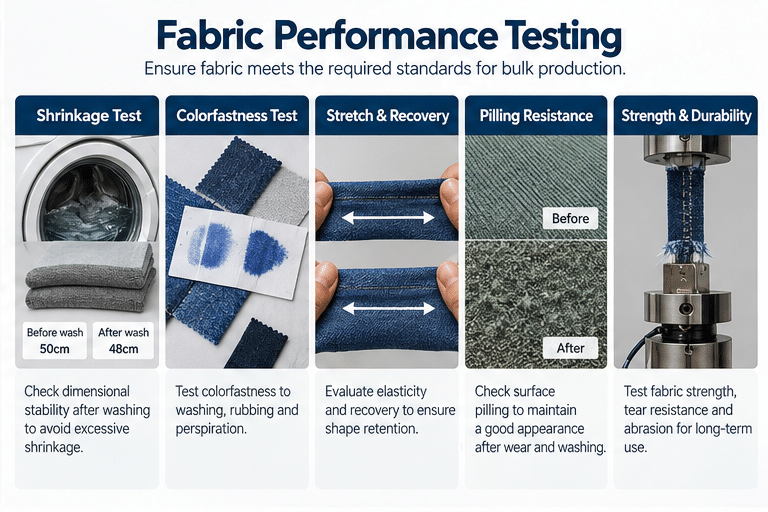
Step 3: Conduct Fabric Performance Tests
Visual inspection alone cannot determine how fabric will perform during washing and everyday use.
Depending on the garment and target market, appropriate fabric tests may include the following.
Shrinkage Test
Wash the fabric or garment according to the specified care instructions and measure the dimensions before and after washing.
The acceptable shrinkage level should be established according to:
- Fabric construction
- Fiber composition
- Finishing process
- Garment design
- Customer requirements
Uncontrolled shrinkage can cause garments to fall outside measurement tolerances after washing.
Colorfastness Testing
Colorfastness should be evaluated according to the intended use and applicable testing requirements.
Relevant tests may include resistance to:
- Washing
- Dry rubbing
- Wet rubbing
- Perspiration
- Water
- Light
Poor colorfastness can cause fading, staining, and customer complaints.
Stretch and Recovery Testing
For knitwear and stretch fabrics, evaluate how well the material returns to its original dimensions after stretching.
Good stretch recovery helps garments maintain their shape after repeated wear.
For stretch denim and other elastic fabrics, the relationship between stretch, recovery, and finished garment measurements should also be considered.
Pilling Resistance
For fabrics where pilling may be a concern, pilling resistance testing can help determine how the surface is likely to perform during repeated use and washing.
Fabric Strength and Durability
Depending on the product, additional testing may include:
- Tensile strength
- Tear strength
- Abrasion resistance
- Seam slippage
- Dimensional stability
- Water resistance
- Moisture management
The specific test requirements should always be determined according to the garment category, fabric type, customer specification, and target market.ry, fabric type, customer specification, and target market.
Step 4: Evaluate Garment Construction
Good fabric quality alone does not guarantee a durable garment.
The construction of the garment must also be evaluated.
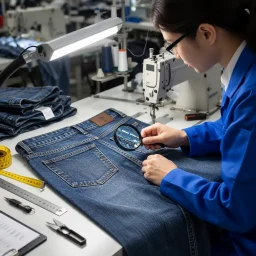
Stitching Quality
Inspect stitching for:
- Consistent stitch density
- Straight seams
- Loose threads
- Broken stitches
- Skipped stitches
- Uneven thread tension
- Seam puckering
- Unsecured thread ends
Seam Strength
Pay particular attention to areas exposed to stress, including:
- Shoulder seams
- Armholes
- Side seams
- Crotch seams
- Necklines
- Waistbands
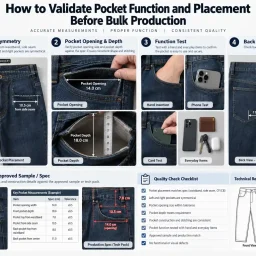
- Pocket openings
- Zipper areas
Weak seams can result in garment failure during normal use.
Construction Consistency
Compare bulk production garments with the approved sample to ensure that:
- Seam construction is consistent
- Stitching methods are consistent
- Panels are correctly assembled
- Trims are correctly positioned
- Labels are correctly attached
- Garment shape matches the approved sample
For products with high-stress areas, a more targeted durability evaluation may be appropriate. Our guide to building garment durability tests around high-stress areas explains how to connect potential failure points with suitable test methods.
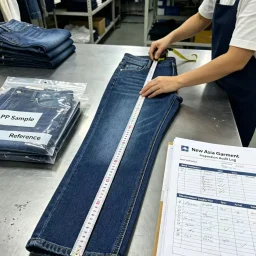
Step 5: Verify Garment Measurements and Fit
Incorrect sizing is one of the most common causes of apparel returns.
Measurements should be taken according to a standardized measurement method.
Depending on the garment, key points of measurement may include:
- Chest
- Waist
- Hip
- Shoulder width
- Sleeve length
- Body length
- Neck opening
- Armhole
- Inseam
- Outseam
- Bottom opening
Each measurement should be compared against the approved size chart.
Check Measurement Tolerances
Not every garment will measure exactly the same.
Manufacturers and buyers should agree on acceptable measurement tolerances before production begins.
For example, the specification may define acceptable tolerances for:
- Body length
- Chest width
- Sleeve length
- Waist width
- Shoulder width
Clear tolerances help both the factory and buyer determine whether a garment is within specification.
Check Size Grading
It is also important to verify grading across all sizes.
A garment may fit correctly in the sample size but still have incorrect grading between sizes.
Where the size range or design complexity requires it, representative size-set samples should be evaluated before bulk production.
Step 6: Check Garment Safety and Compliance
Safety and regulatory requirements depend on the garment category, materials, components, and target market.
A garment testing plan should identify applicable requirements before bulk production.
Buttons and Trims
Buttons, snaps, buckles, decorative components, and other trims should be securely attached and suitable for normal use.
Zipper Performance
Check whether zippers:
- Open and close smoothly
- Remain securely attached
- Function correctly
- Show no obvious damage
- Meet the required specification
Sharp Edge Inspection
Inspect metal components, zippers, snaps, buckles, and decorative accessories for sharp edges or other defects that could cause injury during normal use.
Drawcords and Functional Components
Where garments contain drawcords, cords, toggles, or similar components, their design and construction should be reviewed against the requirements applicable to the target market.
Chemical and Regulatory Requirements
Depending on the destination market, garments may also need to meet applicable requirements relating to:
- Restricted substances
- Flammability
- Product safety
- Fiber composition
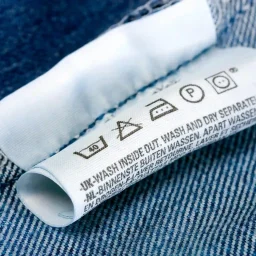
- Care labeling
- Country-of-origin labeling
- Other applicable regulations
Compliance requirements should be confirmed before production rather than after the goods have been manufactured.
Step 7: Check Printing and Embroidery Quality
Printing and embroidery can have a major impact on the perceived quality of a garment.
Inspect:
- Artwork accuracy
- Print position
- Print size
- Color accuracy
- Registration
- Print adhesion
- Crack resistance
- Embroidery density
- Thread quality
- Thread trimming
- Backing quality
All decoration should match the approved artwork and pre-production sample.
For branded apparel, even small differences in logo position, size, or color can affect the final appearance.
Step 8: Perform Wearability and Fit Evaluation
A garment should not only look good. It should also perform comfortably during normal use.
Evaluate:
- Overall fit
- Freedom of movement
- Collar comfort
- Seam comfort
- Label placement
- Fabric flexibility
- Garment weight
- Ease of movement
- Overall appearance after wear
The evaluation should reflect the intended use of the product.
For example, activewear may require greater freedom of movement and stretch recovery, while outerwear may require greater durability and protection.
SStep 9: Review Garment Packaging
Packaging is often overlooked during product development, but it can affect product presentation, warehouse handling, and transportation.
Check:
- Folding method
- Polybag size and quality
- Barcode placement
- Size stickers
- Care labels
- Hangtags
- Carton markings
- Shipping marks
- Carton quantity
- Packing ratio
Packaging specifications should be approved before bulk packing begins.
Incorrect packaging can lead to warehouse problems, barcode scanning issues, shipping mistakes, or damage during transportation.
Step 10: Document Every Test and Inspection Result
A garment testing plan should not rely on verbal approvals.
Every important test and inspection should be documented.
A basic quality checklist may include:
| Inspection Area | Result |
|---|---|
| Fabric Quality | Pass / Fail |
| Fabric GSM | Pass / Fail |
| Shrinkage | Pass / Fail |
| Colorfastness | Pass / Fail |
| Stitching Quality | Pass / Fail |
| Seam Construction | Pass / Fail |
| Measurements | Pass / Fail |
| Size Grading | Pass / Fail |
| Safety & Compliance | Pass / Fail |
| Print / Embroidery | Pass / Fail |
| Fit & Wearability | Pass / Fail |
| Packaging | Pass / Fail |
Documented inspection results provide a clear reference for both the manufacturer and buyer.
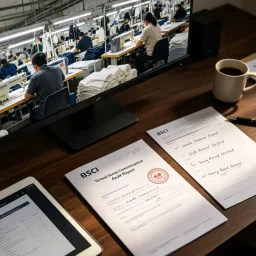
However, a Pass / Fail entry alone is not sufficient to establish that a test result applies to a particular bulk order. The report must also identify what was tested, under which conditions, and against which requirements.
Does This Test Report Apply to Your Bulk Order?
A garment or fabric test report provides evidence about the specific sample, material, component, or product evaluated under the stated test conditions.
It does not automatically prove that every subsequent production batch meets the same requirements.
For example, a report issued for a development fabric may not cover a replacement fabric from another mill. A colorfastness report for one colorway should not automatically be applied to every other color. Likewise, a report for an earlier production lot may not represent a new bulk lot if the material source, construction, finishing process, or other relevant conditions have changed.
Before accepting an existing report as evidence for a bulk order, buyers and manufacturers should check whether the tested item and the current production requirements are sufficiently comparable.
The key question is not simply whether the report says “Pass.” It is whether the report supports the exact product and production scope being approved.
1. Confirm the Tested Sample Identity
Start by identifying exactly what was submitted for testing.
Check:
- Sample name or description
- Style number or product reference
- Sample stage, such as development, PP, or bulk
- Fabric or component identification
- Sample size, where relevant
- Colorway
- Material supplier or mill, where recorded
- Sample submission date
- Production lot or batch reference, if applicable
A report that identifies only a generic fabric description may not provide enough information to establish that the tested material is the same as the material used in the current order.
For garment-level tests, the construction and relevant components should also be identifiable.
Where the sample was supplied by the buyer or manufacturer rather than collected independently by the laboratory, that distinction should be clear in the supporting records.
2. Match the Report to the Current Style, Color, and Production Lot
The next step is to compare the tested item with the actual bulk order.
| Verification Field | What to Check | Why It Matters |
|---|---|---|
| Style / Article Number | Does the tested item match the current style or material reference? | Different products may use different specifications. |
| Colorway | Is the tested color the same as the ordered color? | Dye chemistry, finishing, and colorfastness may differ. |
| Fabric Composition | Does the fiber content match the approved BOM? | Material performance and labeling requirements may change. |
| Fabric Construction | Are knit, weave, weight, and relevant construction details comparable? | Different constructions may behave differently. |
| Supplier / Mill | Is the material from the same approved source or a verified equivalent? | Supplier changes can introduce new material variables. |
| Production Lot / Batch | Does the report identify the relevant lot, or is separate lot verification available? | A previous sample may not represent a new production batch. |
| Garment Construction | Do seams, trims, stitching, and finishing match the tested garment? | Component or assembly changes may affect performance. |
Not every field must be identical for a report to remain useful.
However, any difference that could affect the tested property must be evaluated before the evidence is carried forward.
3. Verify the Test Method and Its Edition
A test report should identify the method used, including its applicable edition or revision where relevant.
The reviewer should check:
- Test method or standard number
- Method edition or revision
- Any relevant amendments
- Deviations from the standard procedure
- Testing instructions supplied by the buyer
- Whether the method is appropriate for the tested material or garment
Two reports may examine a similar property but use different procedures.
For example, different washing methods, rubbing conditions, or dimensional-change procedures may produce results that are not directly comparable.
A method name alone is not enough if the actual procedure or edition differs from the buyer’s requirement.
If a standard has been revised, the buyer and technical team should determine whether the earlier method remains acceptable for the current project.
4. Review the Testing Conditions
The reported result should be interpreted together with the conditions under which the test was performed.
Depending on the test, relevant details may include:
- Conditioning requirements
- Temperature
- Relative humidity
- Washing procedure
- Detergent or chemical conditions
- Number of washing cycles
- Applied load or force
- Test duration
- Specimen dimensions
- Number of specimens
- Equipment or measurement procedure
For example, a shrinkage result obtained using one washing and drying procedure should not automatically be compared with a result obtained under a different care process.
Similarly, a colorfastness result should be reviewed according to the specific exposure method and rating system used.
The test conditions must be sufficiently aligned with the agreed product requirements before the result can support an approval decision.
5. Compare the Result With the Buyer’s Acceptance Criteria
A laboratory report may contain measured values or ratings without independently deciding whether they meet the buyer’s commercial requirements.
The buyer and manufacturer should identify the applicable acceptance criteria before interpreting the result.
Review:
- Required limit or rating
- Actual measured result
- Unit of measurement
- Applicable tolerance
- Pass / Fail decision
- Any conditional remarks
- Any deviations or limitations
- Required follow-up action
For example, a report may state a measured dimensional change after washing.
The reviewer still needs to compare that result with the agreed shrinkage limit for the particular fabric or garment.
A report marked “Pass” should also be checked against the actual requirement specified in the purchase agreement, test plan, or approved technical documentation.
Do not assume that a laboratory’s generic assessment automatically replaces the buyer’s own acceptance criteria.
6. Check the Laboratory and Report Traceability
The identity and traceability of the report should also be reviewed.
Where relevant, confirm:
- Laboratory name
- Report number
- Report issue date
- Testing date
- Report status or revision
- Authorized approval or signature
- Laboratory accreditation information, if required
- Whether the specific test method falls within the laboratory’s accredited scope, where accreditation is claimed
- Whether the report has been amended, withdrawn, or superseded
A laboratory’s accreditation status should not be treated as proof that every test it performs is within its accredited scope.
If the buyer requires accredited testing, confirm that the laboratory, method, and relevant scope meet the contractual requirements.
Where clarification is needed, contact the issuing laboratory through an appropriate verified channel.
7. Determine Whether the Report Still Applies to the Bulk Order
After checking the sample identity, production scope, method, conditions, and acceptance criteria, the buyer and manufacturer can decide how the report should be used.
There are three practical outcomes.
| Review Outcome | Meaning | Recommended Action |
|---|---|---|
| Applicable | The tested item, relevant specifications, method, conditions, and acceptance criteria adequately represent the current production requirement. | The report may be used as supporting evidence within its defined scope. |
| Applicable With Limitations | Some aspects remain comparable, but certain differences or production risks are not covered by the report. | Obtain additional lot checks, targeted testing, or other verification before the affected approval. |
| Not Applicable | The tested item, method, conditions, or specification differs in a way that prevents the report from supporting the current requirement. | Arrange appropriate new testing or other required validation. |
An old report is not automatically invalid simply because it was issued earlier.
Equally, a recent report is not automatically applicable merely because it has a recent issue date.
Applicability depends on what was tested and whether the evidence represents the current material, product, process, and requirements.
Garment Test Report Verification Checklist
Before using an existing report to support bulk-order approval, review the following fields.
| Report Verification Field | Required Check |
|---|---|
| Report Number | Unique and traceable reference |
| Laboratory | Issuing laboratory and relevant qualification information |
| Report Issue Date | Date of issue and any subsequent revisions |
| Test Date | Date the specimen was tested |
| Sample Identity | Clear sample or material description |
| Style Number | Match with the current order |
| Colorway | Confirm relevant color coverage |
| Material Specification | Composition, construction, GSM, and other applicable properties |
| Supplier / Mill | Match or assess source differences |
| Production Lot | Identify the tested lot and relationship to the current bulk lot |
| Sample Stage | Development, PP, bulk, or other identified stage |
| Test Method | Correct method number and applicable edition |
| Testing Conditions | Relevant conditioning, washing, exposure, or load conditions |
| Specimen Details | Number, dimensions, and selection where relevant |
| Acceptance Criteria | Buyer-approved limits or ratings |
| Actual Results | Measured values, ratings, and observations |
| Deviations | Any method deviations or report limitations |
| Approval Reference | Related buyer requirement or test-plan revision |
| Final Decision | Applicable, applicable with limitations, or not applicable |
| Reviewer | Responsible person and review date |
This checklist helps prevent a common documentation mistake: accepting a test report because it is available, without verifying whether it actually represents the product being ordered.
Example: An Existing Fabric Report for a New Bulk Order
Consider a hypothetical order for 2,000 cotton-blend hoodies.
During development, the buyer approved Fabric A from Mill X. A laboratory report was issued for its dimensional stability and colorfastness.
For the repeat bulk order, the original mill cannot supply the same material, so the factory proposes Fabric B from Mill Y.
Both materials have the same nominal fiber composition and GSM.
However, the existing report identifies Fabric A from Mill X. It does not establish that Fabric B has identical shrinkage, dye behavior, or performance.
A controlled review would involve:
- Comparing the approved and proposed fabric specifications.
- Confirming whether the fabric construction, finishing, and relevant properties are equivalent.
- Checking which previous test results remain applicable.
- Identifying any properties requiring new material testing.
- Evaluating whether the replacement fabric could affect garment fit or appearance.
- Obtaining garment-level validation if the change introduces a relevant garment risk.
- Recording the final review decision and applicable production scope.
If the evidence demonstrates that the relevant properties remain comparable and the buyer accepts the supporting verification, a complete repeat of every development test may not be necessary.
If important properties cannot be established, additional testing or sampling should be completed before the affected production requirement is approved.
This is a hypothetical example for explaining report applicability, not an actual Newasia Garment production record.
Important: A Test Report Is Not Automatically a Bulk Lot Certificate
A laboratory report describes the specimen and test conditions identified in that report.
It should not automatically be interpreted as a certification that every garment or fabric roll in a later bulk order has passed.
For example:
- A fabric report does not necessarily establish finished-garment seam strength.
- A zipper component report does not automatically establish the performance of the installed zipper assembly.
- A report for one color does not automatically cover every other colorway.
- A development-sample report does not automatically represent every bulk material lot.
- A test result from an earlier construction does not necessarily apply after a relevant construction change.
The appropriate level of bulk verification depends on the buyer’s quality plan, the nature of the product, the test method, material variability, and the risks associated with the production process.
Incoming material inspection, lot identification, applicable batch testing, in-line checks, and final inspection may all provide additional evidence.
For a broader view of how material, workmanship, and production inspection are controlled, see our clothing factory quality control process.
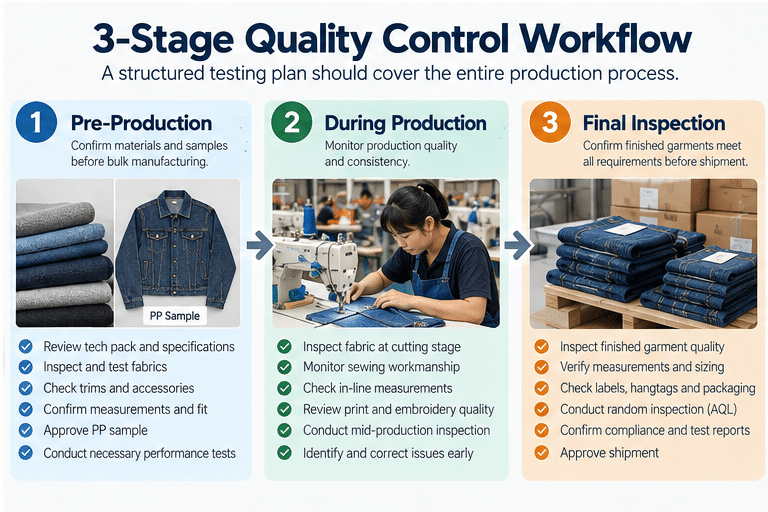
When Should Garment Testing Take Place?
Testing should not be treated as a single inspection at the end of production.
A stronger quality control system uses several checkpoints.
1. Pre-Production
Before bulk production:
- Confirm fabric specifications
- Approve materials
- Test fabric performance
- Confirm measurements
- Approve the pre-production sample
- Confirm trims and accessories
- Review applicable compliance requirements
- Review whether existing test reports apply to the intended bulk materials
For more information about the physical and technical requirements that should be finalized before production, see our guide to pre-production sample approval.
2. During Production
During manufacturing:
- Inspect cutting
- Monitor sewing quality
- Check measurements
- Monitor workmanship
- Check printing and embroidery
- Identify production defects early
- Verify that production uses the approved materials and specifications
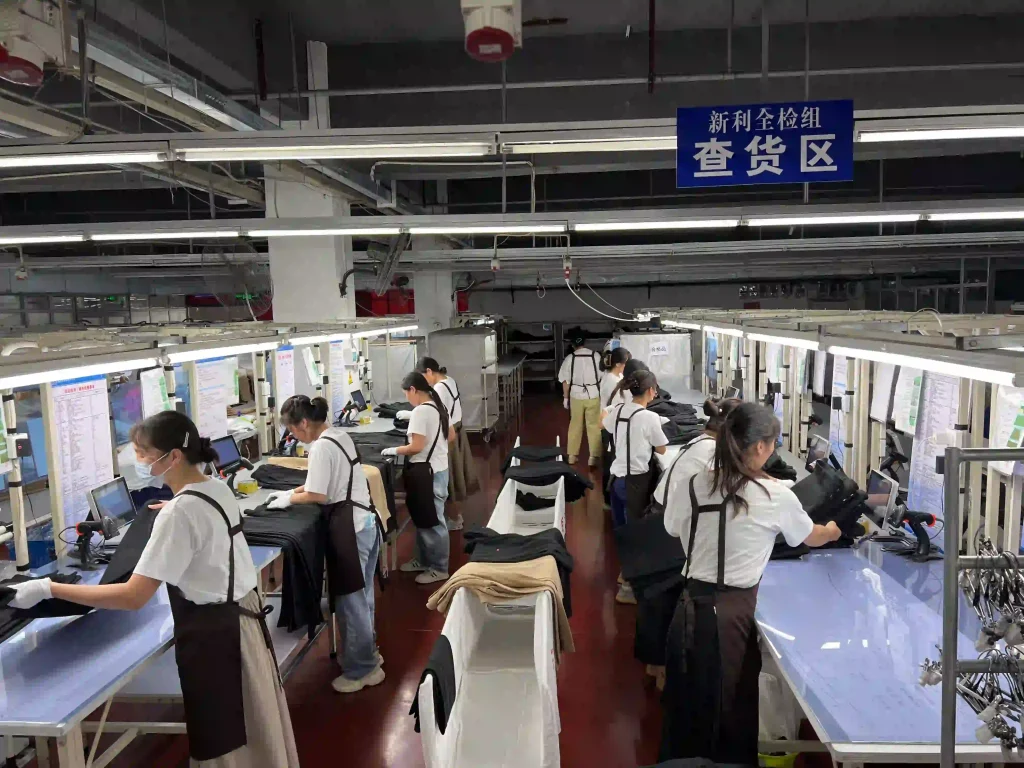
3. Final Inspection
Before shipment:
- Inspect finished garments
- Check measurements
- Review workmanship
- Verify labeling
- Check packaging
- Confirm carton quantities
- Conduct final quality inspection according to the agreed inspection standard
This multi-stage approach reduces the chance that a problem will remain undetected until the entire order has been completed.
Common Garment Quality Control Mistakes
Many quality problems begin with incomplete sample approval or unclear specifications.
Common mistakes include:
| Mistake | Potential Risk |
|---|---|
| Approving a sample based only on appearance | Hidden performance problems |
| Skipping fabric testing | Shrinkage, fading, or durability issues |
| Not defining measurement tolerances | Size inconsistencies |
| Ignoring size grading | Poor fit across different sizes |
| Not checking trims | Component failures |
| Skipping compliance checks | Regulatory problems |
| Not monitoring production | Large quantities of defective goods |
| Overlooking packaging | Warehouse and shipping problems |
| Relying on an old test report without checking applicability | Unsupported bulk approval |
| Rushing final approval | Costly rework and returns |
A structured garment testing plan helps reduce these risks before they become expensive production problems.
How a Professional Garment Manufacturer Supports Quality Control
An experienced garment manufacturer can help buyers establish quality control procedures from product development through final shipment.
At Newasia Garment, quality control activities may include:
- Fabric inspection before cutting
- Fabric GSM verification
- Material and trim inspection
- Shrinkage testing
- Colorfastness testing
- Pre-production sample approval
- In-line production inspection
- Measurement verification
- Workmanship inspection
- Print and embroidery inspection
- Safety and compliance checks
- Final garment inspection
- Packaging inspection before shipment
The appropriate testing scope, laboratory arrangements, and inspection requirements should be confirmed for each project according to the buyer’s specification and product needs.
The objective is to help ensure that bulk production follows the approved specifications and sample as closely as possible.
Garment Testing Plan Checklist Before Bulk Production
Before approving a garment for mass production, review the following checklist.
| Category | Key Inspection Points |
|---|---|
| Fabric | Composition, GSM, hand feel, consistency |
| Fabric Performance | Shrinkage, colorfastness, pilling, stretch recovery |
| Construction | Stitching, seams, thread quality, workmanship |
| Measurements | Size accuracy, grading, tolerances |
| Safety & Compliance | Trims, zippers, components, applicable regulations |
| Decoration | Print position, color, adhesion, embroidery |
| Fit & Comfort | Fit, movement, seams, labels |
| Packaging | Folding, polybags, labels, barcodes, cartons |
| Test Report Applicability | Sample identity, style, color, lot, method, conditions, acceptance criteria |
| Documentation | Test reports, inspection reports, approvals |
Conclusion
A comprehensive garment testing plan before bulk production is an important part of professional apparel quality control.
Testing fabric performance, garment construction, measurements, fit, workmanship, decoration, compliance, and packaging before mass production helps brands identify potential problems while there is still time to make corrections.
However, having a test report is not the same as having applicable evidence for the current bulk order.
The tested sample, material, color, production lot, method, testing conditions, and buyer acceptance criteria must be reviewed before an existing report is used to support a production decision.
A report that is valid for one specimen may not automatically cover a different material, colorway, construction, or production batch.
The key is not simply to test the finished garment. Quality should be controlled throughout the entire production process—from material selection and sample development to bulk manufacturing and final inspection.
A reliable garment testing plan therefore connects three things:
- Defined requirements: What the garment and materials must achieve.
- Relevant evidence: What was tested, under which conditions, and against which criteria.
- Production verification: Whether the current bulk order follows the approved requirements.
For apparel retailers, wholesalers, importers, and private-label brands, this approach supports more informed production decisions and a more traceable quality control process.
Frequently Asked Questions About Garment Testing
1. What is a garment testing plan?
A garment testing plan is a structured quality control process used to evaluate fabric, construction, measurements, performance, safety, compliance, and packaging before and during bulk production.
Its purpose is to identify potential quality issues early and ensure that finished garments meet the agreed specifications.
2. Why is garment testing important before bulk production?
Garment testing helps identify problems before large quantities of garments are manufactured.
Testing can reduce the risk of production defects, fabric shrinkage, color fading, incorrect sizing, poor workmanship, compliance issues, product returns, and customer complaints.
3. What tests should be included in a garment testing plan?
Testing requirements depend on the garment and target market, but common tests include:
- GSM
- Shrinkage
- Colorfastness
- Pilling resistance
- Stretch and recovery
- Fabric strength
- Seam strength
- Seam slippage
- Abrasion resistance
- Dimensional stability
Additional tests may be required depending on the product specification and destination market.
4. Does a previous test report automatically apply to a new bulk order?
No. An existing report should be checked against the current product, sample identity, material specification, colorway, production lot, test method, testing conditions, and buyer acceptance criteria.
If relevant materials, processes, or construction details have changed, additional verification or testing may be necessary. A report for one specimen should not automatically be treated as proof that every subsequent bulk lot complies.
5. How can buyers check garment quality before production?
Buyers should review the fabric specification, approved sample, measurement chart, workmanship standards, trims, decoration, packaging, and applicable compliance requirements.
They should also verify that supporting test reports apply to the materials and product intended for bulk production.
A standardized inspection checklist can help ensure that important quality points are not overlooked.
6. What should be checked during final garment inspection?
A final inspection may include:
- Appearance
- Workmanship
- Measurements
- Fabric defects
- Stitching
- Trims
- Printing and embroidery
- Labels
- Packaging
- Carton quantity
The inspection should follow the quality standards and acceptance criteria agreed between the buyer and manufacturer.
7. What should I ask a garment manufacturer before placing a bulk order?
Before approving bulk production, buyers should ask about:
- Fabric test reports
- Material specifications
- Pre-production sample approval
- Measurement standards
- Quality control procedures
- In-line inspection
- Final inspection
- AQL or other agreed acceptance criteria
- Compliance documentation
- Packaging standards
- Pre-shipment inspection
Buyers should also confirm whether the available test reports represent the actual materials and production scope of the order.
8. Can a garment manufacturer help create a testing plan?
Yes. An experienced garment manufacturer can help identify appropriate inspection points and testing requirements based on garment type, fabric, construction, target market, and customer specifications.
Working with the manufacturer during the development stage can help identify potential production risks before bulk manufacturing begins.
Read more
- Knitwear Manufacturer: Custom Sweaters, Cardigans & Cable Knit
- Garment-Dyed vs Piece-Dyed Hoodies: MOQ, Shrinkage and Color Approval Trade-Offs
- Moving Apparel Production to a New Factory: A Handover and Validation Checklist
- How to Compare Clothing Manufacturer Quotes: A Cost Checklist for Apparel Brands
- How to Build Durability Tests Around High-Stress Garment Areas