
Why Denim Garment Measurements Vary Between Production Batches
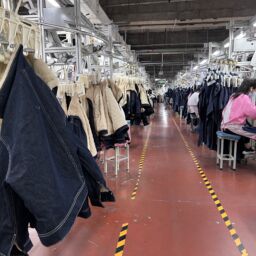
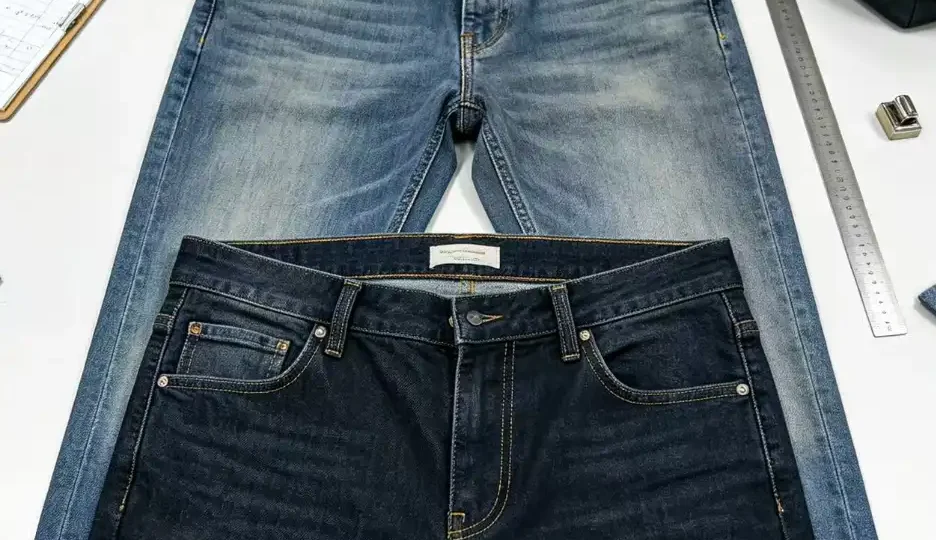
In global apparel manufacturing, denim is widely recognized as one of the most technical and volatile product categories. Sourcing directors, technical designers, and retail buyers frequently encounter a puzzling phenomenon: two production batches of the exact same style, cut from the same pattern size, end up fitting completely differently on the shelf. A pair of size 32 jeans from Batch A fits like a gloves, while Batch B feels tight around the hips or drapes longer at the inseam.
Because denim involves organic cotton fibers, mechanical weaving tension, manual assembly, and aggressive wet chemistry, dimensional drift between manufacturing runs is practically inevitable unless managed with extreme technical precision. Understanding why denim garment measurements vary between production batches is the first critical step toward diagnosing fit errors, reducing factory chargebacks, and enforcing strict quality control across your global supply chain.
1. What Counts as Batch Variation
Before diagnosing production defects, brands must distinguish between natural manufacturing tolerances and actionable batch variation.
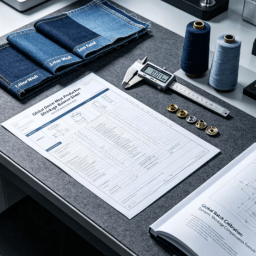
- Acceptable Production Tolerances: Due to the flexible nature of woven textiles, global standards generally permit a small margin of error (typically ±0.5 cm to ±1.0 cm depending on the specific Point of Measure, such as waistband width, hip circumference, or inseam length). Variations within these pre-approved POM limits are considered standard industry tolerance.
- True Batch Variation (Size Drift): True batch variation occurs when an entire production lot systematically skews toward the outer extreme of a tolerance range, or exceeds it altogether. This results in “size shift,” where an entire shipment of size Medium fits like a size Small, or where inconsistent inseam lengths ruin retail rack presentations.
- Cumulative Variance: The primary danger in denim manufacturing is cumulative error. Minor, sub-millimeter variations at the cutting, sewing, and laundering stages frequently compound, transforming minor material deviations into major garment sizing failures.
2. Fabric Lot Variation
Denim is made from natural cotton fibers woven under high tension, making raw fabric the single largest source of dimensional instability.
- Yarn Properties and Mill Tension: Cotton crops vary in staple length, moisture absorption, and fiber maturity between harvests. Furthermore, different weaving looms or mill runs apply varying levels of warp and weft tension. Yarns held under higher tension during weaving naturally shrink more when exposed to water and heat during washing.
- Dye Lot and Finishing Inconsistencies: Denim fabric shipped across different dye lots (or from different textile mills) undergoes varying chemical treatments, such as mercerizing or sanforizing. Variations in heat-setting and chemical finishing alter how readily the cotton fibers react to laundry processing.
- Elastane Blend Dynamics: For stretch denim incorporating elastane or spandex, raw material lot variance becomes even more pronounced. Minor variations in elastane ratio or core-spun yarn tension lead to drastic differences in fabric stretch, recovery, and heat-induced contraction during garment processing.
3. Cutting Spread & Relaxation
Precision cutting requires stable fabric. If raw denim is moved directly from storage rolls to the cutting table without adequate mechanical relaxation, size variation is guaranteed before a single stitch is sewn.
- Fabric Tension Recovery (Relaxation): As denim is wound tightly onto rolls at the mill, internal mechanical stress is trapped within the yarns. Unrolling fabric and cutting it immediately traps that tension into cut panels. Once the cut panels are sewn and washed, the trapped tension releases, causing unpredictable shrinkage. Professional factories require denim rolls to relax flat on spreading tables for 24 to 48 hours prior to cutting.
- Ply Height and Blade Deflection: When spreading fabric for bulk cutting, stacking too many plies (layers) creates vertical displacement. As the heavy cutting knife passes through 40 or 50 layers of heavy 14 oz denim, blade deflection causes the top layers to be cut slightly larger or smaller than the bottom layers.
- Marker Direction and Grainline Shift: Even slight rotational errors during digital marker nesting cause cut panels to deviate from the true fabric grainline. Off-grain panels react erratically to laundry processes, causing leg twisting and asymmetrical inseam shrinkage.
4. Sewing Operator/Process Variation
While cutting relies increasingly on automated machinery, garment assembly remains heavily dependent on human hand-eye coordination.
- Operator Seam Allowance Drift: Even with guide attachments, human operators may drift slightly from the specified seam allowance (e.g., taking a 12 mm seam instead of a 10 mm seam). Across multiple vertical seams (front rise, back rise, outseams, inseams), a 2 mm drift per seam aggregates into a 1.6 cm reduction in total hip circumference.
- Differential Feeding and Fabric Stretching: When joining heavy denim panels, sewing machine feed dogs can pull the bottom fabric layer faster than the top layer. Operators who manually stretch or pull fabric to align notches inadvertently introduce localized tension, which contracts unevenly during washing.
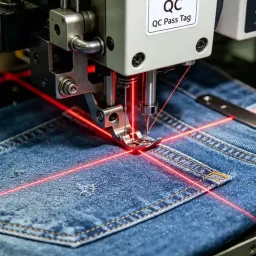
- Machine Calibration and Folder Wear: Industrial machinery—such as specialized twin-needle flat-felled seamers or automated waistband-attaching machines—wears down over time. Uncalibrated folder attachments alter seam overlap widths, directly shifting finished garment dimensions between production lines.
5. Wash Shrinkage Variation
Industrial wet processing (washing, distressing, and drying) causes the most dramatic physical changes in denim, making it the most volatile stage for measurement drift.
- Water Temperature and Liquor Ratio Shifts: Industrial laundries process denim in massive industrial washers. If water temperature fluctuates by even 5°C, or if the ratio of water to garment weight changes between laundry batches, the rate of cotton fiber swelling and shrinkage alters significantly.
- Tumble Drying Heat and Moisture Content: Cotton fibers shrink predominantly during the drying phase, where thermal energy causes fiber contraction. Over-drying garments at high heat causes excessive shrinkage, while under-drying leaves fibers expanded. Without moisture-sensor-controlled dryers, batch-to-batch dryer temperatures cause significant size drift.
- Abrasive Processing and Chemical Treatments: Enzyme washes, stone washing, bleaching, and ozone processing degrade cotton fibers to varying degrees. Longer wash cycles or higher chemical concentrations weaken structural yarns, causing garments to expand or contract unpredictably during final pressing.
6. Measurement Method Variation
Frequently, perceived garment size variation is not a physical manufacturing defect at all, but rather an error in human measurement methodology.
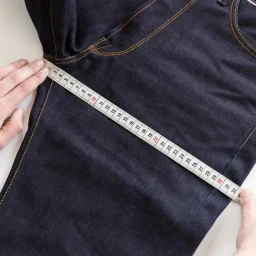
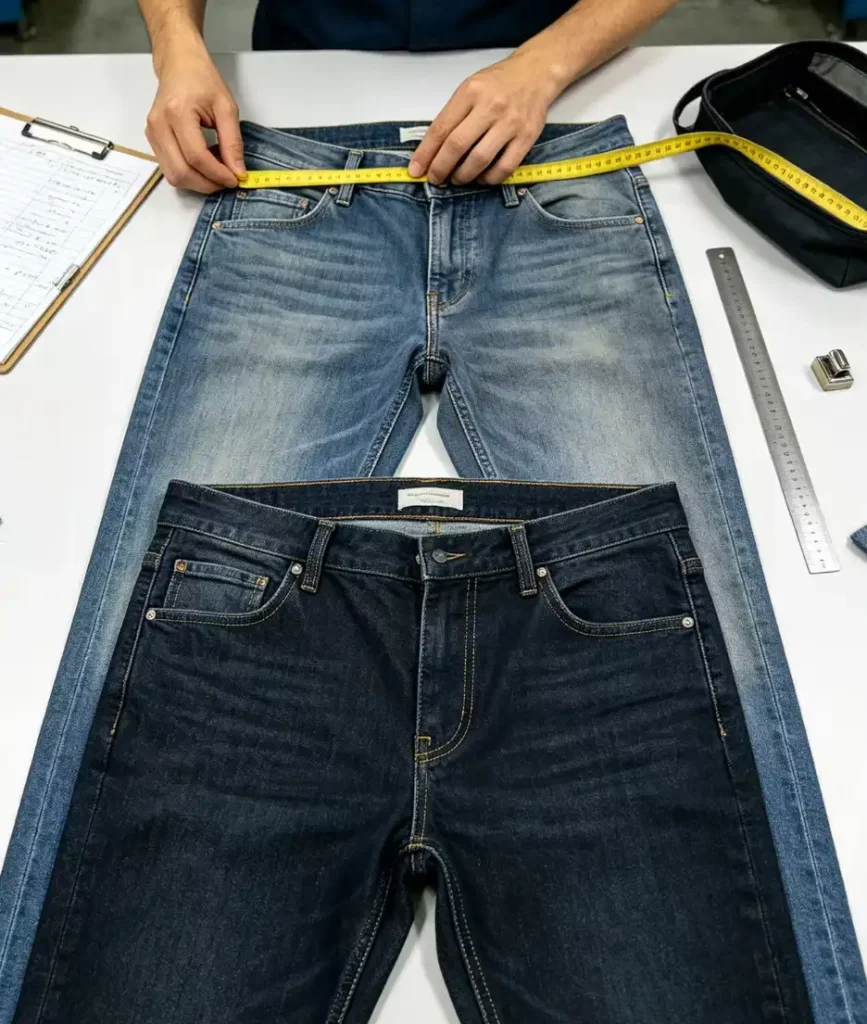
- Relaxed vs. Stretched Measuring: Measuring waistbands—especially contoured or stretch denim waistbands—requires strict protocol. If Inspector A measures the waistband totally flat without tension, while Inspector B pulls the waistband taut to eliminate wrinkles, their recorded measurements will differ by 1.5 cm to 3.0 cm on the exact same garment.
- Inconsistent Reference Points: Minor discrepancies in where a tape measure is placed cause massive data shifts. For example, measuring hip width 15 cm down from the waistband versus 18 cm down yields completely different numbers.
- Tool Calibration and Environmental Factors: Flexible fabric tape measures stretch over time with daily use. Using stretched cloth tapes or uncalibrated measuring tools across different QC stations introduces artificial measurement variance.
7. How Buyers Diagnose the Source
When a retail buyer or quality team receives a batch with measurement discrepancies, systematic root-cause analysis is required to identify where the failure occurred.
- Step 1: Inspect Unwashed (Green) Garments: Compare unwashed bulk garments against the original unwashed pre-production patterns. If the unwashed garment dimensions deviate from the green spec, the root cause lies in pattern grading, fabric relaxation, or cutting/sewing execution.
- Step 2: Conduct Fabric Swatch Shrinkage Testing: Cut 50 cm x 50 cm fabric swatches from the problematic batch and run them through standard laboratory wash testing. Compare the resulting warp and weft shrinkage percentages against the original fabric approval testing. If shrinkage rates differ significantly, the issue stems from fabric mill lot variation.
- Step 3: Audit Laundry Process Logs: Review digital laundry logs for water temperature, chemical dosage, cycle duration, and dryer temperature curves. Discrepancies in drying heat or cycle times point directly to laundry process instability.
- Step 4: Cross-Check QC Measuring Techniques: Conduct a blind measurement audit where multiple quality inspectors measure the exact same 10 garments. If inspectors record varying numbers, calibrate measuring protocols and retrain auditing staff.
Partnering with experienced, technical apparel manufacturers like New Asia Garment eliminates the headache of measurement drift. By enforcing strict fabric relaxation protocols, computerized pattern shrinkage grading, calibrated sewing attachments, and automated laundry controls, professional manufacturing partners ensure that your bulk production matches your approved sample batch after batch.
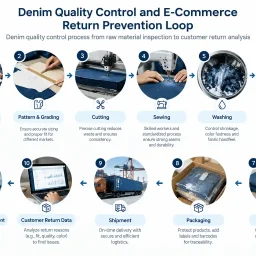
Brands that want to see how fabric control, pattern adjustment, washing, and bulk quality management fit into one production workflow can review our denim manufacturing process.
Read More
- What US Apparel Brands Should Verify About Care Labels Before Bulk Production
- Size Set Approval Before Bulk Production: How to Catch Pattern Grading Problems Early
- How to Investigate a Garment Quality Claim: From Symptom to Root Cause and CAPA
- Garment Packaging Quality Control: Preventing Creases, Print Damage and Shape Distortion
- How to Validate Pocket Function and Placement Before Bulk Production