
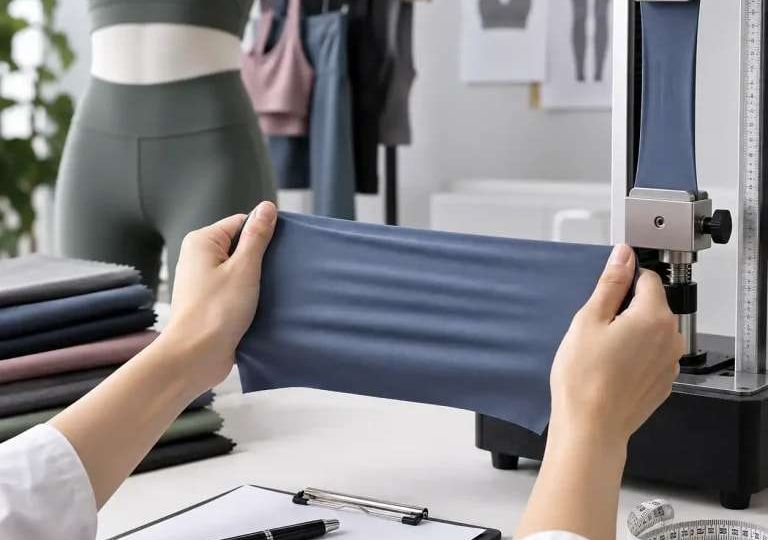
Choosing the right activewear fabric before bulk production is one of the most important steps in ensuring consistent garment quality. For activewear brands, sportswear buyers, clothing manufacturers, and private-label companies, fabric approval should involve more than checking color, appearance, and hand feel.
Before placing a bulk fabric order, buyers should confirm whether the fabric meets the required standards for opacity, stretch, elastic recovery, breathability, moisture management, durability, and dimensional stability.
A fabric may look excellent during sampling but perform differently during bulk production. It may become see-through when stretched, lose its shape after repeated wear, shrink after washing, or provide insufficient comfort during exercise.
A structured activewear fabric approval process helps identify these problems before bulk cutting and production.
Why Activewear Fabric Approval Matters
Activewear fabrics need to balance several performance requirements at the same time.
Leggings need sufficient stretch and recovery. Sports bras need support and shape retention. Running tops may require lightweight construction, breathability, and moisture management. Training shorts may need durability and resistance to repeated washing.
There is no single fabric specification that works for every activewear product.
For this reason, fabric approval should be based on the intended garment and end use rather than simply choosing a fabric because it feels soft or has a high stretch percentage.
A typical activewear fabric approval process may evaluate:
- Fiber composition
- GSM and fabric width
- Stretch
- Elastic recovery
- Opacity
- Breathability
- Moisture management
- Shrinkage
- Color fastness
- Pilling resistance
- Surface appearance
- Finished garment performance
The exact acceptance criteria should be agreed upon between the buyer and supplier before bulk production begins.
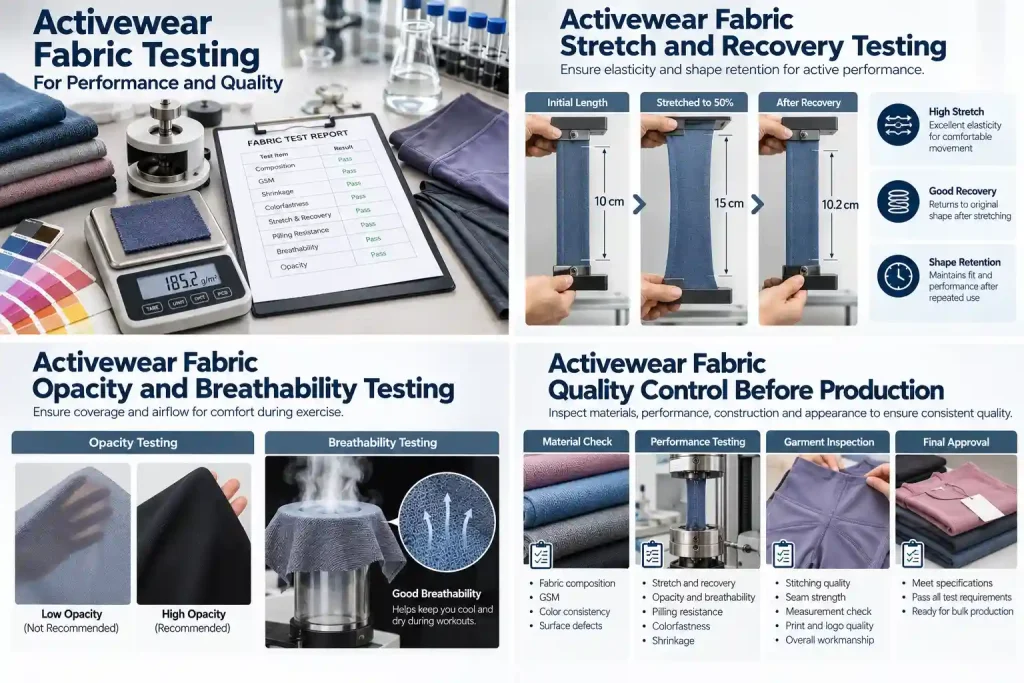
1. Check Activewear Fabric Opacity
Opacity is one of the most important fabric characteristics for leggings, yoga pants, cycling shorts, compression garments, and other fitted activewear.
A fabric may look opaque when it is lying flat but become transparent when stretched around the hips, thighs, knees, or other high-stress areas.
Therefore, fabric opacity should be evaluated under conditions that represent actual garment use.
How to Check Fabric Opacity
A practical opacity evaluation can include:
- Testing under controlled lighting
- Checking under natural and indoor light
- Stretching the fabric to the expected garment stretch level
- Using contrasting backgrounds
- Checking whether skin or underwear becomes visible
- Comparing with an approved reference sample
- Performing a squat test on finished leggings where applicable
Factors such as GSM, fabric density, knit construction, yarn type, fiber composition, and elastane content can all affect opacity.
Define the Opacity Requirement Clearly
Instead of simply telling a supplier that leggings fabric must be “not see-through,” buyers should define the testing conditions.
For example, the specification can identify:
- Required stretch percentage
- Lighting conditions
- Background color
- Evaluation method
- Fabric or finished garment testing
- Acceptance criteria
This creates a clear reference for the buyer, fabric supplier, and quality-control team.
2. Test Activewear Fabric Stretch
Stretch determines how easily a garment accommodates body movement.
For leggings, sports bras, cycling shorts, compression wear, and fitted training garments, both lengthwise and crosswise stretch can be important.
When approving fabric, buyers should check:
- Original fabric measurement
- Lengthwise stretch
- Crosswise stretch
- Fabric extension under tension
- Stretch consistency
- Permanent deformation
Four-way stretch can provide movement in multiple directions, but more stretch does not automatically mean better performance.
A fabric with very high stretch but poor recovery may become loose after repeated wear. Conversely, fabric with insufficient stretch may restrict movement or create excessive pressure.
The appropriate stretch level should therefore be determined by the garment design, pattern, fit, and intended activity.
3. Evaluate Elastic Recovery
Stretch and recovery are closely related but are not the same.
Stretch measures how far a fabric can extend.
Recovery measures how effectively the fabric returns toward its original dimensions after stretching.
Good elastic recovery is essential for activewear that needs to maintain its fit during repeated movement.
Poor recovery can lead to:
- Baggy knees
- Loose waistbands
- Sagging areas
- Loss of compression
- Distorted garment shape
- Poor fit after repeated wear
How Is Fabric Recovery Tested?
A recovery test should use consistent testing conditions, including:
- Stretch percentage
- Holding time
- Number of stretching cycles
- Recovery period
- Final measurement
- Acceptance standard
For example, compression leggings may require stronger recovery performance than a loose-fitting training top.
When comparing bulk fabric with an approved sample, suppliers should check whether there are changes in elastane content, fabric construction, yarn characteristics, or finishing.
4. Check Breathability and Moisture Management
Breathability is another important consideration for performance activewear.
During exercise, the fabric needs to manage heat, perspiration, and moisture. Depending on the product, buyers may evaluate:
- Air permeability
- Moisture wicking
- Moisture spreading
- Drying rate
- Water vapor transmission
However, breathability and quick-dry performance are not exactly the same thing.
A fabric may dry quickly without having high air permeability. Similarly, a breathable fabric may not provide the moisture-wicking performance required for a particular garment.
Therefore, buyers should define performance requirements according to the intended product rather than relying only on general marketing terms such as “breathable,” “quick dry,” or “moisture wicking.”
For running tops and training shirts, breathability and moisture management may be especially important. For leggings, these characteristics need to be balanced with opacity, stretch, recovery, and comfort.
5. Check GSM, Composition and Fabric Width
GSM, or grams per square meter, is commonly used to monitor activewear fabric consistency.
However, GSM should not be treated as the only indicator of fabric quality.
Two fabrics with similar GSM can have very different performance because of differences in:
- Fiber composition
- Elastane percentage
- Knit construction
- Fabric density
- Yarn characteristics
- Finishing processes
Before bulk cutting, compare the bulk fabric with the approved sample for:
- Fiber composition
- GSM
- Fabric width
- Color and shade
- Hand feel
- Stretch
- Recovery
- Surface appearance
Fiber composition is particularly important because even a change in elastane content can affect stretch and recovery.
The approved development sample should therefore be documented and retained as a reference for bulk production.
6. Test Dimensional Stability After Washing
Activewear is regularly washed, so fabric performance should also be considered after laundering.
Important checks may include:
- Length shrinkage
- Width shrinkage
- Twisting
- Skewing
- Stretch changes
- Recovery changes
- Surface appearance
- Pilling
- Color fastness
Testing should be consistent with the garment’s intended care instructions.
A fabric may perform well before washing but change significantly after laundering. This can affect garment measurements, waistband fit, compression, and overall appearance.
For this reason, post-wash fabric testing can be an important part of activewear quality control.
7. Check Color Fastness and Pilling
Color fastness is important for activewear because garments are frequently exposed to sweat, washing, and friction.
Depending on the product, testing may include:
- Color fastness to washing
- Color fastness to rubbing
- Color fastness to perspiration
- Color fastness to water
- Color fastness to light where applicable
Pilling resistance should also be considered for fabrics that experience repeated friction.
Leggings, for example, may rub against gym equipment, other garments, or the wearer’s skin. Tops may experience friction from backpacks or sports bras.
The required durability level should be based on the intended application and expected frequency of use.
8. Test the Finished Garment, Not Just the Fabric
Fabric approval is important, but fabric testing alone cannot always predict finished garment performance.
Pattern design, garment fit, seam construction, elastic application, cutting direction, and sewing tension can all affect the final result.
Where appropriate, buyers should evaluate a finished garment before bulk production.
For leggings, a practical finished-garment evaluation can include:
- Squat test
- Stretch comfort
- Opacity during movement
- Waistband recovery
- Overall fit
- Seam comfort
- Appearance after washing
For sports bras, the evaluation may focus more on support, recovery, comfort, and fit.
This is why an effective approval process should connect fabric testing with garment testing.
9. Compare Bulk Fabric With the Approved Sample
One of the most important steps before bulk production is comparing the actual production fabric with the approved development sample.
The bulk fabric may come from a different production lot or involve changes in yarn, dyeing, knitting, finishing, or processing.
Before releasing fabric for bulk cutting, compare:
Approved Sample → Bulk Fabric → Test Results → Acceptance Standard
If the bulk fabric differs from the approved sample, the difference should be documented and evaluated.
Depending on the deviation, additional testing or buyer approval may be required.
This helps prevent a common production problem: a fabric that was approved during development but performs differently during mass production.
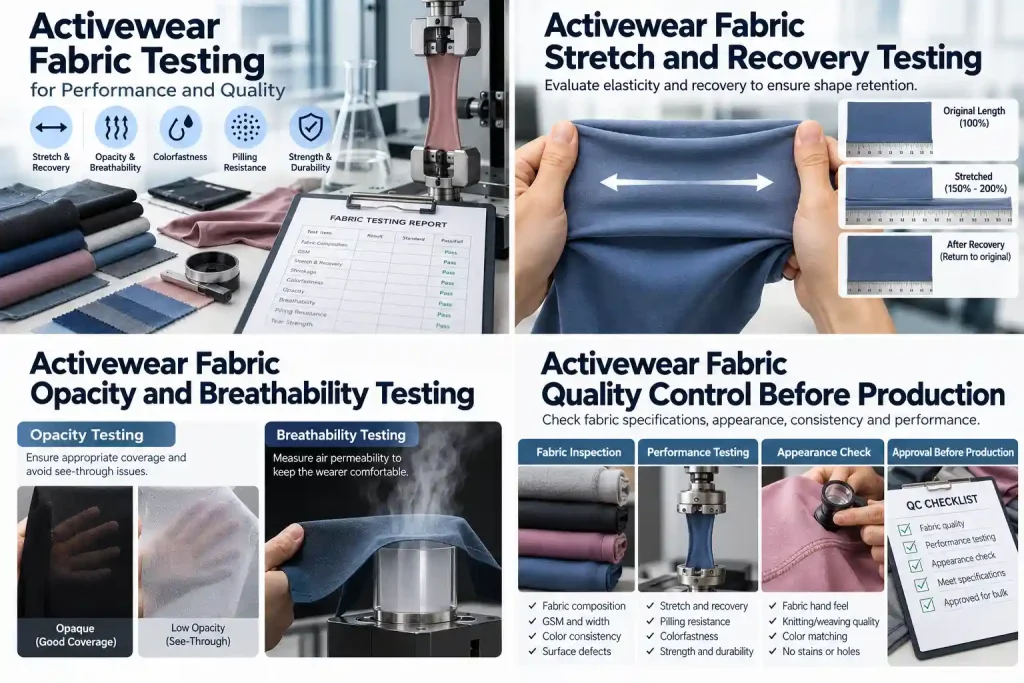
Activewear Fabric Approval Checklist
Before releasing fabric for bulk production, buyers and suppliers can use the following checklist.
Fabric Specifications
- Fiber composition approved
- GSM approved
- Width approved
- Color and shade approved
- Hand feel approved
- Fabric construction approved
Performance
- Stretch meets specification
- Recovery meets specification
- Opacity meets requirements
- Breathability meets requirements
- Moisture management meets requirements
- Shrinkage is acceptable
- Color fastness is acceptable
- Pilling resistance is acceptable
Finished Garment
- Fit approved
- Squat test completed where applicable
- Waistband recovery approved
- Coverage approved
- Seam construction approved
- Appearance after washing approved
Bulk Release
- Bulk fabric compared with approved sample
- Test results reviewed
- Production lot documented
- Deviations recorded
- Buyer approval completed where required
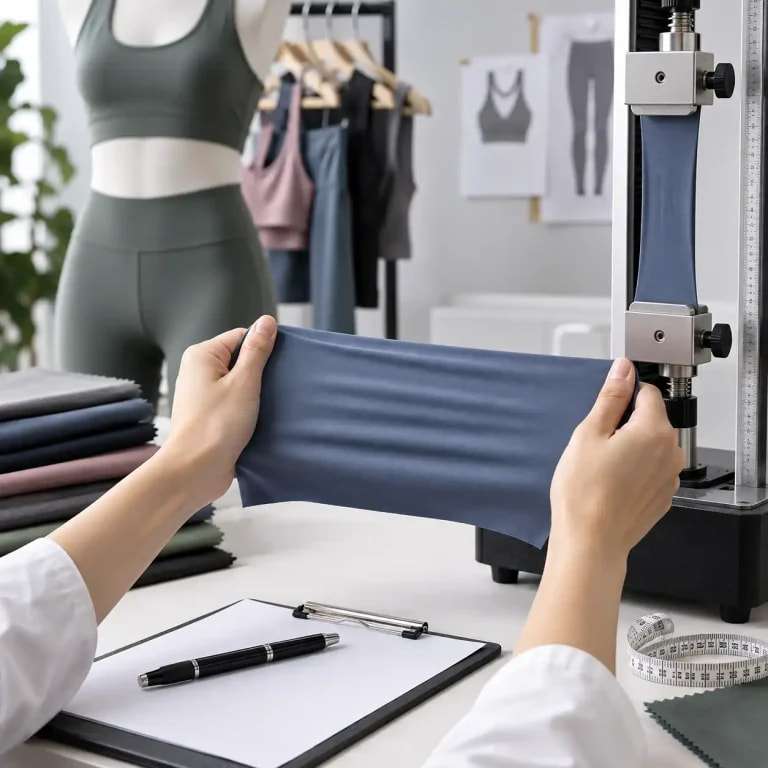
FAQ: Activewear Fabric Approval
Q1:What should I check before approving activewear fabric?
At minimum, check fiber composition, GSM, width, stretch, recovery, opacity, and dimensional stability. Depending on the product, breathability, moisture management, pilling, and color fastness may also need to be tested.
Q2:How do you test if leggings fabric is see-through?
Test the fabric at the expected garment stretch level under controlled lighting. Checking the fabric against contrasting backgrounds and performing a squat test on finished leggings can provide additional information.
Q3:Is higher GSM better for activewear?
Not necessarily. Higher GSM may contribute to coverage, but fabric performance also depends on construction, fiber composition, elastane content, stretch, recovery, and moisture management.
Q4:What is the difference between stretch and recovery?
Stretch measures how far the fabric can extend. Recovery measures how well it returns toward its original dimensions after stretching.
Both characteristics are important for maintaining activewear fit during movement and repeated use.
Q5:Should bulk fabric be tested after the sample is approved?
Yes. The bulk production fabric should be compared with the approved sample because production lots can vary in composition, construction, dyeing, or finishing.
Q6:Should activewear fabric be tested after washing?
Yes, when wash durability is important. Washing can affect shrinkage, stretch, recovery, pilling, color, and overall fabric appearance.
Q7:What fabric tests are important for activewear leggings?
Common checks include opacity under stretch, stretch percentage, elastic recovery, GSM, fiber composition, pilling, color fastness, dimensional stability, and finished-garment fit.
The exact requirements should depend on the garment design and intended use.
Final Thoughts
A reliable activewear fabric approval process helps buyers identify potential quality problems before bulk production begins.
Instead of evaluating fabric only by appearance and hand feel, brands and suppliers should establish clear requirements for opacity, stretch, recovery, breathability, composition, durability, and wash performance.
The most effective approach is to compare the approved sample with actual bulk fabric and, where necessary, confirm performance through finished-garment testing.
For activewear manufacturers and private-label suppliers, this process helps create a consistent quality standard from fabric development to bulk production, reducing the risk of unexpected fabric performance issues and costly production problems.
Read more
- Activewear Fabric Approval Before Bulk: Opacity, Stretch, Recovery and Breathability
- How to Build a Garment Test Plan Before Bulk Production (Complete Guide)
- Apparel Change Control: How to Approve BOM, Material and Construction Revisions
- Denim Quality Control: Testing Methods, Common Defects & Quality Standards
- How Denim Quality Control Reduces E-Commerce Returns