
Choosing a knitwear manufacturer involves more than finding a supplier that can produce a sweater from a design image. The manufacturer needs to understand the yarn, knitting structure, gauge, garment measurements, finishing requirements, and quality standards that define the finished product.
For US apparel brands developing custom sweaters, cardigans, or cable knit styles, these details should be agreed before bulk production. A clear technical brief helps reduce sampling changes, material substitutions, fit problems, and disagreements over finished quality.
New Asia Garment is a B2B apparel OEM/ODM manufacturer supporting brand development, sampling, and production requirements. For custom knitwear projects, the proposed construction, production route, minimum quantities, sampling schedule, and private-label requirements should be confirmed individually.
For brands exploring different production arrangements, learn more about our OEM clothing manufacturing and ODM clothing development services.
Custom Knitwear Development: Sweaters, Cardigans and Cable Knit
Knitwear covers a range of products and constructions, each with different development requirements.
Custom Sweaters
Sweater development involves selecting the yarn, knitting structure, gauge, silhouette, neckline, cuffs, and finishing details. The combination determines the garment’s appearance, weight, drape, and fit.
Custom Cardigans
Cardigans require additional attention to front openings, button or zipper construction, plackets, and reinforcement. These details need to work with the knitted structure rather than being treated as separate decorative components.
Cable Knit Sweaters
Cable knit designs use raised stitch patterns to create texture and visual depth. The cable repeat, direction, spacing, and placement should be defined in the design and checked across the intended size range.
Other design details, such as ribbed hems, textured panels, contrast stitching, and different neckline constructions, should also be documented in the technical package.
The important starting point is the actual garment specification. A reference photograph can communicate the overall look, but it cannot fully define the yarn, stitch construction, finished measurements, or performance requirements.
1. Start With the Garment, Then Confirm the Gauge
For a US brand’s sourcing and technical teams, the useful question is not simply whether a supplier makes sweaters. It is whether the supplier can translate the approved design into a defined, costed, and inspectable product.
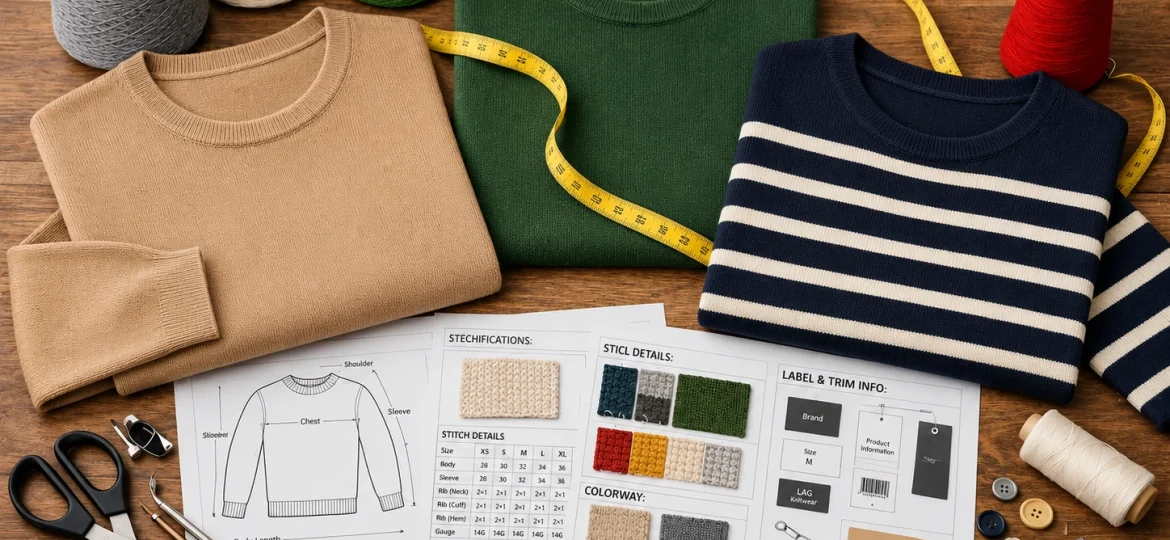
Include the following information in your tech pack:
- Front and back sketches.
- Intended silhouette and fit.
- Finished garment measurements and tolerances.
- Yarn composition and proposed yarn specification.
- Gauge and stitch references.
- Color standards.
- Neckline, cuff, hem, and sleeve construction.
- Finishing and care instructions.
- Labels, trims, and packaging requirements.
For cardigans, identify the closure type, placket construction, button placement, and reinforcement requirements.
If the design uses a zipper, specify its length, opening configuration, tape color, attachment construction, and operating requirements separately. Approve it in the actual knitted garment rather than from a loose trim sample alone.
Understanding Knitwear Gauge
Gauge commonly describes knitting-machine needle density. It does not, by itself, specify yarn thickness, finished fabric weight, softness, drape, or quality.
The following gauge bands can help organize a development discussion. They are reference categories, not a guarantee of supplier capacity or a fixed rule about garment weight.
| Proposed gauge | Typical development focus |
|---|---|
| 3GG–5GG | Chunky appearance, yarn combination, stitch structure, garment weight, and seam bulk |
| 6GG–8GG | Stitch definition, drape, structure, and finished dimensions |
| 9GG–12GG | Finer appearance, stitch definition, coverage, and durability |
Ask the manufacturer to identify the actual machine gauge and knitting arrangement proposed for the style.
Request a swatch made with the intended yarn, stitch structure, and finishing process before treating a gauge reference as an approved specification.
A similar gauge does not necessarily mean two fabrics will have the same appearance or performance. Yarn thickness, fiber composition, stitch construction, machine setup, and finishing all affect the finished result.
Developing Cable Knit Structures
For cable knit, mark the cable repeat, placement, direction, and spacing on the design.
Review the finished swatch for:
- Cable definition and relief.
- Pattern consistency.
- Fabric coverage and openness.
- Surface appearance.
- Dimensional behavior.
- Comfort and flexibility.
Then confirm that the repeat works across the size range.
A visually balanced sample in one size does not settle grading, neckline placement, or cable alignment in every size. The approved pattern and grading rules should account for the intended placement of the knitted design.
2. Record Yarn Count as a Complete Specification
“Cotton yarn” or “soft wool blend” is not enough information for a production handoff.
Record:
- Fiber composition and percentages.
- Yarn count and count system.
- Ply or number of ends.
- Yarn construction where relevant.
- Color reference.
- Approved yarn identification.
- Required finishing characteristics.
Ask which specifications are fixed and which are still proposed.
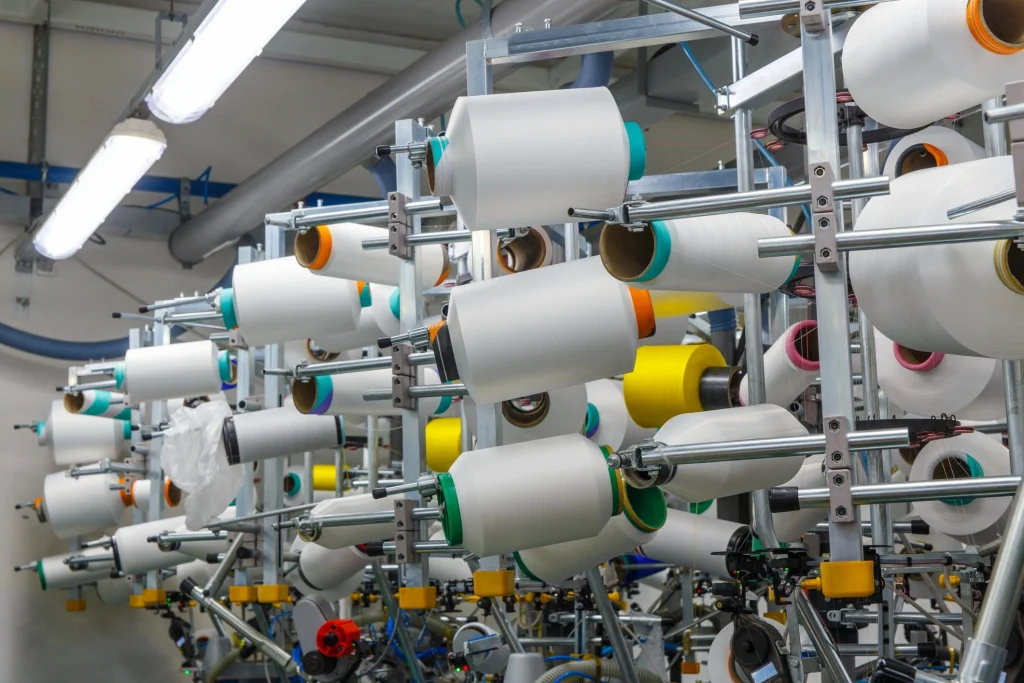
Understand Yarn Count Systems
Count systems are not interchangeable.
In indirect systems such as Nm, a higher count indicates a finer yarn. In a direct system such as tex, a higher value indicates a heavier yarn per unit length.
A count without its system can therefore create a material misunderstanding.
Ask the supplier to write out any notation that could be interpreted differently, including ply and how many ends will be knitted together.
For example, a yarn count alone does not tell the buyer whether the yarn will be used as a single end or combined with additional ends in the knitting process.
Approve Yarn Substitutions Carefully
Keep the approved yarn reference with the finished swatch.
If a substitute is proposed, compare the replacement in the intended construction and finish before approving it.
Matching a fiber percentage does not establish equivalent appearance, hand feel, fit, or care performance.
A yarn change may affect stitch definition, garment weight, dimensional stability, pilling, and the way the finished garment drapes.
Any proposed substitution should therefore be reviewed against the original product requirements, with additional sampling or testing where necessary.
3. Set Pilling and Shrinkage Criteria Before Testing
Knitwear performance depends on more than its appearance when first produced.
Pilling, shrinkage, and dimensional growth can affect the garment after wear and laundering. These requirements should be agreed before bulk approval rather than addressed only after production problems appear.
Ask for a test plan with the sample stage, method, preparation, exposure or care conditions, acceptance criteria, and report owner.
Do not accept “pilling tested” or “shrinkage controlled” as a complete result.
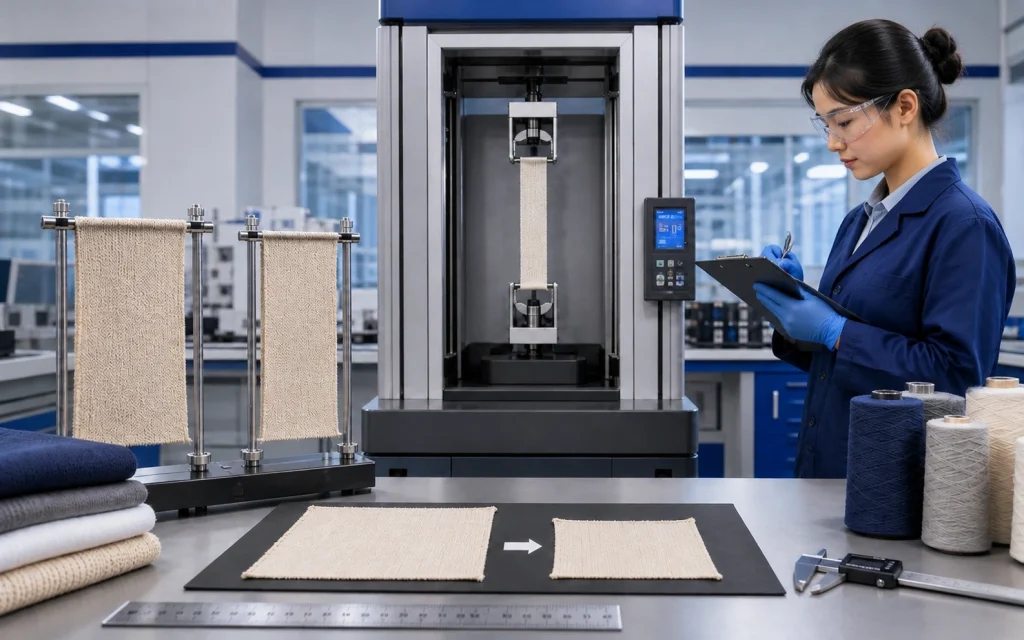
Pilling Performance
For pilling, agree on:
- Applicable test method and edition.
- Sample preparation.
- Test duration or cycles.
- Assessment procedure.
- Rating system.
- Minimum acceptable result.
Compare results only when the relevant conditions match.
A rating without the method and test conditions is not a usable bulk acceptance requirement.
Request evidence tied to the approved yarn, construction, and finish. A report for a different product does not establish performance for this style.
Shrinkage and Dimensional Stability
For dimensional change, agree on the care procedure, number of cycles, measurement points, conditioning, and allowed change for each critical dimension.
Record before-and-after measurements for:
- Body length.
- Chest width.
- Shoulder width.
- Sleeve length.
- Cuff and hem dimensions.
- Other fit-critical areas.
Track growth as well as shrinkage.
One calculation convention is:
Dimensional change (%) = (After-care measurement − Before-care measurement) ÷ Before-care measurement × 100.
Under this convention, a negative result indicates shrinkage and a positive result indicates growth.
Define the convention in the specification so a sign is not mistaken for a pass or failure.
Set tolerances with the technical team for the intended product. Do not import an arbitrary percentage from another garment.
For additional guidance on dimensional stability in heavier knitted fabrics, see our article on shrinkage control in high-GSM cotton knits.
If a test result misses the agreed requirement, document the proposed material, construction, or finishing change and retest the affected requirements.
Approving the original sample does not approve a later change automatically.
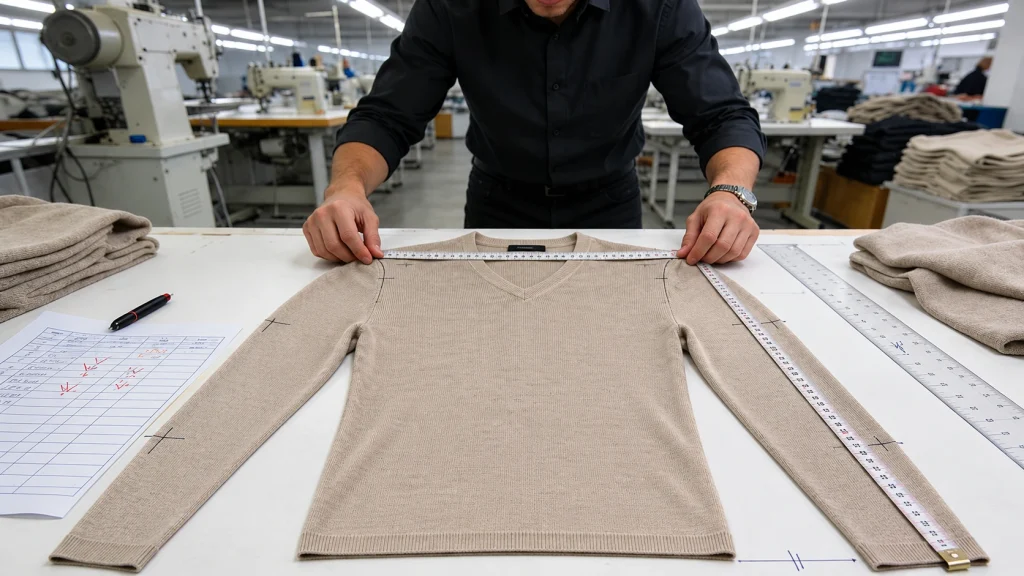
4. Use Sample Approvals as Production Checkpoints
A structured sample approval process helps the brand and manufacturer resolve technical questions before committing to bulk production.
Organize approvals around decisions, with a named buyer-side owner for each one.
Stage 1: Swatch Approval
Confirm:
- Yarn identity and composition.
- Gauge and knitting arrangement.
- Stitch or cable repeat.
- Color direction.
- Proposed finish.
- Initial appearance and hand feel.
Record unresolved items rather than treating the swatch as final garment approval.
Stage 2: Development and Fit Approval
Review the garment against the measurement specification, construction details, closure behavior, and intended silhouette.
Check the relevant size measurements and fit requirements.
For cable knit, verify pattern placement and repeat proportions. For cardigans, review the front opening, placket, button or zipper attachment, and garment balance.
Keep dated comments and revision numbers so each sample can be linked to the correct specification.
Stage 3: Pre-Production Approval
Confirm the agreed production materials, labels, trims, measurements, workmanship criteria, and applicable test evidence.
Retain an identifiable approved reference.
The pre-production sample should represent the agreed construction and materials intended for bulk production, not an earlier development version.
Stage 4: Bulk Inspection Agreement
Define inspection timing, sampling approach, defect classifications, measurement tolerances, and the response to a failed inspection before production release.
The buyer and supplier should agree who reviews inspection results and who has authority to approve any deviation.
Additional Checks for Cardigan Closures
For a cardigan with a zipper, check:
- Zipper operation.
- Alignment and opening smoothness.
- Distortion around the knitted placket.
- Attachment construction.
- Tape and trim appearance.
- Performance after relevant care procedures.
Ask the supplier to confirm the trim specification and any supporting evidence required by your team.
Control Changes After Approval
Require written approval for changes to yarn, knitting arrangement, stitch structure, finishing, labels, or closures.
State who can authorize a change, which samples or tests must be repeated, and which version becomes the production reference.
This keeps a commercial discussion about availability from silently becoming a technical substitution.
5. Understand Knitwear MOQ, Pricing, and Production Lead Times
Knitwear production costs depend on more than the number of finished garments. Yarn purchasing, knitting structure, color requirements, trims, sampling, and finishing can all affect the quotation.
A supplier’s garment MOQ may also differ from the minimum quantity required to purchase a particular yarn or develop a custom color.
Common MOQ Starting Points
The following are common starting points across different apparel project types. Actual minimums depend on the selected product, customization requirements, and production arrangements.
| Project Type | Common Starting Point |
|---|---|
| Selected in-stock products | No MOQ |
| Existing style customization | From 50 pcs |
| T-shirts / Hoodies / Sweatpants | From 100 pcs / color |
| Garment-dyed programs | From 150 pcs / color |
| Denim & other fashion garments | From 300 pcs / style |
Selected in-stock products generally refer to ready-stock products without production customization. Existing-style customization and all custom-production minimums remain subject to the selected product and actual project requirements.
For custom knitwear, ask the manufacturer to confirm the applicable minimum based on the sweater or cardigan style, yarn requirements, colorways, and knitting construction. The general starting quantities above should not be treated as guaranteed minimums for every knitwear project.
Request Quotes at Different Quantities
For a custom knitwear project, use several quantity scenarios to compare feasibility and cost.
| RFQ quantity | Ask the manufacturer to confirm |
|---|---|
| 50 units | Whether the trial quantity is feasible for the proposed style, yarn, colors, and size split; identify separate development or setup charges |
| 100 units | Whether the requested color and size allocation meets the applicable knitting, yarn, and trim minimums |
| 150 units | How the quote changes with the same specifications, and whether material purchasing constraints remain |
| 300 units | The proposed production allocation, inspection plan, and cost breakdown for the larger order |
For each scenario, ask whether the minimum applies per style, color, yarn lot, or total order.
Separate a garment production minimum from a yarn purchasing minimum.
Typical Planning Windows
Production timing depends on material availability, design complexity, sample revisions, and production scheduling. The following are typical planning windows for initial discussions.
5–10 Days: Sampling
Sampling commonly takes 5–10 days after the key product and material requirements are confirmed.
The actual schedule may vary depending on yarn sourcing, stitch development, design complexity, and the number of sample revisions required.
15–30 Days: Bulk Production
Bulk production commonly takes 15–30 days after sample approval and material readiness.
The production schedule should account for material availability, knitting, garment assembly, finishing, quality inspection, and order quantity.
What Should a Knitwear Quote Include?
Request a cost breakdown covering:
- Yarn and material costs.
- Knitting and garment construction.
- Pattern or technical development charges, if applicable.
- Sampling and sample revisions.
- Dyeing and finishing.
- Buttons, zippers, and other trims.
- Private labels and packaging.
- Inspection and required testing.
- Shipping terms and applicable additional charges.
Also confirm quotation validity, currency, payment terms, and the conditions under which the quoted price may change.
A low unit price is not necessarily the lowest total project cost if sampling, custom yarn purchasing, or small color allocations create additional expenses.
Final MOQ, price, timing, specifications, and commercial terms should be confirmed in writing for the actual order.
For a broader explanation of how order quantities affect production commitments, see our clothing manufacturing MOQ guide.
6. Confirm Private Label and Customization Requirements
For apparel brands, knitwear development may involve more than the garment itself.
Private-label requirements should be included in the original brief so they can be reviewed alongside construction and costing.
Depending on the project, discuss:
- Main brand labels.
- Size labels.
- Care and composition labels.
- Hangtags.
- Packaging.
- Custom colors.
- Approved artwork and branding placement.
- Special buttons, zippers, or other components.
Confirm whether each item is supplied by the buyer or sourced by the manufacturer.
For custom labels and trims, request relevant artwork, dimensions, material details, and approval samples before bulk production.
Private-label availability, development requirements, and associated costs should be confirmed for the individual project rather than assumed.
7. How to Choose a Knitwear Manufacturer
A suitable knitwear manufacturer should be able to review the technical requirements and explain what needs to be confirmed before production.
When evaluating a potential supplier, consider the following.
| Evaluation area | What to verify |
|---|---|
| Product understanding | Can the supplier interpret the sweater, cardigan, or cable knit design? |
| Technical development | Can the proposed gauge, yarn, and stitch structure be assessed? |
| Material sourcing | Are yarn composition, count, color, and alternatives clearly specified? |
| Sampling | Are development stages, revision procedures, and approval responsibilities clear? |
| Quality requirements | Can the agreed testing and measurement criteria be documented? |
| MOQ and pricing | Are garment, color, yarn, and development minimums separated? |
| Private labeling | Are labels, trims, and packaging requirements confirmed? |
| Production planning | Are lead times, material availability, and delivery conditions documented? |
Do not rely solely on product photographs or general statements about manufacturing experience.
Request project-specific confirmation and evaluate the proposed construction, sample quality, and commercial terms before making a production decision.
8. Frequently Asked Questions About Custom Knitwear
What is the MOQ for custom knitwear?
The MOQ depends on the selected sweater or cardigan style, yarn requirements, colorways, knitting construction, and production arrangements.
New Asia’s general apparel starting points include no MOQ for selected in-stock products, existing-style customization from 50 pieces, T-shirts, hoodies, and sweatpants from 100 pieces per color, garment-dyed programs from 150 pieces per color, and denim and other fashion garments from 300 pieces per style.
These are general starting points, not guaranteed knitwear-specific minimums. The actual quantity should be confirmed for each project.
How long does custom sweater sampling take?
Sampling commonly takes 5–10 days after the key product and material requirements are confirmed.
The actual schedule may vary depending on yarn sourcing, knitting structure, design complexity, and sample revisions.
How long does bulk knitwear production take?
Bulk production commonly takes 15–30 days after sample approval and material readiness.
The final schedule depends on the order quantity, yarn availability, production arrangements, finishing requirements, and inspection schedule.
Can I order custom sweaters with private labels?
Private-label requirements should be confirmed with the manufacturer.
Provide your main label, size label, care label, hangtag, and packaging requirements so sourcing and development costs can be assessed before production.
What information should I provide for a custom knitwear quote?
Prepare your tech pack, front and back design references, gauge preference, yarn specification or proposed composition, stitch references, colorways, size breakdown, target quantity, and required finishing.
If you have specific pilling or dimensional-change requirements, include those as well.
What is the difference between a sweater and a cardigan for production planning?
A sweater is generally developed as a pullover garment, while a cardigan has a front opening and requires additional closure and placket considerations.
Both need clear yarn, gauge, construction, measurement, and finishing specifications. Cardigans also require appropriate approval of buttons, zippers, or other closure components.
Send a Knitwear Development Inquiry
A successful knitwear project begins with a clear technical brief and realistic production requirements.
Use the knitwear quote request below to share:
- Your tech pack and garment sketches.
- Intended gauge within 3GG–12GG, if known.
- Yarn specification or proposed composition.
- Stitch and cable references.
- Colorways and size breakdown.
- Requested quantities per style and color.
- Private-label and packaging requirements.
- Sample deadline and desired delivery window.
- Pilling and dimensional-change criteria.
New Asia Garment can review the proposed sweater, cardigan, or cable knit project and discuss the feasibility, sampling steps, private-label requirements, and commercial terms that need confirmation.
Specific knitwear equipment, testing arrangements, production routes, MOQ, sampling lead times, and manufacturing capabilities must be confirmed for the individual project.
Knitwear Quote Request
Ask New Asia Garment to review your custom sweater, cardigan, or cable knit requirements and confirm the next development steps.
Submit your knitwear development inquiry or use the form below.
MOQ, price, sampling and bulk production timeframes are starting points for planning. Final specifications, availability, timing, and commercial terms must be confirmed in writing for the actual order.
Read More
- Knitwear Manufacturer: Custom Sweaters, Cardigans & Cable Knit
- Garment-Dyed vs Piece-Dyed Hoodies: MOQ, Shrinkage and Color Approval Trade-Offs
- Moving Apparel Production to a New Factory: A Handover and Validation Checklist
- How to Compare Clothing Manufacturer Quotes: A Cost Checklist for Apparel Brands
- How to Build Durability Tests Around High-Stress Garment Areas