

For emerging apparel brands, established fashion houses, and global retail distributors, scaling a design from a digital tech pack into full-scale manufacturing is a high-stakes transition.
The ultimate gatekeeper between creative concept and commercial production is the Pre-Production (PP) sample. Rushing through this approval stage or treating it as a formality can result in expensive bulk production errors, delayed delivery schedules, quality disputes, and costly inventory write-offs.
Securing precise and documented approval of a PP sample gives the factory a clear physical benchmark for executing every technical specification and design detail. This guide covers the essential checkpoints apparel brands should lock down before authorizing bulk manufacturing.
1. Lock the Master Color Standard and Pantone Matching
Color consistency across thousands of garments is one of the most challenging variables in global apparel manufacturing. Differences in dye lots, fabric composition, finishing processes, and lighting conditions can all affect the final appearance of a garment.
Approve Pantone References and Physical Color Standards
Brands should establish definitive color standards using physical Pantone (PMS) textile references, approved lab dips, or physical color swatches rather than relying solely on computer monitors.
The approved physical reference should become the master color standard used for bulk production and final inspection.
Evaluate Colors Under D65 Illumination
Color approval should be performed under standardized lighting conditions, including simulated natural daylight such as D65.
Where necessary, brands should also evaluate garments under retail or store lighting to identify metamerism, where a color appears different under different light sources.
Control Fabric-Specific Dye Lot Variation
Cotton, polyester, nylon, and blended fabrics can absorb and reflect dyes differently. For this reason, color approval should be performed on the exact fabric construction and composition intended for bulk production.
For collections containing multiple materials, each fabric base should be evaluated separately to ensure consistent color harmony across the finished range.
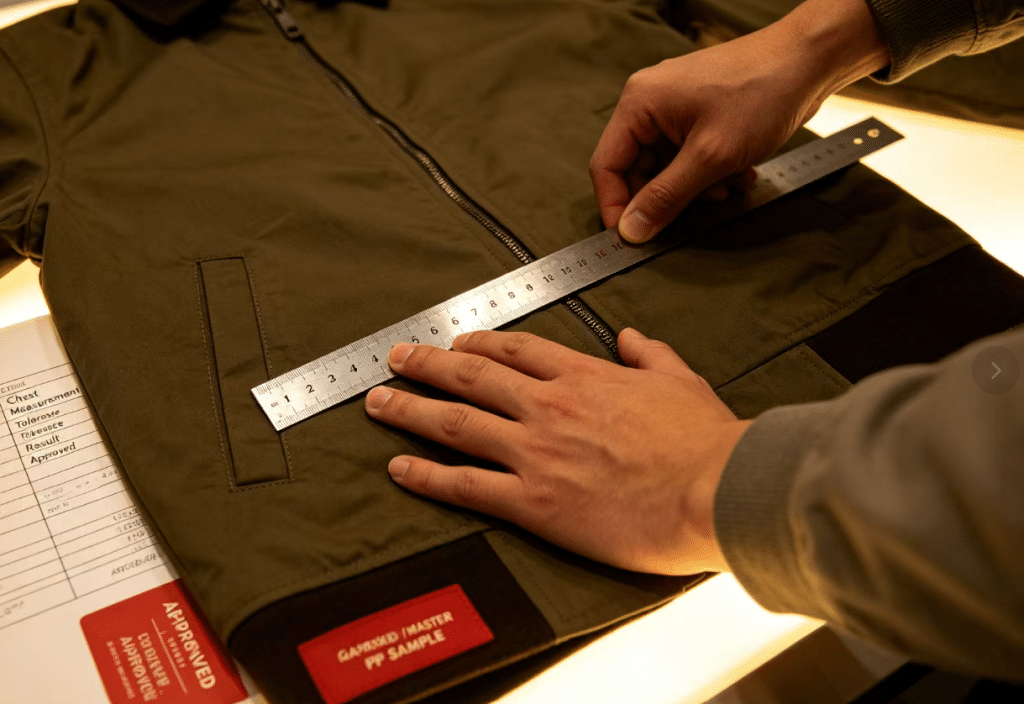
2. Verify Sizing, Grading Accuracy, and Garment Fit
A PP sample that fits perfectly in one size does not automatically guarantee accurate proportions across the entire size range.
Incorrect grading can affect garment balance, comfort, silhouette, and the positioning of functional and decorative details.
Check the Proportional Scaling of Design Details
Grading should account for more than simply increasing or decreasing overall garment dimensions.
Manufacturers should verify the proportional positioning of:
- Pockets
- Buttonholes
- Plackets
- Print graphics
- Embroidery
- Labels
- Sleeve details
- Other functional components
This helps prevent details from appearing too high, too low, too close to seams, or disproportionately large on different sizes.
Test Multiple Size Fit Sets
Brands should consider approving fit samples across key boundary sizes rather than relying exclusively on a single master size.
For example, an XS, M, and XXL fit set can help verify whether the garment maintains its intended comfort, drape, proportions, and silhouette across the size range.
Validate Stretch, Ease, and Movement
For stretch fabrics and structured woven garments, pattern blocks should incorporate appropriate ease and tension allowances.
Fit testing should confirm that the garment is neither excessively restrictive nor unnecessarily loose during normal movement.
3. Lock Artwork Alignment, Print Scale, and Embroidery Quality
For graphic T-shirts, streetwear, uniforms, and branded apparel, translating digital artwork into physical garments requires strict control over placement, scale, and decoration quality.
Define Artwork Placement Using Fixed Coordinates
Graphic placement should be specified using measurable distances from fixed garment reference points.
Common reference points include:
- High Point Shoulder (HPS)
- Collar rib seam
- Center front
- Side seam
- Sleeve hem
- Pocket edge
Coordinate-based specifications reduce subjective interpretation and help factories reproduce artwork placement consistently during bulk production.
Validate Printing and Embroidery Techniques
The PP sample should be evaluated under realistic use and care conditions.
Depending on the decoration method, testing may include:
- Stretch testing
- Wash testing
- Print adhesion testing
- Screen-print cracking inspection
- DTF transfer adhesion testing
- Embroidery puckering inspection
- Backing and stabilization verification
The goal is to confirm that the selected decoration technique is compatible with the fabric and intended end use.
Confirm Proportional Graphic Scaling
Large graphics should be appropriately scaled across different garment sizes.
A graphic that works well on a size Large may wrap around side seams or appear oversized on a smaller garment if the same dimensions are used across the entire size range.
4. Verify Trim, Hardware, and Fastener Durability
Functional and decorative hardware—including zippers, buttons, rivets, snap fasteners, and drawcord aglets—can significantly affect both garment performance and perceived product quality.
Conduct Tensile and Pull-Strength Testing
Zippers, snaps, buttons, and other fasteners should be tested for resistance to mechanical stress.
Testing should verify that components remain securely attached without tearing through the surrounding fabric during normal use.
Check Corrosion and Laundering Resistance
Metal hardware should be evaluated for resistance to oxidation, discoloration, and corrosion.
This is particularly important for garments exposed to repeated washing, moisture, humidity, or long-distance transportation.
Verify Hardware Branding and Logo Quality
Custom hardware and branded trims should be checked for:
- Logo accuracy
- Lettering clarity
- Correct color
- Engraving quality
- Surface finish
- Attachment security
- Dimensional consistency
Small branding details can have a significant impact on the perceived quality of a finished garment.
5. Lock Seam Construction, Stitch Density, and Internal Finishing
The internal construction of a garment determines much of its long-term durability, comfort, and resistance to fraying.
Verify Stitches Per Inch (SPI)
Stitch density should be checked against the approved technical specification.
Insufficient stitch density may reduce seam strength, while excessive stitch density can contribute to puckering, fabric damage, or an unnecessarily rigid seam.
The appropriate SPI should therefore be determined according to the fabric, seam type, garment construction, and intended end use.
Approve Seam Finish Standards
The master tech pack should clearly specify the required internal finishing method for each garment section.
Depending on the product, suitable constructions may include:
- Clean-bound seams for selected unlined jackets
- Flat-felled seams for workwear
- Overlock safety stitches for knit garments
- Binding finishes
- Reinforced seam constructions
Clearly defined seam standards help ensure that internal workmanship remains consistent during bulk manufacturing.
Reinforce High-Stress Areas
High-friction and high-load areas should be reviewed during PP sample approval.
Potential reinforcement points include:
- Pocket openings
- Belt loops
- Crotch seams
- Placket ends
- Shoulder junctions
- Other high-stress construction points
Bar-tacks, rivets, or other reinforcement methods can be used where required by the garment design and intended application.
6. Create a Final PP Sample Approval Checklist
Before bulk production begins, brands should consolidate all approved specifications into a documented PP approval package.
The final approval should cover:
- Color and approved physical standards
- Fabric composition and construction
- Measurements and grading
- Garment fit
- Artwork placement and scale
- Print and embroidery quality
- Trim and hardware specifications
- Seam construction
- Stitch density
- Internal finishing
- Labels and branding
- Packaging requirements
The approved PP sample should be retained as the physical reference for production and final QC wherever practical.
Conclusion: Lock Every Critical Detail Before Bulk Production
Pre-production sample approval is one of the most important quality-control stages in apparel manufacturing. A PP sample should not simply demonstrate what the finished garment looks like—it should establish the physical and technical benchmark that the factory must reproduce during bulk production.
By locking down color standards, size grading, fit, artwork placement, decoration quality, hardware durability, seam construction, and internal finishing before production begins, apparel brands can reduce manufacturing discrepancies and create a clear quality standard for both suppliers and inspection teams.
For brands working with experienced manufacturing partners such as New Asia Garment, a structured PP approval process can provide a stronger foundation for consistent, retail-ready apparel production at scale.
Frequently Asked Questions About Pre-Production Sample Approval
1. What is a pre-production (PP) sample in apparel manufacturing?
A pre-production (PP) sample is the final sample produced before bulk manufacturing begins. It is used to confirm key specifications such as color, fabric, measurements, fit, artwork, trims, construction, stitching, and finishing. Once approved, the PP sample serves as an important physical reference for bulk production and quality control.
2. Why is PP sample approval important before bulk production?
PP sample approval allows brands to identify and correct manufacturing issues before thousands of garments are produced. Approving the sample helps reduce risks related to color inconsistency, incorrect sizing, artwork placement, poor fit, hardware failure, seam defects, and other costly bulk production errors.
3. What should brands check when approving a PP sample?
Brands should review the complete garment, including color, fabric, measurements, grading, fit, artwork placement, print or embroidery quality, trims, hardware, stitching, seam construction, labels, and internal finishing. Any changes should be documented and approved before bulk production starts.
4. Should brands approve multiple sizes during the PP sample stage?
For products with a broad size range, approving multiple key sizes can provide a more reliable evaluation than checking only one sample size. Testing sizes such as XS, M, and XXL can help identify grading, proportion, fit, and artwork placement issues that may not be visible in the master size.
5. How should apparel brands approve colors for bulk production?
Brands should use physical color standards such as approved Pantone textile references, lab dips, or physical swatches rather than relying solely on digital screens. Colors should be evaluated under standardized lighting, such as D65, and the approval should be performed on the actual fabric intended for bulk production.
6. Can a PP sample be changed after it has been approved?
Changes can still be made if a problem is discovered, but they should be documented and formally communicated to the factory before bulk production begins. Any significant changes to color, measurements, materials, artwork, trims, or construction should result in an updated specification or revised sample approval to prevent conflicting production instructions.
Read more
- Pre-Production Sample Approval: What Brands Should Lock Before Bulk Production
- Custom Sports Jersey Manufacturing Quality Control: A Global Manufacturing Guide
- Bulk Print and Embroidery Quality Control for Custom Apparel
- Activewear Fabric Approval Before Bulk: Opacity, Stretch, Recovery and Breathability
- How to Build a Garment Test Plan Before Bulk Production (Complete Guide)