
Apparel Change Control: How to Approve BOM, Material and Construction Revisions
In garment manufacturing, production specifications can change even after a style has been developed or approved.
A fabric supplier may become unavailable. A zipper may be replaced. A buyer may request a different trim, construction detail, label, or packaging method. Although these changes can appear small, they may affect fit, quality, cost, compliance, lead time, and bulk production consistency.
This is why apparel change control is essential.
Apparel change control provides a structured way to identify, assess, approve, document, and implement product revisions before they become the new production standard.
For garment factories and apparel buyers, the objective is simple:
Everyone involved in production should be working from the same current and approved specification.
What Is Apparel Change Control?
Apparel change control is the process used to manage revisions to an approved or developing garment specification.
Changes may involve:
- Bill of Materials (BOM)
- Main fabric or lining
- Trims and accessories
- Zippers, buttons, and snaps
- Thread, elastic, rib, or interlining
- Pattern and measurements
- Sewing construction
- Print and embroidery
- Labels and hangtags
- Washing and finishing
- Packaging
- Testing and compliance requirements
Not every change requires the same level of review.
For example, correcting a carton mark may only require a document update. Replacing the main fabric may require material testing, garment sampling, fit evaluation, and buyer approval.
The level of change control should therefore match the potential risk.
Why Change Control Matters in Apparel Manufacturing
Garment production involves multiple departments and suppliers. Product information may pass between product development, sourcing, purchasing, pattern making, production, QC, and packing.
Without revision control, different teams may unknowingly use different specifications.
For example:
- The BOM lists Fabric A.
- Purchasing orders Fabric B.
- The approved sample uses Fabric A.
- Production cuts Fabric B.
- QC receives an older measurement specification.
The result can be inconsistent production, rework, delays, or disputes over what was actually approved.
A controlled apparel tech pack helps establish the technical reference for materials, measurements, construction, artwork, and other production requirements.
Change Control Is More Than Sending an Email
A message such as “Please use the new zipper” does not provide sufficient change control.
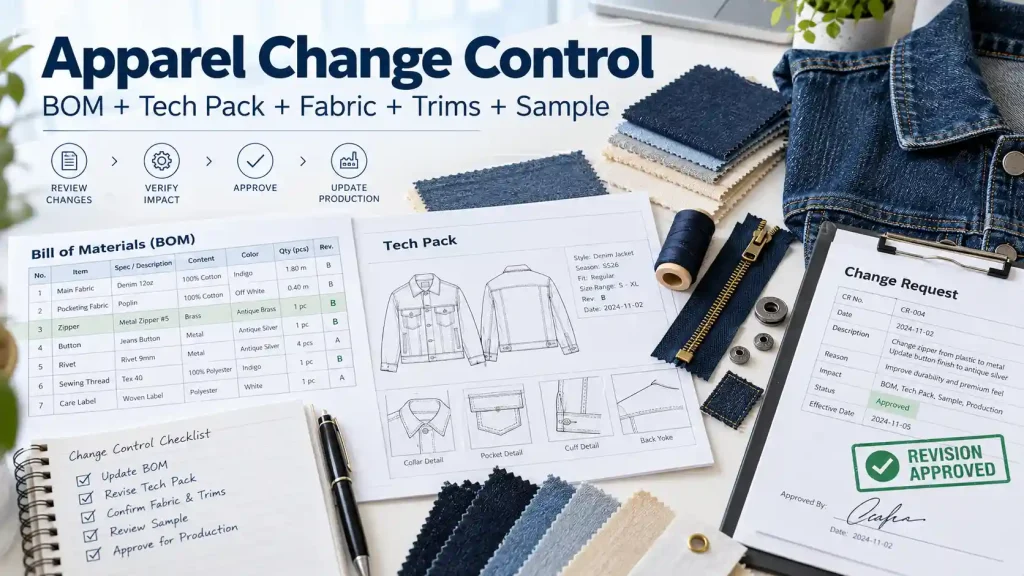
A proper change record should explain:
- What is changing?
- Why is it changing?
- What was the previous specification?
- What is the new specification?
- Which styles, colors, or sizes are affected?
- What risks could the change create?
- Is testing required?
- Is a new sample required?
- Who approved the change?
- When does the new revision become effective?
This information creates a traceable record and reduces confusion during production.
What Apparel Changes Usually Require Approval?
1. BOM Revisions
The Bill of Materials (BOM) identifies the materials and components required to manufacture a garment.
Common BOM changes include:
- Main fabric substitution
- New fabric supplier
- Lining replacement
- Zipper change
- Button or snap change
- Thread specification
- Elastic or rib change
- Interlining change
- Label revision
- Packaging material change
A BOM revision should show both the old and new specifications.
| Component | Previous | Proposed | Review |
|---|---|---|---|
| Main fabric | Article A123 | Article A127 | Material validation |
| Lining | Polyester | Recycled polyester | Compliance review |
| Zipper | ZP-102 | ZP-108 | Function review |
| Button | ABS | Recycled ABS | Appearance review |
This makes it easier for purchasing, production, and QC teams to understand exactly what changed.
2. Material Substitutions
Material changes can have a major effect on garment performance.
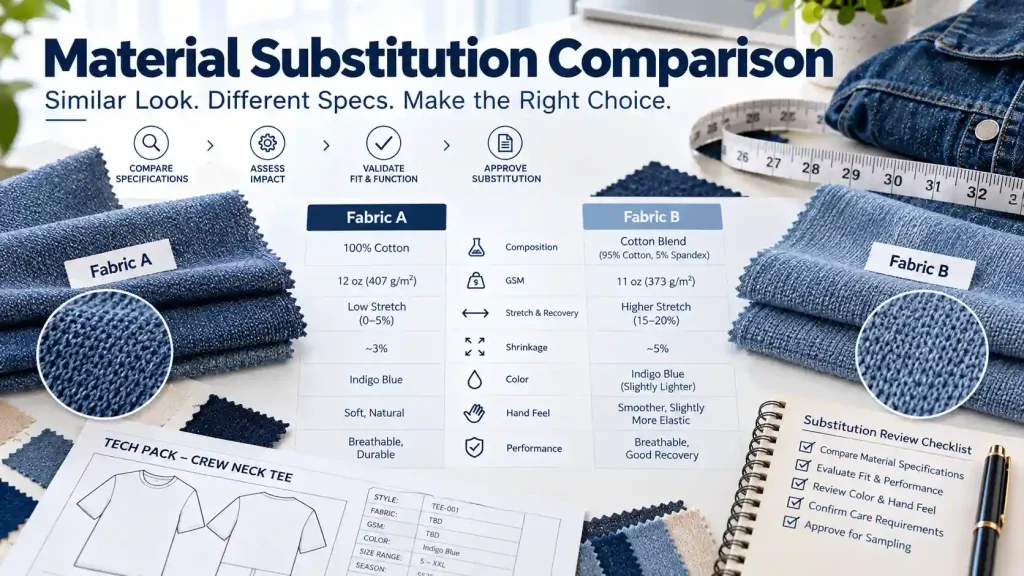
When reviewing a replacement fabric, compare it with the approved material for:
- Fiber composition
- GSM
- Fabric width
- Stretch and recovery
- Shrinkage
- Color
- Hand feel
- Fabric construction
- Finishing
- Pilling
- Colorfastness
- Product-specific performance
A fabric should not be approved simply because it looks similar.
For example, a replacement fabric with higher stretch may alter garment measurements and recovery. A fabric with different shrinkage may affect the final dimensions after washing.
Depending on the product, material validation may require laboratory testing, wash testing, fabric inspection, or garment-level testing.
For significant changes, the garment sample development process may also need to be repeated.
A material substitution should be treated as a technical change, not only a purchasing decision.
3. Construction Revisions
Construction changes affect how a garment is assembled.
Examples include:
- Seam type
- Stitch type
- Stitch density
- Seam allowance
- Pocket construction
- Collar construction
- Cuff construction
- Hem construction
- Reinforcement
- Bartack placement
- Fusing
- Topstitching
- Sewing sequence
A factory may suggest a different construction to improve efficiency or reduce sewing time.
However, the revised method should still be checked for:
- Appearance
- Strength
- Durability
- Fit
- Production consistency
- Machine requirements
- Washing and finishing performance
A construction method that works on one sample must also be practical for repeatable bulk production.
4. Pattern and Measurement Revisions
Pattern changes can directly affect garment fit.
Typical revisions include changes to:
- Chest
- Waist
- Hip
- Shoulder
- Body length
- Sleeve length
- Armhole
- Neck opening
- Rise
- Inseam
- Hem opening
- Pocket position
For important revisions, record actual measurements before and after the change.
| POM | Previous | Revised | Tolerance |
|---|---|---|---|
| Chest | 52 cm | 53 cm | ±1 cm |
| Body length | 70 cm | 69 cm | ±1 cm |
| Sleeve length | 62 cm | 61.5 cm | ±1 cm |
This gives the production and QC teams a measurable reference instead of relying on visual judgment.
A Practical Apparel Change Control Process
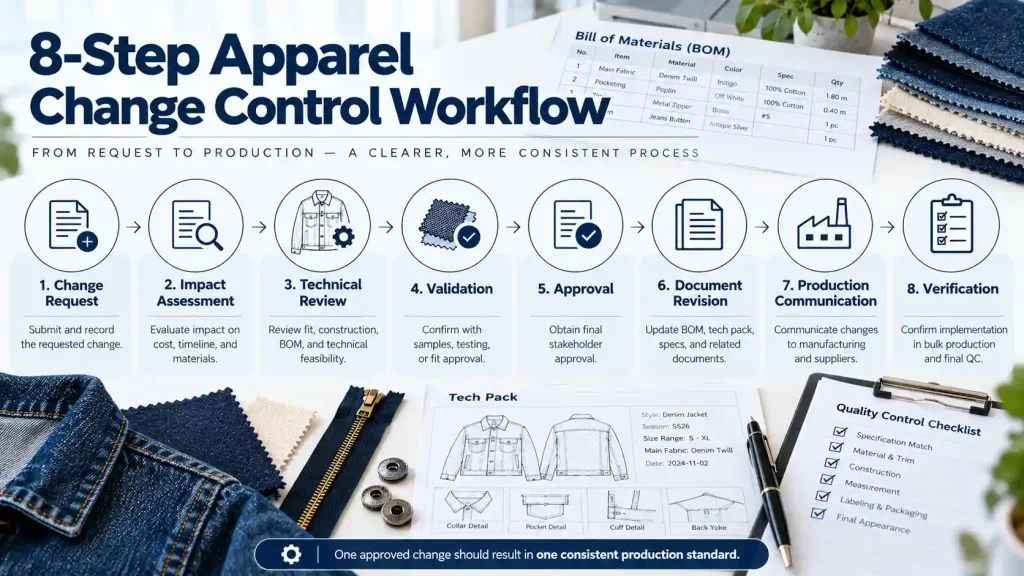
A simple change control workflow can follow eight stages:
Change Request → Impact Assessment → Technical Review → Validation → Approval → Document Revision → Production Communication → Verification
Step 1: Create a Change Request
Give every significant revision a unique reference number, such as CC-003.
The request should include:
- Style number
- Color
- Size range
- Current revision
- Proposed revision
- Reason for change
- Affected component
- Supplier
- Requested implementation date
- Person responsible
This creates a clear starting point for the review.
Step 2: Assess the Impact
Before approving a revision, consider how it could affect the garment.
| Area | Question |
|---|---|
| Quality | Will performance or appearance change? |
| Fit | Will measurements or balance change? |
| Cost | Will material or labor cost change? |
| Compliance | Are new tests or approvals needed? |
| Production | Will operations or machinery change? |
| Supply chain | Will lead time or availability change? |
Changes can then be categorized according to risk.
Low-Risk Changes
Examples include administrative corrections, minor carton information, or other changes with no effect on the garment itself.
Medium-Risk Changes
These may include secondary trim, artwork, or non-critical construction revisions.
High-Risk Changes
These may include:
- Main fabric substitution
- Fiber-content change
- Major pattern revision
- Wash-process change
- Safety-related component change
- Compliance-related information
Higher-risk changes generally require stronger evidence before bulk production.
Step 3: Compare the Original and New Specification
Do not evaluate a change only by saying that the new material or component is “equivalent.”
Compare the actual specifications.
For materials, review composition, GSM, width, stretch, shrinkage, color, and performance.
For construction, compare seam type, stitch density, reinforcement, appearance, and durability.
For BOM revisions, record the original article, replacement article, supplier, consumption, cost, and effective date.
This creates an audit trail that can be referenced later.
Step 4: Decide Whether Testing or Sampling Is Required
The next question is whether the change can affect the physical garment.
Depending on the risk, validation may include:
- Fabric inspection
- Material testing
- Color approval
- Shrinkage testing
- Colorfastness testing
- Stretch and recovery testing
- Wash testing
- Fit evaluation
- Construction sample
- Revised PP sample
A minor label correction may only require artwork approval.
A main-fabric substitution may require a new garment sample and additional testing.
The important principle is:
The greater the potential impact on the finished garment, the stronger the validation should be.
Step 5: Obtain Formal Approval
A change should not become a production requirement simply because it was mentioned during a meeting or in an email.
The approval record should identify:
- Change number
- Previous revision
- New revision
- Reason for change
- Validation completed
- Approval date
- Approver
- Effective production date
- Remaining conditions, if any
Depending on the project, approval may involve the buyer, product development, technical team, sourcing, QA, or compliance team.
Step 6: Update the Controlled Documents
After approval, update every document affected by the revision.
This may include:
- BOM
- Tech pack
- Pattern
- Measurement specification
- Construction specification
- Material specification
- Artwork
- Label specification
- Packaging specification
- Cost sheet
- QC specification
- Testing requirements
- Purchase order
The factory should not have to choose between old and new documents.
One approved change should result in one consistent production standard.
Step 7: Communicate the New Revision
The revised information should reach all relevant departments.
This may include:
- Purchasing
- Material warehouse
- Pattern department
- Cutting
- Sewing
- Finishing
- QC
- Packing
- External suppliers
Old documents should be withdrawn or clearly marked as obsolete.
This becomes particularly important when several factories or subcontractors are involved.
Step 8: Verify the First Production Output
Change control does not end when the approval document is signed.
For important revisions, inspect the first production output against the new specification.
Check:
- Correct material
- Pattern version
- Measurements
- Construction
- Artwork
- Labels
- Finishing
- Packaging
QC should always inspect against the current approved revision.
This final verification confirms that the approved change has actually reached production.
Change Control After PP Sample Approval
Changes before PP approval are normally part of product development.
After PP approval, however, changes require greater control because the PP sample represents the approved physical production reference.
For example, if the PP sample was made with Fabric A but bulk production is planned with Fabric B, the factory should not assume that the original PP approval automatically covers the replacement.
The change may require:
- Written approval
- Updated BOM
- Updated tech pack
- Material validation
- Revised sample
- Additional testing
- First-output inspection
The PP sample and bulk production process should therefore be connected to the change control system.
If the new material or construction changes the appearance, measurements, performance, or compliance status of the garment, the revision should be formally reviewed before bulk release.
Apparel Change Control Checklist
Before approving a significant revision, confirm:
- Change number assigned
- Original specification recorded
- New specification recorded
- Reason documented
- Material impact assessed
- Construction impact assessed
- Fit and measurement impact checked
- Testing requirements confirmed
- Sample requirement confirmed
- Cost impact reviewed
- Lead-time impact reviewed
- BOM updated
- Tech pack updated
- QC specification updated
- Buyer approval recorded
- Production team informed
- First production output verified
If important information remains unresolved, the revision should not be treated as fully released.
Frequently Asked Questions
What is apparel change control?
Apparel change control is the process of identifying, assessing, approving, documenting, and verifying changes to a garment’s BOM, materials, pattern, construction, measurements, artwork, labels, or packaging.
Does every material substitution require a new PP sample?
No. The requirement depends on the risk and potential effect of the change. Minor component changes may only require document approval, while significant fabric changes may require testing, fit review, or a revised PP sample.
Can a factory change fabric after PP approval?
A significant fabric substitution should be documented and approved before it becomes the new production standard. The replacement should be evaluated for fit, quality, performance, testing, cost, and delivery impact.
Who should approve apparel production changes?
The approval process depends on the organization and project. Buyers, product developers, technical teams, sourcing, QA, and compliance teams may all have responsibilities. High-risk revisions should receive the appropriate technical and buyer approval.
How can buyers prevent old and new revisions from being mixed?
Use revision numbers, effective dates, controlled documents, clear production communication, and first-output verification. QC should always receive the latest approved specification.
Can New Asia Garment support apparel change control?
New Asia Garment can discuss production-related revisions involving materials, trims, construction, measurements, samples, labels, packaging, and bulk manufacturing within the confirmed project scope. Buyers can provide the current apparel tech pack, BOM, approved sample information, and proposed revision for review.
Key Takeaways
Effective apparel change control is not about preventing every production change.
It is about making sure important revisions are:
- Clearly identified
- Technically evaluated
- Commercially reviewed
- Properly approved
- Added to controlled documents
- Communicated to production
- Verified during manufacturing
The core principle is simple:
One garment style should have one current and approved production standard.
If you are reviewing a BOM revision, material substitution, construction change, or PP sample before bulk production, contact New Asia Garment with the current BOM, tech pack, approved sample information, and proposed revision. This gives the production team the information needed to evaluate potential quality, cost, fit, and delivery risks before bulk manufacturing is released.
Read more
- Apparel Change Control: How to Approve BOM, Material and Construction Revisions
- Denim Quality Control: Testing Methods, Common Defects & Quality Standards
- How Denim Quality Control Reduces E-Commerce Returns
- How to Write Accurate Denim Product Specifications
- Pre-Shipment Denim Quality Inspection Checklist