
For global apparel brands, sourcing managers, and denim directors, few challenges in technical garment manufacturing are as frustrating—or as costly—as denim sizing variance. A sales sample that fits perfectly in a fitting room can easily transform into a customer service nightmare if bulk production runs half a size too small, sags at the waist, or suffers from inconsistent inseams.
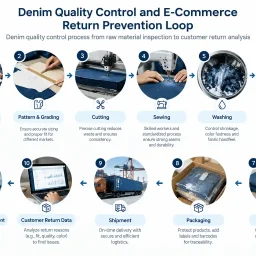
Because denim involves complex wet processing, heavy laundering, fabric tension, and fabric shrinkage, maintaining true-to-size consistency requires strict technical management at every stage of the supply chain. Here is how leading global manufacturers eliminate size drift between the approved pre-production sample and mass production.
1. Approved Sample & Measurement Method
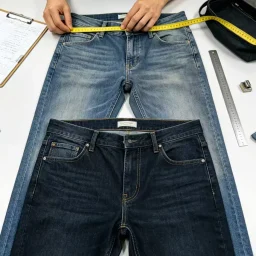
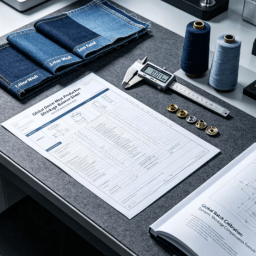
Sizing consistency begins with an absolute, unshakeable reference point: the approved Pre-Production (PP) sample and a standardized Point of Measure (POM) protocol.
- Locking the Golden Sample: The physical sample approved during fit sessions must serve as the technical benchmark. Both the buyer and the factory must hold sealed, identical “golden samples” to settle any physical size disputes during inline or post-wash audits.
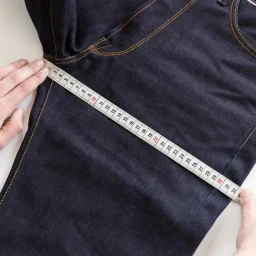
- Standardizing Measurement Techniques: Measurement drift frequently occurs because different operators measure garments differently. A standardized POM specification dictates whether garments are measured relaxed or stretched, where the tape is placed across contoured waistbands, and how curvature along the front and back rises is calculated.
- Calibrated Measuring Tools: Factories must enforce the use of standardized, non-stretch flexible steel rules or high-grade fiberglass tailor tapes across all sampling and quality departments to eliminate tool-based errors.
2. Fabric Relaxation / Shrinkage Allowance
Denim is a living material. Cotton yarns are subjected to high mechanical tension during spinning, weaving, and rolls winding. If raw fabric is unrolled and cut immediately, stored internal tension causes unpredictable fabric contraction during cutting and subsequent washing.
- Mandatory Fabric Relaxation: Before pattern cutting, bulk fabric rolls must be unrolled and allowed to relax flat on spreading tables for 24 to 48 hours. This allows internal yarn stress to dissipate naturally, stabilizing the fabric’s dimensional state.
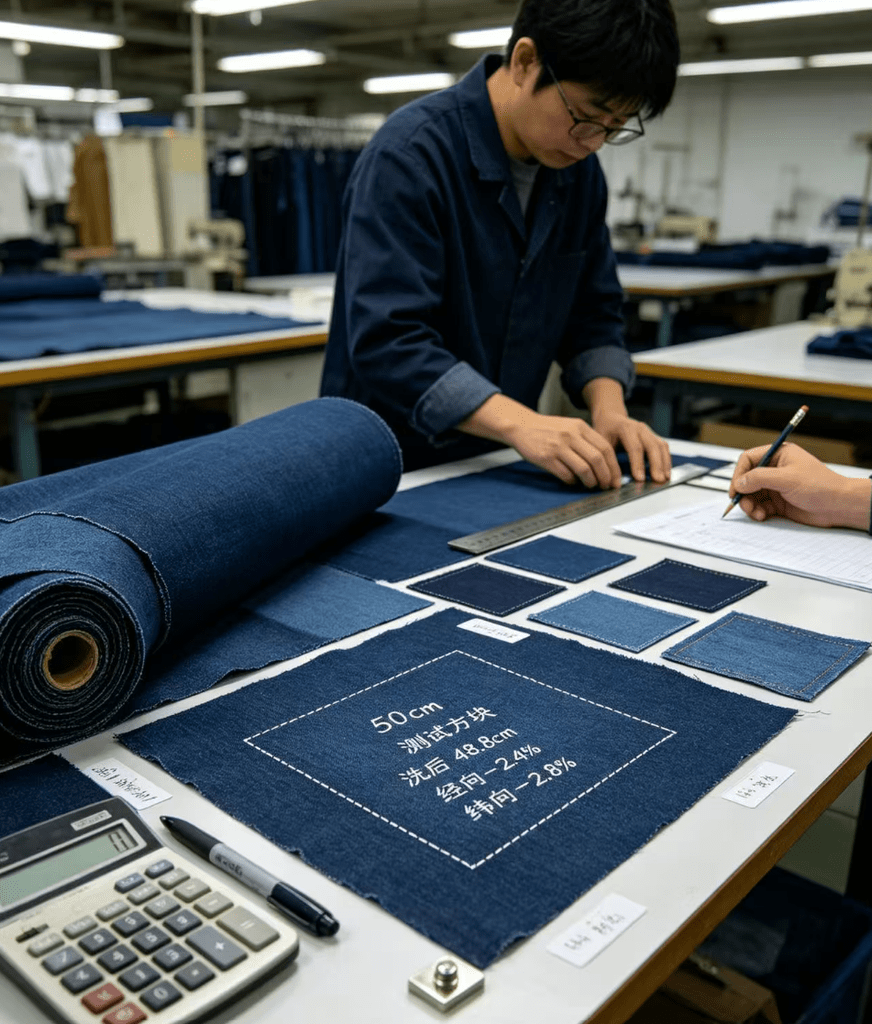
- Batch-Specific Wash Shrinkage Testing: Every mill dye lot or fabric shipment exhibits slight variations in warp and weft shrinkage rates. Factories must run standardized wash-test swatches for every individual fabric batch before cutting, calculating exact warp (length) and weft (width) dimensional changes.
- Pattern Shrinkage Grading: Rather than using a generic pattern for all denim rolls, pattern master files must be dynamically adjusted—adding or subtracting specific shrinkage allowances to the digital CAD markers based on the exact test results of each fabric lot.
3. Cutting and Sewing Tolerance Control
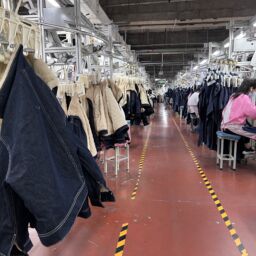
Precision in pattern design is useless if manual errors occur on the cutting and sewing floors. Controlling mechanical execution tolerances prevents compounding errors before garments ever enter the wash house.
- Automated CAD Nesting and Cutting: Utilizing computerized automatic cutting machines ensures every pattern piece—from front panels to pocket facings—is cut with millimeter precision, eliminating the edge distortion common in thick manual knife cutting.
- Ply Height Restrictions: Spreading too many fabric plies on a cutting table creates blade deflection, where top fabric layers are cut larger or smaller than bottom layers. Factories must limit ply stack heights based on denim fabric weight (GSM).
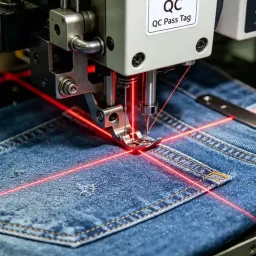
- Guarded Operator Tolerances: Sewing operations must adhere to strict construction tolerances (typically ±0.5 cm across critical seams). Utilizing specialized folder attachments for flat-felled inseams and automated waistband-attaching machines guarantees uniform seam allowances across every operator station.
4. Wash / Finishing Effect
Industrial denim washing—including stone washes, enzyme treatments, bleaching, ozone treatments, and high-heat drying—is the single greatest variable affecting final garment dimensions.
- Standardized Wash Recipes: Industrial laundry processes must follow strict, digitally monitored recipes. Water temperature, chemical liquor ratios, wash cycle durations, and load weights must remain 100% identical between sample development and bulk production runs.
- Controlled Drying and Curing Temperatures: Over-drying denim at excessive temperatures causes aggressive fiber contraction, while under-drying leaves garments expanded. Commercial tumble dryers must utilize precise moisture sensors and temperature locks to ensure uniform drying cycles.
- Laser and Hand-Scraping Uniformity: Manual distressing or hand-scraping causes localized fabric weakening and varying shrinkage responses. Standardizing scraping templates or utilizing automated industrial laser engraving ensures consistent surface agitation across all sizes.
5. Inline Measurement Audit
Waiting until garments are fully finished, washed, and packed to measure them is a critical quality control mistake. Inline measurement audits catch dimensional shifts while corrective action is still possible.
- Raw Green-State Audits: Measure cut panels and raw, unwashed assembled garments directly off the sewing line. Comparing green-state measurements against pre-established unwashed benchmarks ensures sewing operators are not stretching or cinching seams.
- Post-Wash Sample Pilot Runs: Before sending an entire bulk order through the laundry facility, factories run a small “pilot batch” (typically 20 to 50 units) through the complete wash cycle. Measuring this pilot run verifies whether the calculated pattern shrinkage allowances matched real-world laundry results.
- Real-Time Data Tracking: Inline inspectors record measurements using digital quality control software, triggering immediate line halts if dimensional metrics drift beyond specified limits.
6. Final Inspection and Batch Consistency
The final defense against sizing discrepancies is a systematic, statistically sound inspection protocol before goods leave the factory floor.
- AQL 2.5 Dimensional Inspection: Final Random Inspections (FRI) must evaluate garment measurements against the master POM specification using standard Acceptable Quality Limit (AQL 2.5) protocols across all size ratios.
- Size-Ratio Balance Checks: Inspectors must sample evenly across the entire size run (e.g., XS through XXL) rather than auditing only middle sizes, ensuring pattern grading rules held true across extreme ends of the spectrum.
- Shade and Shrinkage Grouping: When minor dimensional variations occur due to raw material lot differences, professional factories sort, pack, and label final shipments into matched shade and size lots, ensuring individual retail deliveries maintain absolute consistency.
7. Activewear Cross-Category Case: Same-Style/Same-Size Variation
Sizing variance is not unique to denim. In performance activewear and hybrid athleisure apparel, brands frequently face the “same-style/same-size” defect, where two identical leggings or sports bras in the same labeled size fit completely differently.
- Fabric Blend Elasticity Shifts: In high-elastane activewear, minor shifts in synthetic yarn tension during knitting cause massive differences in stretch recovery and compression force, causing garments cut from the same pattern to feel tighter or looser.
- Thermal Bonding and Heat Transfer Curing: Activewear frequently uses seamless thermal bonding, bonded waistbands, or heat-transfer logos. Excessive heat during bonding cures synthetic fibers into a permanently contracted state, shrinking specific zones of the garment.
- Cross-Category Engineering Solutions: Just as with denim, mitigating activewear sizing drift requires batch-specific tension testing, pre-shrunk elastane conditioning, and calibrated bonding temperatures.
Partnering with technical manufacturing leaders like New Asia Garment gives apparel brands direct access to precision pattern grading, batch-tested shrinkage controls, and rigorous inline auditing protocols. Standardizing technical quality controls from raw material relaxation to final packing guarantees your customer receives the exact same flawless fit across every order, style, and season.