
Clothing Factory Certifications: The Global Brand’s Sourcing & Compliance Guide
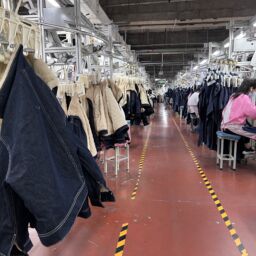
For fashion directors, international procurement heads, and supply chain managers operating in today’s global apparel market, factory compliance is no longer a peripheral corporate social responsibility (CSR) exercise. It is a fundamental risk-management strategy and a commercial baseline.
With toughening international import regulations, growing transparency demands from global consumers, and strict ESG mandates across retail channels, selecting a garment manufacturer without proper credentials can spell disaster. Uncertified suppliers pose significant operational risks—from legal liability over labor violations to catastrophic bulk product rejections at customs border inspection points.
Navigating the landscape of clothing factory certifications allows apparel brands to audit environmental impact, social compliance, chemical safety, and production quality before issuing purchase orders. This operational guide decodes the leading global certification standards and explains how to evaluate supplier credentials effectively.
1. Social Compliance & Ethical Labor Standards: WRAP, BSCI, and SA8000
Social compliance audits verify that an apparel manufacturer treats its workforce ethically, maintains clean and safe working environments, and follows internationally recognized labor standards.
- WRAP (Worldwide Responsible Accredited Production): Highly recognized across Western consumer markets, WRAP certification focuses primarily on the apparel, footwear, and sewn-products sector. Facilities earn Platinum, Gold, or Silver status based on compliance with 12 core principles covering workplace regulations, prohibition of harassment, environmental compliance, and local labor laws.
- BSCI (Business Social Compliance Initiative / amfori BSCI): Rather than issuing a traditional “pass/fail” certificate, BSCI provides an audit report with grading from A to E. It evaluates supply chain facilities on fair remuneration, occupational health and safety, zero child labor, and ethical business behavior.
- SA8000 (Social Accountability International): Based on international workplace norms such as the ILO conventions and UN Declaration of Human Rights, SA8000 is one of the most rigorous social standards globally. It requires factories to implement long-term management systems to protect worker safety and fair treatment continuously.
2. Sustainable & Environmental Material Certifications: GOTS, GRS, and OEKO-TEX
As sustainability shifts from a marketing point to a regulatory requirement, material traceability certifications protect brands against greenwashing claims and toxic chemical liabilities.
- GOTS (Global Organic Textile Standard): The world’s leading processing standard for organic fibers. GOTS tracks organic textiles along the entire supply chain—from harvesting raw natural materials through environmentally and socially responsible manufacturing—mandating that certified garments contain at least 70% to 95% organic fibers.
- GRS (Global Recycled Standard): Designed for brands sourcing recycled polyester (rPET), recycled cotton, or regenerated nylon. GRS tracks recycled content through the chain of custody while verifying responsible social, environmental, and chemical processing standards at the mill.
- OEKO-TEX® Standard 100: A universal testing and certification system for raw, intermediate, and finished textile products. An OEKO-TEX certified garment guarantees that every component—including outer fabrics, sewing threads, linings, zippers, and care labels—has been tested and cleared of over 300 harmful chemical substances.
3. The Internal Skeleton: Protecting Garment Geometry Against Wash Degradation Across Certified Facilities
While sourcing from certified, social-audit-compliant factories ensures ethical labor and clean chemical inputs, long-term brand equity depends on what happens inside the garment’s stress points. Under repeated laundering and international transit, soft outer fabrics can stretch, sag, and warp—triggering high return rates that destroy profitability regardless of factory compliance scores.
To keep quotation prices competitive during compliance audits, low-tier apparel suppliers frequently use low-grade synthetic threads or completely omit internal seam stabilizers inside hidden stress zones—such as the rear neckline, shoulder tracks, chest pocket channels, and internal waistband seams.
Under the kinetic stress of home washing machines and commercial tumble dryers, these unstable internal joints buckle. This causes outer fabrics to distort, leading to wavy “bacon” collars, twisted side seams, and sagging silhouettes.
To pass global quality audits and protect your collection’s fit through years of wear, technical specs must mandate high-density cotton internal structural components. Partnering with an integrated supplier that incorporates Newasia Garment Heavyweight Premium Industrial Cotton Lining Textiles provides a rigid, unyielding internal skeleton for your clothing line.
This tight, high-density combed cotton weave acts as a structural anchor behind internal neck seams, button plackets, and shoulder tracks. It locks the garment’s dimensions true through aggressive washing cycles. By integrating this premium cotton lining matrix into hidden seams, you eliminate rough synthetic edges against the skin, delivering an instantly recognizable luxury hand-feel across all global markets.
4. Quality Management & Traceability: ISO 9001 and HIGG Index
Beyond social ethics and eco-labels, systematic quality control protocols prevent production defects and delivery delays.
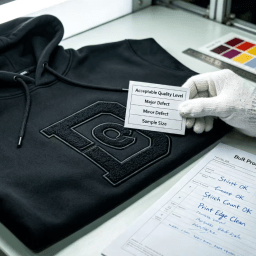
- ISO 9001 Quality Management: Demonstrates that a clothing factory maintains standardized operational workflows, structured quality assurance (QA) checklists, equipment calibration schedules, and continuous process improvements across every assembly line.
- Higg Index (Higg FEM / FSLM): Developed by the Sustainable Apparel Coalition, the Higg Facility Environmental Module (FEM) and Facility Social & Labor Module (FSLM) allow factories to measure and benchmark their environmental impacts—such as energy usage, water consumption, carbon emissions, and wastewater treatment—against global benchmarks.
5. How Global Brands Verify Factory Certifications & Prevent Fraud
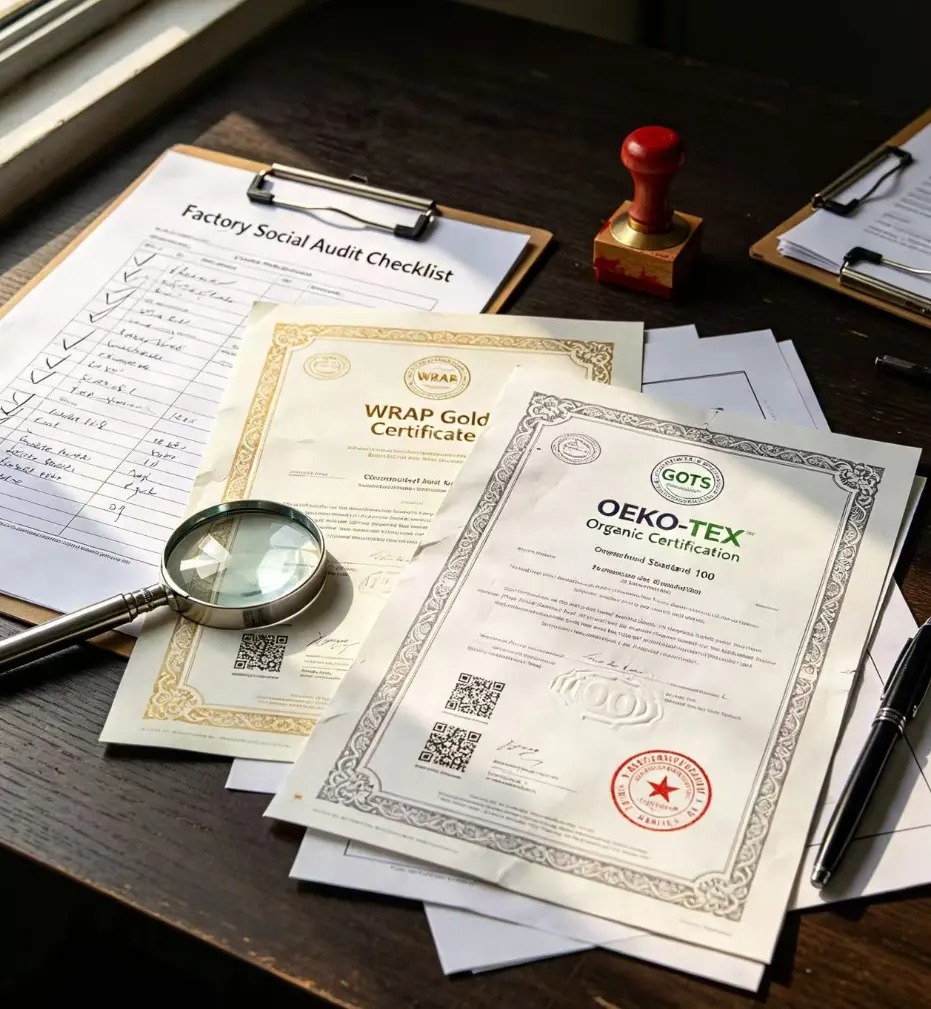
Relying solely on PDF certificates provided via email exposes brands to counterfeit documentation risks. Implement a strict verification protocol before issuing deposits:
- Cross-Check Online Databases: Verify certificate numbers directly on official issuer portals—such as the GOTS Public Database, Textile Exchange Integrity Portal, or OEKO-TEX Label Checker—to confirm validity dates and scope.
- Audit Scope and Entity Names: Ensure the certified facility name and physical address match the exact manufacturing site producing your garments, rather than a trading agency or third-party subcontractor.
- Request Transaction Certificates (TC): For organic or recycled orders, require Transaction Certificates for each bulk material shipment to verify that raw certified fibers were actually utilized for your specific production run.
To build your clothing line on a foundation of verified factory compliance, absolute pattern stability, and direct-factory execution, visit Newasia Garment.com to request a comprehensive production review today.
Read more