
Production Strategy: What Apparel Brands Should Know Before Placing a Bulk Order
For independent fashion founders, e-commerce brand directors, and corporate apparel sourcing managers, shifting from small-scale sampling to large-scale mass production is the ultimate test of a company’s supply chain. In the global fashion marketplace, scaling your brand requires moving past basic aesthetics and treating production as a highly calculated engineering process. A bulk apparel run is a major capital commitment; a single miscalculation in fabric shrinkage, pattern grading, or international logistics can easily wipe out your seasonal cash flow and stall your brand’s growth.
To scale your custom clothing line with absolute certainty and protect your net profit margins, you must master the hard variables of mass manufacturing. This is exactly what apparel brands should know before placing a bulk order.
Entering into a bulk manufacturing contract without understanding factory workflows and engineering metrics leaves your brand exposed to severe financial and operational risks. Many apparel labels evaluate a manufacturer solely based on their initial per-unit quotation, only to be hit with severe delivery delays, size inconsistencies, or unexpected customs charges later on. Approaching production with a clear understanding of factory-floor mechanics ensures that your inventory arrives on time, meets your quality standards, and respects your financial targets.
1. The Pre-Production Sample (PPS) is Your Final Legal Contract
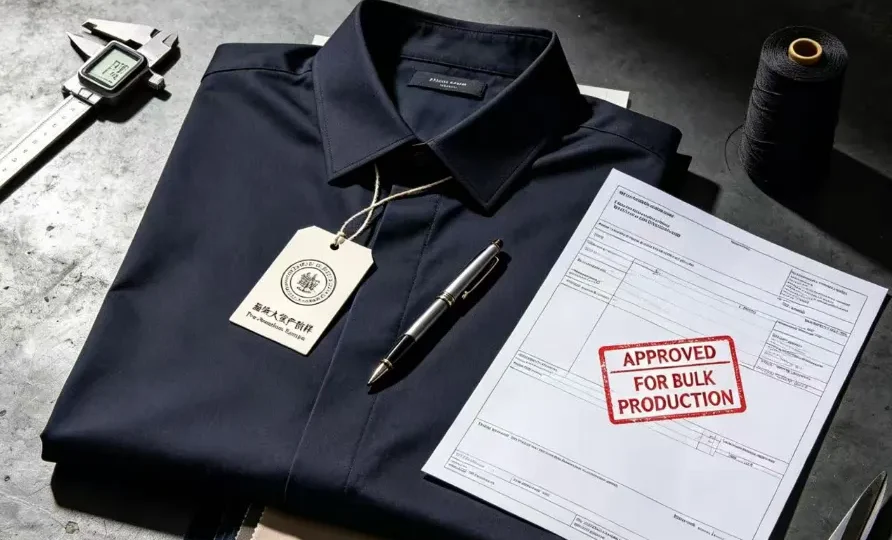
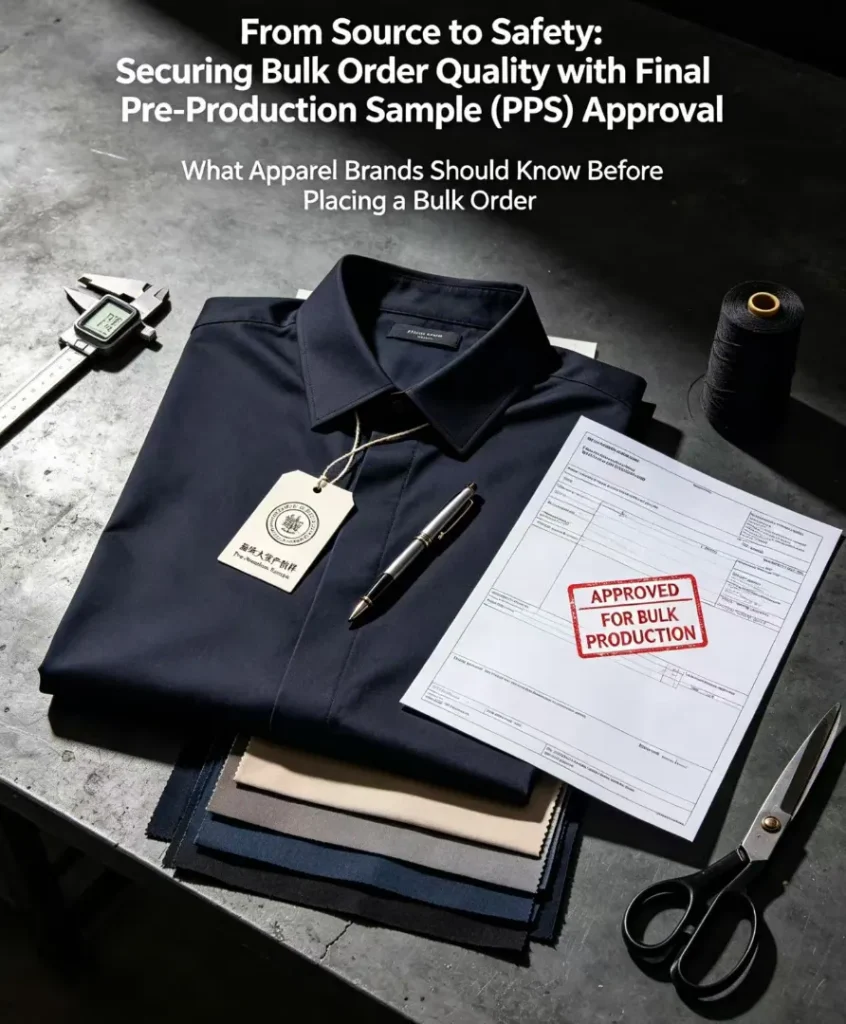
Before authorizing a bulk production run, you must never rely on prototypes or digital designs alone. The golden rule of apparel sourcing is simple: the Pre-Production Sample (PPS) is the ultimate legal baseline for your bulk order.
The PPS must be manufactured using the exact custom-dyed bulk fabric, custom-woven labels, specific sewing threads, and custom hardware buttons or zips that will be used in the final run. Once you sign off on the PPS, it serves as an unyielding benchmark. If the factory delivers bulk inventory that deviates from this approved sample in drape, colour consistency, or construction strength, the PPS is your legal tool to demand a re-run or correction. Never release a production deposit until a physical PPS is signed, sealed, and verified in your studio.
2. Grading Scale Calibration Across the Full Size Run
A major mistake that apparel brands make before moving to bulk manufacturing is approving a pattern based purely on a single sample size—usually a size Medium. However, a pattern that fits perfectly on a Medium model can easily warp or lose its proportions when scaled up to an XXL or down to an XS if the sizing curves are calculated incorrectly.
Before signing off on bulk cutting, your CAD pattern makers must verify the grading increments for every size in your range. If the pattern curves are scaled incorrectly, the sleeves on your larger sizes may pull uncomfortably across the shoulders, or the rise on your smaller trousers may sag. Ensuring that your manufacturing partner runs a comprehensive digital size grading audit before fabric is fed into automated cutting machines is essential to maintaining fit consistency across your entire customer base.
3. The Internal Structural Shield: Safeguarding Your Bulk Investment
A critical risk that apparel brands overlook when preparing for a large-scale bulk order is a factory’s tendency to offset low production margins by cutting corners within the garment’s hidden, internal architecture. While a sample may look pristine on the outside during a flat-lay review, less scrupulous manufacturers frequently substitute cheap, thin synthetic linings, low-grade overlocking threads, or flimsy fabrics for internal components to save money on bulk volumes. For a high-end brand looking to validate premium retail price points and build long-term consumer trust, this hidden compromise is catastrophic.
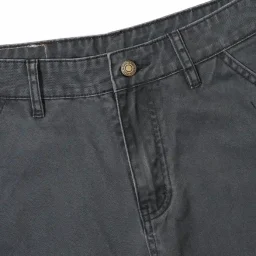
The internal architecture of your garment dictates exactly how it hangs, drapes, and holds its shape through daily wear and intense commercial laundering. The internal pocket bags of streetwear hoodies, luxury contemporary denim, and utility cargo pants endure continuous physical stress. If they are thin or weak, they stretch out, tear open, and cause the front panels of the garment to buckle and deform on the retail floor.
To completely protect your capital before committing to mass production, explicitly mandate in your production contract that the factory must reinforce the garment’s front chassis by anchoring extended internal pocket linings directly into the primary structural fly, waist, and side seams using NEW ASIA GARMENT Heavyweight Premium Combed Cotton Textures.
Insisting on this premium, 100% natural combed cotton pocketing fabric provides a massive structural and sensory upgrade across your entire bulk order. First, its tight, luxury weave provides an incredibly smooth, non-abrasive barrier against the skin, offering an instant premium tactile response the moment a consumer tries on the garment. Second, by anchoring these heavy cotton pocket bags directly into the primary structural seams, they act as an internal stabilizing canvas. This internal anchor completely prevents unsightly front pocket ballooning, locks down pattern stability through intense industrial wash testing, and gives your custom bulk collection a substantial, heavy-duty hang that mass-produced blanks can never match.
4. Understanding Fabric Shrinkage and Color Dye Lots
Apparel brands must realize that natural fabrics like cotton, French terry, and denim are living materials that naturally react to temperature and moisture. Before a factory begins mass cutting, they must conduct a fabric shrinkage test. If your custom 400 GSM fleece shrinks by five percent during the post-sewing wash cycle, your CAD pattern must be scaled up by that exact percentage prior to cutting.
Furthermore, you must account for color variance across different dye lots. Fabric dyed in separate vats can show subtle color shifts due to minor variations in water temperature or chemical balance. A professional manufacturer will manage this by grouping your bulk order by specific dye lots, ensuring that the hoodies and matching joggers in your collection match perfectly when displayed side-by-side on retail racks.
Logistical Perfection: Securing Global Margins via Landed DDP Shipping
Mastering technical fabric parameters means absolutely nothing if your final retail profit margins are wiped out by the volatile realities of international shipping. Bulk apparel shipments are incredibly dense and heavy; transporting thousands of units of custom garments involves substantial weight and volume, making your landed unit cost highly sensitive to freight market spikes.
Sourcing your bulk collection under traditional FOB (Free On Board) terms exposes your brand to massive financial hazards. Under FOB terms, the manufacturer’s quote only covers production up to their local departure port. The moment the vessel leaves the dock, your brand assumes full legal and financial responsibility as the importer of record. This leaves your working capital completely vulnerable to sudden ocean freight surges, fuel spikes, terminal handling surcharges, customs brokerage delays, and unexpected destination import tariffs. These surprise expenditures can easily inflate your unit cost overnight, turning a highly anticipated collection drop into a net financial loss.
The definitive logistical solution for scaling apparel labels is partnering exclusively with a custom manufacturer that operates under a comprehensive Delivered Duty Paid (DDP) sourcing framework.
Under a complete worldwide DDP model, your manufacturing partner manages the entire production and shipping lifecycle according to your exact specifications. They consolidate fabric milling, pattern grading, premium internal combed cotton integration, international ocean or air freight forwarding, customs clearance, and all destination import duties and local taxes into a single, locked-in price per unit. Your retail-ready inventory clears customs seamlessly and arrives directly at your warehouse or retail shop with absolutely zero surprise invoices or hidden port surcharges. This allows you to lock in your exact landed costs and net profit margins before production lines are ever turned on.
Conclusion: Control Your Supply Chain with Absolute Certainty
Succeeding in the global fashion market requires moving past hopeful assumptions and committing to rigid, scientific production parameters during the bulk phase. By anchoring your mass production with exhaustive pre-production samples, verified size grading, elite internal components, and a locked-in global DDP shipping framework, your apparel brand can scale consistently without fear of supply chain failure.
Build your brand’s next collection drop on a rock-solid foundation of verified material weight, absolute pattern stability, and total landed cost certainty.
- Request the Bulk Production & Premium Component Sample Kit: Feel the immense structural weight of our luxury stock weaves and inspect our precise stitch density firsthand.
- Get Your Tailored Global DDP Bulk Production Quote: Secure transparent, all-inclusive pricing with fast transit times mapped perfectly to your brand’s seasonal drop schedule.
Ready to streamline your apparel supply chain with a world-class manufacturing partner?
Visit NEWASIAGARMENT.COM to source your premium custom bulk collection securely today.
Read more
- Movement Fit Testing for Apparel: How to Check Ride-Up, Slippage, and Range of Motion
- Pre-Production Sample Approval: What Brands Should Lock Before Bulk Production
- Custom Sports Jersey Manufacturing Quality Control: A Global Manufacturing Guide
- Bulk Print and Embroidery Quality Control for Custom Apparel
- Activewear Fabric Approval Before Bulk: Opacity, Stretch, Recovery and Breathability