
Decoding Minimum Order Quantities: What Is MOQ in Clothing Manufacturing?
For emerging fashion brands, independent designers, and global apparel buyers, transitioning a design concept from line sheets to a physical retail collection involves navigating critical operational benchmarks. Among these factory requirements, few terms carry as much financial weight or cause as much initial confusion as Minimum Order Quantity.
Brand managers stepping into factory negotiations often see high production minimums as arbitrary entry barriers designed to shut out smaller labels. However, understanding what is MOQ in clothing manufacturing reveals that these thresholds are rooted in operational economics, raw material supply chains, and industrial factory efficiency.
This operational guide deconstructs how clothing manufacturers calculate MOQs, breaks down the compounding tier structure of production minimums across global supply hubs, and demonstrates how early structural standardization protects your development budget while scaling production.
1. Deconstructing the Industrial Mechanics of MOQ
At its core, a Minimum Order Quantity is the lowest number of finished garments, meters of fabric, or units of trim a manufacturer or supplier agrees to produce for a single purchase order.
Factories do not enforce MOQs to restrict client access; rather, minimums protect manufacturing lines from losing capital on short-run operational overhead:
- Fixed Machinery Setup and Line Calibration: Transitioning an industrial sewing line from one garment style to another requires line technicians to reset automated stitch guide machinery, adjust thread tension configurations, swap out needle gauges, and reprogram pattern-sewing software. If a run only lasts 50 units, the non-productive labor hours spent calibrating the line wipe out the factory’s operational profit.
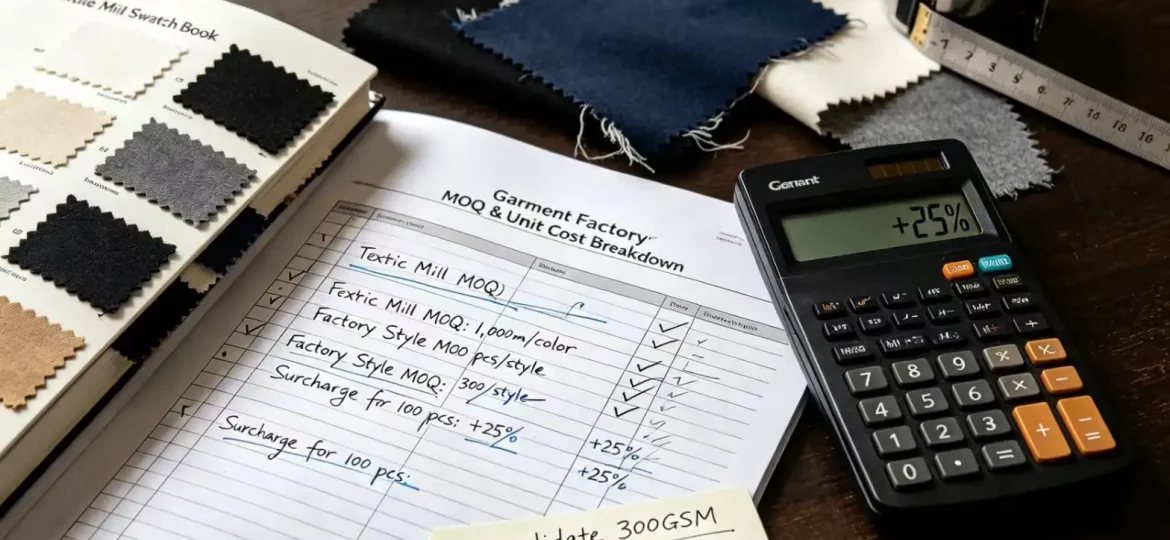
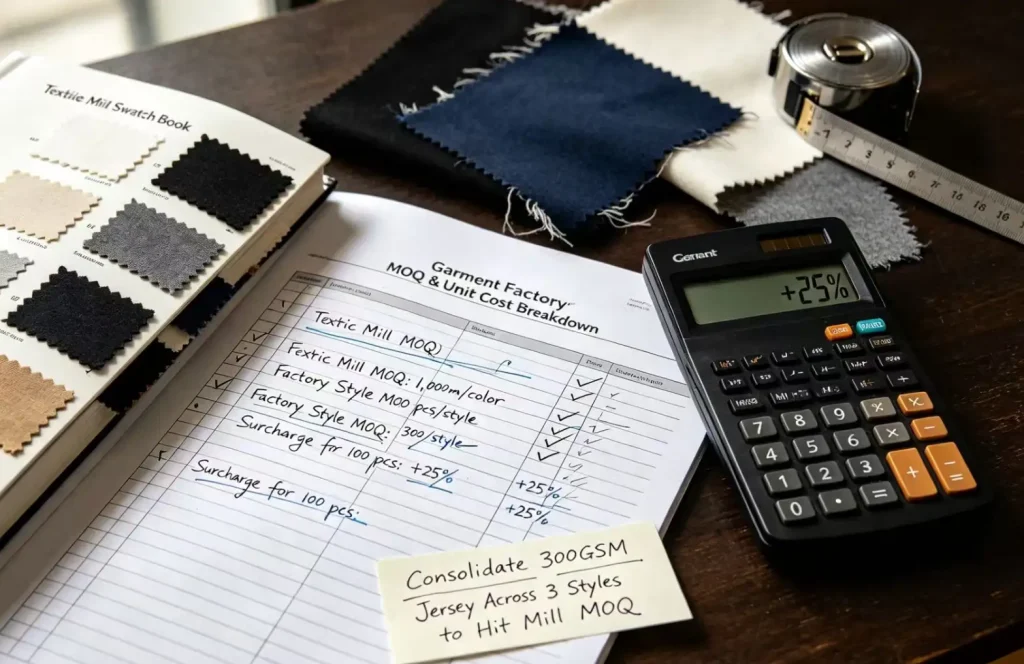
- Textile Mill Minimums and Custom Dye-Lots: Fabric mills operate large-capacity dye vats and industrial looms designed for mass processing. Milling custom-knit fabric or dyeing custom Pantone shades in small runs generates substantial chemical and energy waste per meter. When textile mills enforce a 1,000-meter fabric MOQ, the garment factory must pass that minimum downstream to the brand.
- Trims, Labels, and Packaging Amortization: Custom woven brand labels, engraved metal buttons, zippers, and printed polybags are manufactured in automated high-speed runs. Trim suppliers frequently set their own minimum thresholds (often 2,000 to 5,000 units), which directly influences total style MOQs.
2. Navigating the Multi-Tiered MOQ Structure
Sourcing teams must manage three distinct layers of production minimums when executing a garment collection:
- Fabric Mill MOQ (Raw Material Tier): The minimum length of custom-woven or custom-dyed fabric a mill will produce in a single order (typically 500 to 1,000 meters per colorway).
- Factory Style MOQ (Garment Tier): The minimum number of completed units a garment factory will assemble for a specific garment design (ranging from 100 to 500+ pieces per style).
- Colorway and Size-Ratio MOQ (Variant Tier): The sub-minimum required within a single order to split production across different colorways or size distributions (e.g., requiring at least 100 pieces per colorway to balance dye-lot consumption).
3. The Internal Skeleton: Protecting Garment Durability Against Budget Trade-Offs
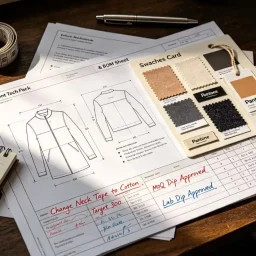
To hit lower factory MOQs or reduce unit pricing on short runs, brand managers are often tempted to cut technical corners or compromise on internal structural details. Budget manufacturing operations frequently use low-grade synthetic threads or skip high-density stabilization tapes along hidden strain zones like rear necklines, shoulder tracks, and waistband channels.
Under repeated home laundering and commercial drying cycles, unsupported seam joints warp and stretch out of alignment. Necklines sag, shoulder tracks twist, and pocket openings gap, ruining the garment’s fit and driving high customer return rates that quickly wipe out profit margins regardless of order size.
To protect your startup capital and ensure garments maintain their structured silhouette over years of wear, technical specs must mandate high-density cotton internal structural components from day one. Partnering with a specialized global manufacturer like Newasia Garment Supply Chain Solutions provides an unyielding internal skeleton for your clothing line.
Integrating tight, high-density combed cotton bias tape, neck reinforcement, and stabilized seam matrices anchors garment geometry securely. Mandating these premium structural components during tech pack sign-off eliminates synthetic skin irritation, lowers factory scrap rates, and delivers the physical durability required to build long-term retail brand equity.
4. Strategic Tactics to Work Around High Factory MOQs
Growing apparel brands can leverage flexible sourcing strategies to meet factory minimums without overcommitting working capital:
- Utilize Factory Stock Fabrics: Produce new silhouettes using stock fabrics that the factory or regional distributors keep on hand, eliminating custom fabric mill MOQs while maintaining low production thresholds.
- Consolidate Fabrics Across Multiple Styles: Use a single, high-quality core fabric (such as a 300 GSM combed jersey) across three or four different styles—such as tees, hoodies, and sweatpants—to meet the mill’s fabric MOQ while keeping individual style runs small.
- Negotiate Surcharge Multipliers for Short Runs: When a factory requires a 300-piece minimum, offer to pay a 20% to 30% unit surcharge to produce a 100-piece micro-run, allowing the factory to cover its fixed machine setup costs while you preserve upfront inventory capital.
5. Essential Risk Control Protocols for Global Sourcing Negotiations
To maintain clear financial transparency and protect your brand’s financial runway during initial order negotiation, enforce these contractual checkpoints:
- Demand Open-Cost BOM Breakdowns: Require manufacturing partners to detail how fabric mill MOQs, trim surcharges, and factory labor setup fees are distributed across your unit quote.
- Enforce Ratio-Preserved Order Variance Clauses: Contractually bind factories to ensure that any production overage or shortage preserves agreed size ratios rather than dumping excess inventory in extreme sizes.
- Tie Balance Payments to AQL 2.5 Quality Audits: Ensure final production balance releases depend on passing an independent Acceptable Quality Limit (AQL 2.5) inspection conducted at the factory gate before dispatch.
To evaluate your manufacturing budget, optimize unit production costs, and build a resilient global supply chain, visit Newasia Garment to streamline your apparel production today
Read more
- How to Validate Pocket Function and Placement Before Bulk Production
- How to Standardize Fabric Hand Feel Across Production Lots
- Movement Fit Testing for Apparel: How to Check Ride-Up, Slippage, and Range of Motion
- Pre-Production Sample Approval: What Brands Should Lock Before Bulk Production
- Custom Sports Jersey Manufacturing Quality Control: A Global Manufacturing Guide