

In apparel manufacturing, approving a perfectly fitting Medium sample does not guarantee that every size in a collection will fit correctly. An Extra Small garment may feel too tight around the shoulders, while an Extra Large version may develop oversized armholes, distorted proportions, or uncomfortable excess fabric.
These problems often result from inaccurate pattern grading, the process of adjusting a base pattern to create a complete size range. When grading errors go unnoticed before bulk production, they can lead to costly alterations, production delays, garment rejections, and higher customer return rates.
Size set approval is a critical quality control step that helps apparel brands identify fit inconsistencies before bulk cutting begins. By evaluating garments across the full size range, manufacturers and quality control teams can verify measurement accuracy, grading increments, garment balance, and fabric performance before authorizing mass production.
This guide explains what size set approval involves, which grading problems to look for, and how to establish a reliable size set approval process for apparel manufacturing.
What Is Size Set Approval in Apparel Manufacturing?
Size set approval is a pre-production quality control process in which garments are produced and evaluated across multiple sizes to confirm that the approved design, measurements, fit, and construction remain consistent throughout the size range.
A typical size set may include sizes from XS to 3XL, depending on the brand’s size chart and product specifications. The garments should use the intended production fabric, trims, stitching methods, and relevant manufacturing processes so that the evaluation reflects actual production conditions.
The primary objective is to confirm that the graded patterns translate into wearable garments that meet the brand’s technical specifications across all required sizes.
Size Set Samples vs. Pre-Production Samples
A pre-production (PP) sample is generally used to confirm the design, materials, construction details, and overall fit before bulk manufacturing. It is often developed in a designated base size, such as Medium or Large.
A size set sample serves a different purpose. It evaluates whether the pattern grading rules work correctly across the complete size range.
For example, a Medium T-shirt may meet every measurement requirement, but the XS version could have insufficient shoulder width, while the 2XL version could have an excessively deep armhole.
Approving the PP sample alone would not necessarily reveal these problems.
The two processes complement each other: PP sample approval confirms the intended product, while size set approval verifies that the approved design can be reproduced consistently in different sizes.
Why Size Set Approval Matters Before Bulk Production
Size set approval helps identify technical problems before they affect hundreds or thousands of garments. It also gives apparel brands a structured opportunity to correct patterns and update specifications before production materials are cut in bulk.
Key benefits include:
- More consistent fit: Confirms that garments fit appropriately across the approved size range.
- Fewer production defects: Identifies grading and measurement errors before they spread across a production order.
- Lower correction costs: Allows pattern adjustments before bulk cutting, reducing material waste and rework.
- Better customer satisfaction: Helps minimize fit-related complaints and product returns.
- More reliable production planning: Reduces the risk of shipment delays caused by late-stage quality failures.
For international apparel sourcing, these benefits are especially important because pattern development, sample approval, fabric procurement, and bulk manufacturing may involve different teams or locations.
A documented size set approval process creates a clear technical checkpoint before production moves forward.
Common Pattern Grading Problems Found During Size Set Evaluation
Pattern grading involves more than adding a fixed amount to every measurement. Body proportions, garment construction, fabric behavior, and design details must all be considered when creating a size range.
The following problems are particularly important to identify during a size set review.
Chest, Shoulder, and Armscye Distortion
The armscye is the opening in a garment where the sleeve attaches to the bodice. Incorrect grading around the armhole, chest, or shoulder can significantly affect garment comfort and mobility.
If the armhole becomes too deep in larger sizes, raising the wearer’s arms may cause the entire garment body to lift. This is commonly described as garment jacking.
If the armhole is too tight or shallow, the garment may restrict movement and create uncomfortable tension around the underarm.
Shoulder width and sleeve-cap proportions also require careful evaluation. Increasing chest width without making appropriate adjustments to the shoulder and sleeve geometry can produce an unbalanced silhouette.
During size set approval, inspect the following:
- Chest and body width across all sizes.
- Shoulder width and shoulder slope.
- Armhole depth and circumference.
- Sleeve length and sleeve-cap balance.
- Garment movement when the wearer raises and extends their arms.
The objective is not simply to achieve larger measurements in larger sizes. It is to preserve the intended fit and functional proportions of the design.
Neckline and Collar Fit Issues
Neckline grading can create noticeable fit problems at both ends of a size range.
An excessively wide neckline may cause collar gaping, shoulder exposure, or an untidy appearance in larger sizes. Conversely, insufficient neckline grading can make smaller garments uncomfortable around the neck.
Collar dimensions, neckline circumference, shoulder placement, and seam construction should be reviewed together rather than treated as isolated measurements.
For garments with ribbed neckbands, collars, or structured necklines, the relationship between the neckline opening and the attached component is especially important.
Inspect each size for neckline symmetry, collar lay, unwanted gaps, and comfortable movement.
Pocket, Trim, and Graphic Proportion Problems
Design details that look balanced on a Medium garment may appear disproportionate in XS or 2XL.
A pocket may look oversized on a smaller shirt but too small on a larger jacket. Embroidery or printed graphics may sit too close to the armhole, appear off-center, or wrap awkwardly around the body.
During size set evaluation, review:
- Pocket dimensions and placement.
- Button, zipper, and trim positioning.
- Logo and graphic alignment.
- Embroidery size and distance from seams.
- Decorative panel proportions across sizes.
Not every design element should increase at the same rate as the garment. Some details may need to remain fixed in size, while others require controlled scaling or size-specific placement.
The appropriate approach depends on the design intent and the brand’s approved technical specifications.
How to Conduct a Professional Size Set Evaluation
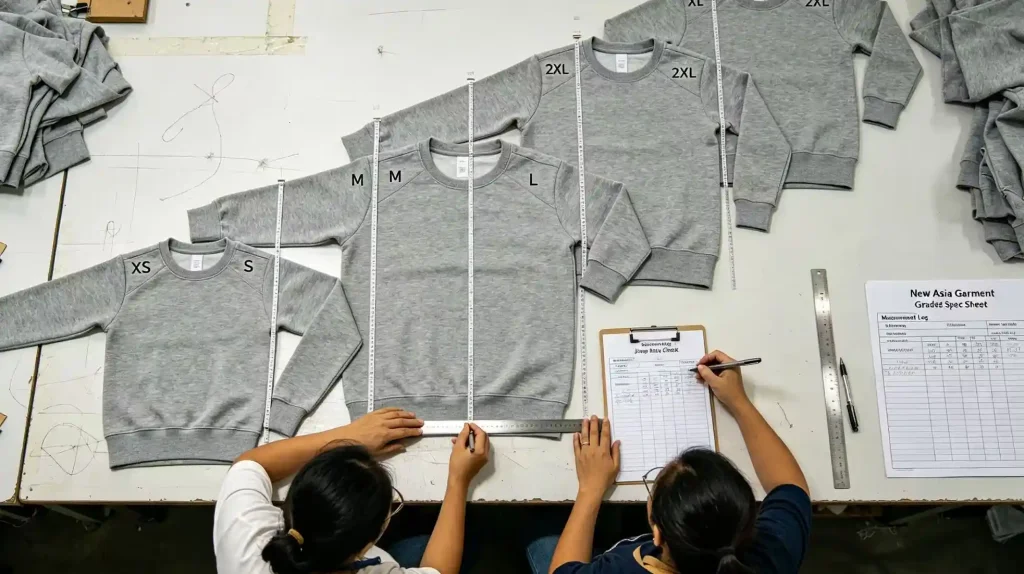
A reliable size set evaluation combines measurement verification, pattern grading analysis, physical garment inspection, and fit testing.
The following process helps apparel manufacturers identify issues systematically before bulk production begins.
Check Garment Measurements Against the Tech Pack
Start by laying the size set garments flat on an inspection table under consistent conditions.
Use an appropriate measuring tape, ruler, or calibrated measuring instrument to check every required point of measurement (POM) against the approved tech pack.
Common measurement points include:
- Chest or bust width.
- Waist and hip measurements.
- Body length and hem width.
- Shoulder width.
- Armhole depth.
- Sleeve length and cuff opening.
- Neckline width and depth.
- Inseam and outseam for trousers.
Record actual measurements for every size and compare them with the specified measurements and tolerances.
Measurements should be taken using the same approved method for every garment. For example, a half-chest measurement taken across a garment laid flat should not be compared directly with a full chest circumference.
If a measurement falls outside the permitted tolerance, determine whether the problem is isolated to one garment, repeated across a size, or caused by a broader grading issue.
Verify Grading Increments Between Sizes
Grading increments, also called size jumps, describe the changes in measurements between consecutive sizes.
For example, if the approved half-chest measurement increases by 2 cm from Small to Medium, the same measurement should follow the specified grading rule for the other size transitions.
However, not every measurement must increase by the same amount. Chest width, body length, sleeve length, shoulder width, and neckline dimensions may follow different grading increments.
The inspector should compare each adjacent-size difference with the approved graded measurement chart rather than applying one universal increment to every measurement.
A simple grading verification table can help identify inconsistencies:
| Measurement | Size S | Size M | Size L | Review focus |
|---|---|---|---|---|
| Half chest | 50 cm | 52 cm | 54 cm | Consistency with the approved size jump |
| Body length | 68 cm | 69 cm | 70 cm | Length progression |
| Shoulder width | 43 cm | 44 cm | 45 cm | Shoulder balance |
| Sleeve length | 61 cm | 62 cm | 63 cm | Sleeve grading |
Illustrative example only. Actual measurements and grading increments must follow the approved tech pack and product design.
Unexpected differences between adjacent sizes may indicate incorrect grading rules, pattern alterations that were not carried through the size range, or measurement inconsistencies during sample production.
Flag these issues for technical review before approval.
Conduct Fit Tests on Extreme Sizes
Flat measurements cannot reveal every fit problem. A garment may meet its dimensional specifications but still feel restrictive or look unbalanced when worn.
For this reason, fit testing should prioritize the smallest and largest sizes, such as XS and 2XL or 3XL, where grading problems are often easiest to detect.
Use qualified fit models who represent the intended customer and match the brand’s established fit criteria as closely as practical.
Evaluate the garment from the front, side, and back. Check shoulder alignment, neckline position, body balance, sleeve hang, and the distribution of excess fabric.
For relevant products, also assess functional movement, including:
- Raising and extending the arms.
- Sitting and bending.
- Walking or squatting in bottoms.
- Reaching and twisting.
- Closing zippers, buttons, or other functional components.
Fit evaluation should consider both appearance and comfort. A garment that looks correct while standing still may still restrict movement during normal wear.
Evaluate Garment Balance and Movement
Garment balance refers to how the garment hangs and distributes its shape around the body.
Poor balance may appear as a twisting side seam, an uneven hem, a sleeve that rotates, excessive fabric pooling, or a front panel that pulls upward.
During the fit review, observe whether these issues occur consistently in one size or become more pronounced as the garment size changes.
If a problem appears only in the largest size, the cause may involve grading proportions rather than the base pattern itself.
Document the issue with photographs, marked-up measurement sheets, and specific corrective comments. The pattern technician should then determine whether the necessary correction involves the pattern, construction method, or measurement specification.
How Fabric Properties Affect Size Set Approval
A successful size set evaluation must consider both pattern geometry and the behavior of the actual production materials.
Different fabrics respond differently to tension, washing, pressing, and repeated wear. These characteristics can influence fit even when the garment measurements appear correct.
Stretch and Recovery in Performance Fabrics
Stretch fabrics containing elastane or spandex require careful evaluation because their performance depends on fabric composition, construction, stretch direction, and recovery.
In activewear, leggings, fitted tops, and compression garments, excessive tension may cause discomfort, poor recovery, seam strain, or fabric transparency.
Larger sizes do not automatically experience greater strain in every situation. The actual result depends on the garment’s ease, pattern dimensions, intended compression level, and fabric properties.
During size set approval, assess whether each size provides the intended fit and stretch performance.
Where appropriate, test fabric stretch and recovery, inspect seam integrity, and evaluate opacity under the intended wearing conditions. Confirm that the fabric behaves as expected across the approved size range.
Shrinkage and Dimensional Stability
Washing, dyeing, heat setting, and finishing can change fabric dimensions and affect the final garment shape.
Potential issues include excessive shrinkage, twisting side seams, uneven hems, and changes in sleeve or body length.
A larger garment panel may experience a greater absolute dimensional change than a smaller panel under the same percentage shrinkage. However, actual results depend on the fabric, construction, finishing process, and measurement direction.
Where garment washing or dimensional stability is relevant, evaluate samples after the specified care or finishing process.
Compare pre-treatment and post-treatment measurements, check seam alignment, and confirm that the finished garment remains within the brand’s approved tolerances.
Testing should follow the product’s intended care conditions and the applicable quality requirements.
Print, Embroidery, and Trim Placement
Printed graphics, embroidery, labels, and decorative trims can become visually unbalanced if their placement rules are not properly defined for each size.
For example, a chest logo placed at a fixed distance from the center front may appear too close to the armhole on a smaller garment. On a larger garment, the same logo may appear disproportionately small.
Before approval, verify graphic centering, distance from seams, pocket alignment, embroidery quality, and consistency with the approved artwork.
Determine whether each design element should retain a fixed dimension, scale proportionally, or follow a size-specific placement rule.
Clear placement specifications help factories reproduce the intended design accurately during bulk production.
Size Set Approval Checklist Before Bulk Cutting
A standardized checklist makes the size set approval process easier to manage across product development, sourcing, and quality control teams.
Use the following checklist before authorizing bulk cutting.
Pattern and measurement checks
- All required sizes have been submitted for review.
- Measurements match the approved tech pack within specified tolerances.
- Grading increments are consistent with the approved measurement chart.
- Shoulder, armhole, neckline, and sleeve proportions have been reviewed.
- No unexplained dimensional differences exist between adjacent sizes.
Fit and construction checks
- Smallest and largest sizes have been evaluated on appropriate fit models or through an approved alternative.
- Garment balance and seam alignment are acceptable.
- Movement and comfort requirements have been checked.
- Stitching, seams, closures, and functional details meet requirements.
- Pockets, trims, and decorative elements remain visually balanced.
Fabric and finishing checks
- Samples use the approved production fabric and trims.
- Stretch and recovery have been assessed where relevant.
- Shrinkage and dimensional stability requirements have been verified where applicable.
- Prints, embroidery, and graphics match approved placement specifications.
- Required washing or finishing evaluations have been completed.
Approval and documentation
- Measurement results have been recorded.
- Fit comments and identified defects have been documented.
- Required pattern corrections have been completed and rechecked.
- The final size set has received approval from the designated stakeholders.
- The approved pattern version and technical specifications are controlled for bulk production.
Bulk cutting should proceed only after the required size set criteria have been met and the authorized stakeholders have documented their approval.
Common Size Set Approval Mistakes to Avoid
Even factories with established quality control systems can overlook grading problems if the approval process is incomplete.
Avoid these common mistakes:
1. Approving only the base size. A successful Medium sample does not demonstrate that the complete size range fits correctly.
2. Checking measurements without reviewing fit. A garment may meet its measurement specifications but still have poor balance, uncomfortable movement, or an unflattering silhouette.
3. Applying identical grading increments to every measurement. Different garment dimensions require different grading rules based on the design and intended fit.
4. Using incorrect or inconsistent measuring methods. Measurement results become unreliable when inspectors use different reference points, garment positions, or measuring techniques.
5. Ignoring fabric performance. Stretch, shrinkage, finishing, and seam behavior may change the garment’s final fit.
6. Approving samples without documenting corrections. Verbal feedback alone can lead to inconsistent pattern revisions and repeated defects.
7. Proceeding to bulk cutting before final approval. If a grading issue is discovered after cutting begins, corrective action may require substantial rework or replacement materials.
A documented approval process helps prevent these avoidable risks and establishes clear accountability across the production team.
How Size Set Approval Reduces Apparel Production Risks
Size set approval is more than a sample review. It is a preventive quality control measure that connects product development, pattern engineering, production planning, and final garment quality.
By checking every required size before bulk cutting, brands can identify grading problems while corrections are still manageable.
The process also creates a technical record that can be used to guide future production runs, supplier evaluations, and product development decisions.
For apparel brands managing multiple styles, suppliers, or international manufacturing locations, standardized size set procedures help improve communication and reduce the risk of inconsistent fit between production batches.
The most effective approach combines accurate pattern grading, clear tech packs, controlled sample measurements, fit evaluation, and documented approval criteria.
Partner with New Asia Garment for Reliable Size Set Approval
Consistent sizing starts long before garments reach the cutting table. It requires accurate technical specifications, carefully graded patterns, reliable sample development, and a disciplined approval process.
New Asia Garment can be positioned as a manufacturing partner for apparel brands seeking greater control over product development and production quality. A well-defined size set workflow helps align pattern grading, measurement verification, fit feedback, and production readiness before bulk manufacturing begins.
When evaluating a manufacturing partner, brands should confirm how the factory manages size set samples, records measurement results, implements pattern corrections, and controls approved specifications.
Working with a manufacturing team that follows clear technical procedures can help reduce avoidable production risks and support more consistent garment quality across the size range.
Planning your next apparel production order? Contact New Asia Garment to discuss your product specifications, sample development requirements, and size set approval process before bulk production begins.
Frequently Asked Questions About Size Set Approval
Q1:How Many Sizes Should Be Included in a Size Set?
The number of sizes depends on the product, the brand’s size range, and its quality requirements. A size set may cover every offered size from XS to 3XL, particularly when the brand needs to verify grading across the entire range. Some programs may use a defined selection of sizes, but the smallest and largest sizes should receive particular attention when grading risk is high.
Q2:Is Size Set Approval Required Before Bulk Production?
Size set approval is not a universal legal requirement for every apparel product, but it is a valuable quality control requirement for brands that need consistent fit across multiple sizes. Whether it is mandatory depends on the brand’s procedures, purchase agreement, product specifications, and manufacturing quality requirements. When specified, approval should be completed before bulk cutting is authorized.
Q3:What Is the Difference Between a Fit Sample and a Size Set Sample?
A fit sample is generally used to evaluate the design, silhouette, proportions, and fit of a garment in a designated size. A size set sample evaluates whether the approved pattern grading produces acceptable fit and measurements across multiple sizes. Both play important roles in apparel product development.
Q4:Who Is Responsible for Approving a Size Set?
Responsibility typically involves the brand’s technical design team, product development team, quality assurance team, or designated approval authority. The garment manufacturer and pattern technician provide technical measurements, fit observations, and proposed corrections. The final approval process should be clearly defined before production begins.
Q5:What Happens If a Size Set Sample Fails Inspection?
The failed sample should be documented with its actual measurements, fit observations, photographs, and corrective comments. The pattern technician or responsible technical team should investigate the cause, revise the pattern or specifications where necessary, and submit corrected samples for re-evaluation. Bulk cutting should remain on hold until the required approval criteria are satisfied.
Q6:Can Size Set Approval Prevent All Fit-Related Returns?
No. Size set approval reduces the risk of grading-related fit problems but cannot eliminate every possible return. Customer body variation, inaccurate online size charts, fabric changes, inconsistent bulk production, and differences in fit preference may still affect customer satisfaction. Size set approval works best alongside production quality inspections, measurement control, accurate product descriptions, and consistent sizing standards.
Final Thoughts
Size set approval is one of the most effective ways to identify pattern grading problems before they become expensive production defects.
By verifying graded measurements, inspecting the smallest and largest sizes, evaluating fabric performance, and documenting every required correction, apparel brands can make more informed production decisions and improve fit consistency across their collections.
Before bulk cutting begins, make sure every approved size works—not just the sample that looks perfect on the fitting table.
Read More
- Size Set Approval Before Bulk Production: How to Catch Pattern Grading Problems Early
- How to Investigate a Garment Quality Claim: From Symptom to Root Cause and CAPA
- Garment Packaging Quality Control: Preventing Creases, Print Damage and Shape Distortion
- How to Validate Pocket Function and Placement Before Bulk Production
- How to Standardize Fabric Hand Feel Across Production Lots