
Pre-Shipment Denim Quality Inspection Checklist: A Technical Guide for Global Apparel Sourcing
In global apparel sourcing, pre-shipment inspection (PSI) serves as the final barrier between factory production lines and overseas retail shelves. For complex garments like denim—where minor variations in fabric weight, shrinkage, wash tones, or metal hardware can render a batch unsellable—a rigorous inspection protocol is essential.
Executing a comprehensive Pre-Shipment Denim Quality Inspection Checklist allows importers, brands, and third-party inspectors to identify structural defects, measurement variances, and specification mismatches before goods are released for shipment.
This technical guide outlines the critical steps required to execute a thorough pre-shipment audit for denim production across global supply chains.
1. Approved Sample, Specification & BOM Check
Every quality audit begins with a baseline comparison against the buyer-approved tech pack, specifications, Bill of Materials (BOM), and golden sample (PP sample).
Golden Sample Comparison
Inspectors compare bulk garments side-by-side with the sealed PP sample to confirm:
- Overall aesthetic and appearance
- Garment silhouette and fit
- Seam construction
- Wash and finishing effects
- Placement of signature design details
- Label and branding placement
Any significant deviation from the approved PP sample should be documented and assessed before shipment release.
BOM Material Audit
Every component listed in the approved BOM should be verified against the bulk production. This includes:
- Main fabric composition
- Fabric weight and construction
- Thread color and ticket size
- Pocketing fabric
- Brand labels
- Care labels
- Zippers
- Tack buttons and rivets
- Leather or synthetic back patches
- Other metal trims and accessories
The objective is to ensure that no unauthorized material or component substitutions have been introduced during production.
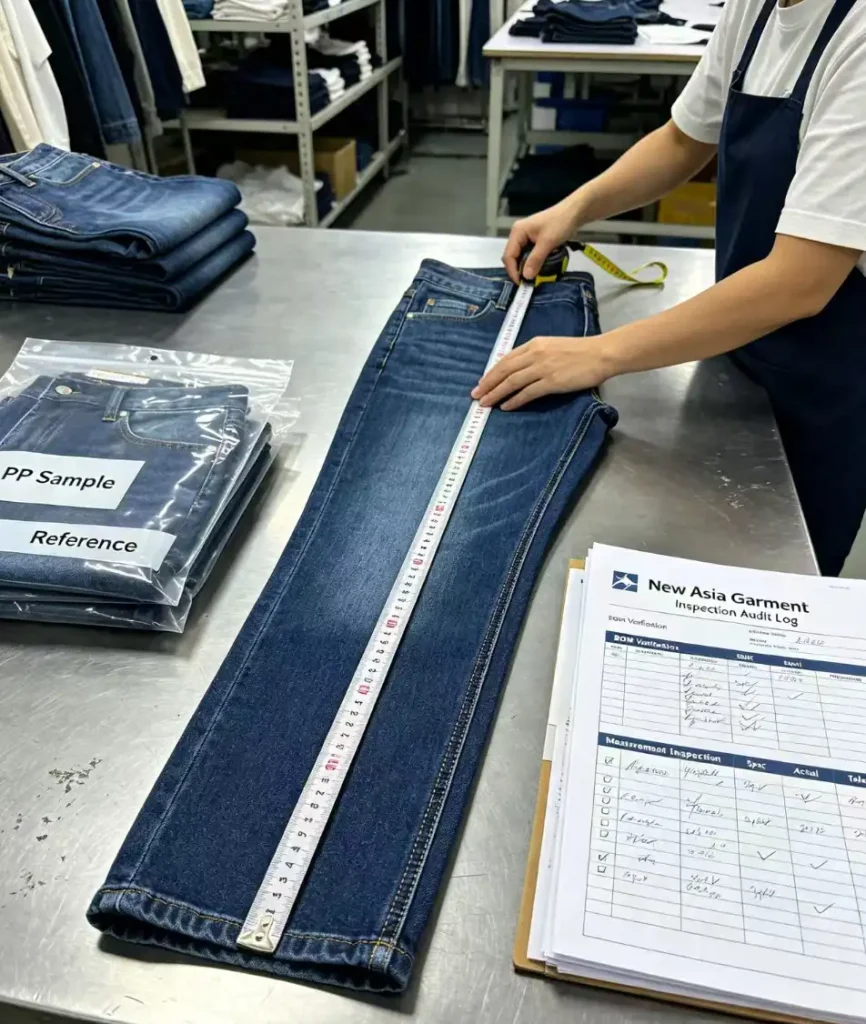
2. Measurement Inspection
Because denim garments undergo aggressive washing, drying, and finishing processes, precise measurement checks are critical for maintaining the approved fit.
Critical Points of Measure (POMs)
Inspectors should record measurements at key points, including:
- Waist width
- Hip circumference
- Front rise
- Back rise
- Thigh width
- Inseam length
- Leg opening
Additional POMs should be included where required by the buyer’s tech pack.
Tolerance Compliance
Each measurement should be compared against the approved size chart and specified tolerance.
Standard denim tolerances generally permit approximately ±0.5 cm to ±1.0 cm, depending on the POM and buyer requirements.
Inspectors should pay particular attention to measurement variance between:
- Different sizes
- Different colorways
- Different wash batches
- Different production lots
Significant variation between lots may indicate inconsistent fabric shrinkage or inadequate wash-process control.
3. Fabric Shade, Hand Feel & GSM Verification
Fabric performance directly influences the garment’s aesthetic, fit, durability, and overall customer perception. Material verification is therefore a key part of the PSI process.
Fabric Weight (GSM/Oz) Verification
Fabric weight should be checked against the approved specification.
For example, a specification may require 12 oz or 14 oz denim, depending on the garment design.
Inspectors can verify fabric weight using:
- Fabric swatches
- GSM testing equipment
- Approved laboratory testing methods
- Non-destructive weighing methods where applicable
Where possible, samples should be taken from multiple production rolls or garments to identify inconsistencies.
Hand Feel and Rigidity Assessment
Inspectors evaluate the fabric’s:
- Softness
- Rigidity
- Slub texture
- Drape
- Surface character
- Overall hand feel
These characteristics should be compared with the approved sample to confirm that enzyme, silicone, stone, or other finishing treatments have achieved the required tactile result.
Shade Sorting and Banding
Bulk garments should be inspected under standardized lighting conditions, such as D65 daylight simulation, to identify shade differences.
Garments can then be grouped into shade bands, such as:
- Shade A
- Shade B
- Shade C
This helps prevent visibly different shades from being mixed within the same shipment lot.
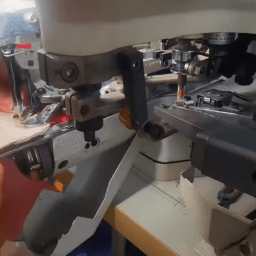
4. Sewing & Workmanship Inspection
Workmanship inspection focuses on the structural integrity, appearance, and durability of the finished garment.
Stitch Density and Thread Tension
Inspectors should measure stitches per inch (SPI) at critical seams.
For heavy denim, approximately 7–9 SPI may be specified depending on the construction and buyer requirements.
The inspection should also cover:
- Thread tension
- Seam balance
- Seam puckering
- Seam grinning
- Thread security
- Back-tacking
- Stitch consistency
Common Workmanship Defects
Inspectors should identify and classify defects such as:
- Skipped stitches
- Broken threads
- Open seams
- Uneven stitching
- Excessive thread tails
- Uneven fly alignment
- Raw edges inside pockets
- Misaligned back yokes
- Incorrect seam construction
- Poorly secured bartacks
Defects should be classified according to the buyer’s approved quality standard and AQL criteria.
5. Wash & Colour Consistency Inspection
Denim finishing involves complex chemical and mechanical processes. Small variations during washing or dry processing can create noticeable differences between garments.
Wash Tone Uniformity
Inspectors should compare bulk production against the approved wash standard to verify consistency in:
- Overall wash tone
- Hand-sanding
- Whiskering
- Scraping
- Laser distressing
- Abrasion effects
- Fading patterns
- Highlight and contrast areas
For garments featuring symmetrical design effects, inspectors should verify that the treatment is positioned consistently on both sides.
Colorfastness and Crocking Checks
Quick on-site rub tests can be used to identify excessive color transfer.
Inspectors should pay particular attention to potential indigo transfer onto:
- Pocket lining
- Pocketing fabric
- Inner garment surfaces
- Light-colored components
Where required, formal laboratory colorfastness testing should be conducted according to the buyer’s testing protocol.
6. Hardware & Trim Substitution Check
Hardware failures can lead to customer complaints, product returns, and, in certain circumstances, safety concerns.
Unauthorized Substitution Audit
Inspectors should cross-reference bulk components against the approved BOM and component specifications.
Key items include:
- Tack buttons
- Rivets
- Zippers
- Zipper pullers
- Leather back patches
- Brand labels
- Metal trims
- Decorative hardware
Part numbers, materials, finishes, colors, dimensions, and branding should be checked wherever applicable.
Attachment and Functional Testing
Hardware should be inspected for both appearance and functional performance.
Depending on the buyer’s requirements, tests may include:
- Button pull testing
- Rivet attachment testing
- Zipper cycling
- Puller strength testing
- Stopper integrity checks
- Slider operation checks
For example, a specified button or rivet pull test may require a minimum force of 90 N for 10 seconds. The actual acceptance criteria should always follow the buyer’s approved testing specification.
7. Packing, Label & Quantity Verification
Packaging and labeling errors can cause customs issues, warehouse receiving problems, inventory discrepancies, and retail scanning failures.
Barcode and Care Label Verification
Inspectors should verify:
- Barcode readability
- SKU accuracy
- Style number
- Size information
- Fiber composition
- Care instructions
- Country-of-origin information
- Required destination-market labeling
All information should match the approved artwork, packing list, and applicable market requirements.
Carton and Polybag Audit
The inspection should also cover:
- Carton dimensions
- Gross weight
- Net weight
- Shipping marks
- Assortment ratios
- Polybag specifications
- Required suffocation warnings
- Carton quantities
- Total packed carton count
The final physical quantity should be reconciled against the packing list and purchase order.
8. AQL & Sampling Framework
Pre-shipment inspections rely on statistically defined sampling methods to determine whether a production lot meets the buyer’s quality requirements.
ISO 2859-1 / ANSI/ASQ Z1.4 Sampling
Many inspections use recognized sampling standards such as ISO 2859-1 or ANSI/ASQ Z1.4.
A commonly used approach is:
- General Inspection Level II
- Defined sample size based on lot quantity
- Pre-agreed AQL levels
- Separate classification of critical, major, and minor defects
The exact sampling plan should be confirmed with the buyer before inspection.
Critical, Major & Minor Defect Limits
A commonly specified framework for apparel inspection may include:
- Critical defects: AQL 0
- Major defects: AQL 2.5
- Minor defects: AQL 4.0
If the number of defects exceeds the applicable acceptance criteria, the shipment may be placed on hold for corrective action and factory re-screening.
The exact AQL values should always be based on the buyer’s purchase agreement or quality manual rather than assumed as universal requirements.
9. Cross-Category Cases: Thinner Fabric, Cheaper Zippers & Lining
Third-party inspectors must remain alert to subtle cost-cutting substitutions that may not be immediately visible during a conventional visual inspection.
Fabric Weight Reduction
A factory may, for example, substitute an approved 13.5 oz selvedge denim with an 11.5 oz fabric to reduce material costs.
A visual inspection alone may not reliably identify this difference.
Inspectors should therefore verify fabric weight across multiple rolls or production lots and compare the results against the approved specification.
Trim and Lining Degradation
Other potential substitutions include:
- Replacing approved brass zippers with lower-cost alternatives
- Substituting specified metal alloys
- Replacing cotton pocketing with thinner polyester-blend fabrics
- Using lower-grade leather or synthetic patches
- Substituting approved labels or trims
These changes can reduce durability and alter the product’s appearance or performance.
A systematic BOM and material verification process helps identify such hidden component downgrades before export.
10. Recommended Denim Pre-Shipment Inspection Workflow
A structured inspection workflow helps ensure that no major quality area is overlooked.
Step 1: Review Approved Documents
Review the:
- Tech pack
- Golden sample / PP sample
- BOM
- Measurement chart
- Wash standard
- Packaging specifications
- Packing list
- AQL requirements
Step 2: Verify Production Status
Confirm that the required percentage of the order has been completed, finished, packed, and made available for inspection according to the agreed PSI conditions.
Step 3: Conduct Random Sampling
Select samples according to the approved sampling plan and ensure that samples are representative of the entire production lot.
Step 4: Perform Technical Inspection
Inspect:
- Measurements
- Fabric
- Shade
- Wash effects
- Sewing workmanship
- Hardware
- Labels
- Packaging
- Quantity
Step 5: Classify and Record Defects
Photograph and document all identified defects and classify them as critical, major, or minor according to the agreed quality standard.
Step 6: Issue the Inspection Report
The final report should clearly state:
- Inspection quantity
- Sample size
- Defect quantities
- Defect classification
- Measurement results
- Material verification results
- Packaging findings
- AQL outcome
- Corrective actions required
- Shipment recommendation based on the agreed inspection criteria
11. Why Pre-Shipment Inspection Matters in Denim Sourcing
Denim quality problems can originate at almost every stage of production—from fabric selection and cutting to sewing, washing, finishing, hardware attachment, and packing.
A structured PSI process provides a final opportunity to identify issues such as:
- Fabric weight deviations
- Measurement inconsistencies
- Shade variation
- Wash defects
- Sewing problems
- Hardware failures
- Unauthorized substitutions
- Labeling errors
- Packing discrepancies
Partnering with reliable apparel manufacturing specialists, such as New Asia Garment, can help brands establish consistent production controls and align bulk manufacturing with approved technical specifications.
By combining production control with rigorous pre-shipment quality audits, global brands can improve product consistency, reduce avoidable shipment issues, and minimize costly quality-related returns.
Conclusion
A structured Pre-Shipment Denim Quality Inspection Checklist is an essential quality-control tool for global denim sourcing.
By systematically verifying BOM specifications, fit measurements, fabric weight, shade consistency, wash effects, sewing workmanship, hardware, packaging, and AQL requirements, brands and manufacturers can identify quality deviations before goods leave the factory.
For complex denim products, PSI should not be treated as a simple visual inspection. It should function as a technical verification process that connects the approved product specification with the actual bulk production.
A disciplined inspection framework ultimately helps create more consistent products, more transparent supplier relationships, and more resilient global apparel supply chains.
Read more