

Choosing the right activewear fabric before bulk production is essential for maintaining consistent garment quality. For activewear brands, sportswear buyers, clothing manufacturers, and private-label companies, fabric approval should involve more than checking color, appearance, and hand feel.
Before placing a bulk fabric order, buyers should confirm whether the material meets the required standards for opacity, stretch, elastic recovery, breathability, moisture management, durability, and dimensional stability.
A fabric may look excellent during sampling but perform differently in a finished garment. It may become see-through when stretched, lose its shape after repeated wear, shrink after washing, or provide insufficient comfort during exercise.
These risks are particularly important for leggings, yoga pants, cycling shorts, compression garments, sports bras, and fitted training wear.
A structured activewear fabric approval process helps identify potential problems before bulk cutting and production. It also gives buyers and manufacturers a consistent reference for evaluating development samples, bulk materials, and finished garments.
One detail that deserves particular attention is opacity. A single fabric swatch, colorway, or garment size should not automatically represent an entire activewear collection. Coverage can change with fabric stretch, garment fit, lighting, and laundering conditions.
This guide explains how to evaluate activewear fabric performance and how to record opacity test conditions across different colors and sizes before bulk production.
Why Activewear Fabric Approval Matters
Activewear fabrics need to balance several performance requirements.
Leggings require sufficient stretch and recovery. Sports bras need appropriate support and shape retention. Running tops may require lightweight construction, breathability, and moisture management. Training shorts need suitable durability and resistance to repeated washing.
There is no single fabric specification that works for every activewear product.
For this reason, fabric approval should be based on the intended garment, fit, and end use rather than simply choosing a material because it feels soft or has a high stretch percentage.
A typical activewear fabric approval process may evaluate:
- Fiber composition and fabric construction
- GSM and fabric width
- Stretch and elastic recovery
- Opacity
- Breathability and moisture management
- Shrinkage and dimensional stability
- Colorfastness
- Pilling resistance
- Surface appearance
- Finished garment performance
The buyer and supplier should agree on the applicable acceptance criteria before bulk production begins.
1. Check Activewear Fabric Opacity
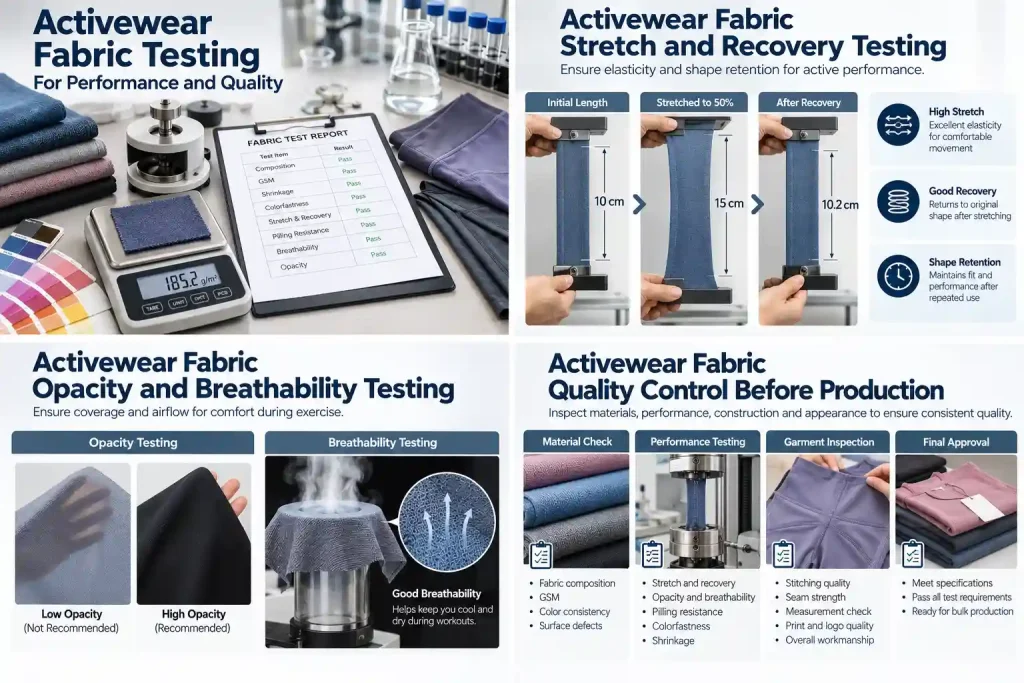
Opacity is one of the most important fabric characteristics for leggings, yoga pants, cycling shorts, compression garments, and other fitted activewear.
A fabric may look opaque when lying flat but become transparent when stretched around the hips, thighs, knees, or other high-stress areas.
The degree of coverage can depend on:
- Fabric GSM and construction density
- Fiber composition and yarn characteristics
- Elastane content
- Fabric stretch percentage
- Garment pattern and finished measurements
- Intended compression and fit
- Fabric color and finishing
- Lighting and background conditions
- Changes after washing
Opacity should therefore be evaluated under conditions that reasonably represent actual garment use.
How to Check Fabric Opacity
A practical opacity evaluation can include:
- Checking the fabric under controlled lighting
- Comparing performance under agreed indoor lighting conditions
- Stretching the fabric to the expected garment extension
- Using contrasting backgrounds
- Checking whether skin or contrasting material becomes visible
- Comparing with an approved reference sample
- Performing a squat test on finished leggings where applicable
Fabric-level evaluation is useful for comparing material samples, but it cannot fully replace finished-garment testing.
A garment’s pattern, size, fit, and compression determine how much the fabric stretches when worn. A fabric that appears sufficiently opaque as a flat swatch may provide less coverage when used in a closely fitted garment.
For opacity-sensitive products, buyers should evaluate both the fabric and the finished garment.
Define the Opacity Requirement Clearly
Instead of simply telling a supplier that leggings fabric must be “not see-through,” buyers should define the testing conditions.
The specification should identify:
- Fabric or finished-garment testing
- Approved fabric or garment reference
- Required stretch condition
- Test colorways
- Test sizes
- Lighting source and conditions
- Background color or contrast
- Garment orientation and evaluation areas
- Pre-wash or post-wash condition
- Evaluation method
- Acceptance criteria
This creates a clearer reference for the buyer, fabric supplier, and quality-control team.
How to Record Opacity Test Conditions Across Colors and Sizes
Testing only one color and one size may not provide enough evidence for a multi-color, multi-size activewear order.
Different colorways can behave differently because of variations in dyeing, finishing, and material processing. Even when the base fabric construction is the same, each color should be considered in the buyer’s opacity approval plan.
Likewise, the same fabric can experience different degrees of extension depending on garment size, pattern dimensions, and intended fit.
A smaller size is not automatically the most critical test case. Actual fabric extension depends on pattern design, garment ease, compression, and the wearer’s body measurements.
A useful opacity test record should connect each result with the specific color, size, stretch condition, lighting, and washing condition used during evaluation.
Opacity Test Record: Colors, Sizes and Test Conditions
The following table provides a practical record format for activewear fabric and finished-garment opacity evaluation.
| Record Field | Information to Record | Why It Matters |
|---|---|---|
| Style / Product ID | Style number and product description | Identifies the garment |
| Fabric Reference | Fabric article number, composition, GSM and supplier | Connects results to the approved material |
| Fabric Lot / Dye Lot | Fabric production lot and dye batch | Supports material traceability |
| Colorway | Exact color name or code | Prevents results from one color being automatically applied to another |
| Garment Size | Actual sample size, such as XS, M or XL | Identifies the size evaluated |
| Test Location | Seat, hip, thigh, knee or other relevant area | Identifies where coverage is assessed |
| Stretch Direction | Lengthwise, crosswise or both | Records the direction of extension |
| Stretch Condition | Relaxed, specified extension or worn-fit condition | Establishes the test condition |
| Applied Force / Load | Force used during controlled stretching, where applicable | Supports repeatability |
| Lighting | Light source, illuminance in lux where measured, and setup | Helps standardize visual comparison |
| Background | Background color and contrast | Helps identify visible transparency |
| Evaluation Method | Fabric swatch, garment inspection, stretch fixture or movement test | Identifies how the result was obtained |
| Washing Condition | Before washing or after the specified care process | Distinguishes pre-wash and post-wash performance |
| Wash Details | Cycle, temperature, detergent and drying method where relevant | Supports repeatable evaluation |
| Specimen Count | Number of specimens or garments evaluated | Shows the basis of the assessment |
| Tester / Evaluator | Person responsible for the evaluation | Supports accountability |
| Result | Pass, Fail or Further Review | Records the actual observation |
| Evidence | Photographs, test records and sample reference | Supports traceability |
| Approval | Reviewer, date and buyer decision | Establishes the final decision |
This record should be completed for each required test combination rather than treating an entire collection as one sample.
1. Record Every Required Colorway
Different colors should be identified separately.
For example, a leggings collection may include:
- Black
- Navy
- Grey
- Burgundy
- Light Pink
The approved black fabric should not automatically be treated as evidence that the other colorways meet the same opacity requirement.
Dyeing and finishing conditions can affect fabric characteristics. The actual bulk colorways should therefore be evaluated according to the buyer’s agreed approval plan.
Where several colors share the same base construction and processing conditions, the buyer may establish a risk-based testing plan. Any reduced testing scope should be documented and supported by suitable evidence.
2. Record Representative Garment Sizes
Finished-garment opacity should be evaluated using sizes selected according to the product’s grading, fit, and intended compression.
For example, an activewear order may include XS, S, M, L, and XL.
The buyer and manufacturer should determine which sizes need physical evaluation.
Where the design uses close compression, substantial grading changes, or different fabric extension across sizes, testing more than one representative size may be necessary.
The test record should identify the actual garment size rather than simply stating that the leggings passed the opacity test.
If only size M has been evaluated, the approval record should not imply that every size has been physically tested.
3. Record Stretch Direction and Extension
Fabric coverage should be assessed at a defined and relevant stretch condition.
For a fabric swatch, record the original measurement and the extension applied during testing.
Stretch percentage can be calculated as:
Stretch (%) = [(Extended Length – Original Length) / Original Length] × 100
For example, if a 10 cm specimen extends to 13 cm, the extension is 30%.
This is an illustrative calculation, not a universal opacity test requirement.
Both lengthwise and crosswise stretch may need to be considered, depending on fabric construction and garment design.
For finished garments, record whether the evaluation was performed on a relaxed garment, under a specified stretch condition, or while worn according to the agreed fit protocol.
Where controlled stretching is used, also record the applied force or load, specimen dimensions, gauge length, holding time, and test direction.
Manual stretching can provide a practical visual assessment, but its results should not be treated as standardized laboratory measurements unless the procedure has been properly defined and controlled.
4. Record Lighting and Background Conditions
Lighting can influence how visible skin or contrasting material appears through activewear fabric.
For more consistent visual assessment, record:
- Light source or lighting type
- Illuminance in lux, where measured
- Distance between the light source and specimen, where relevant
- Viewing direction
- Background color
- Specimen orientation
- Evaluation location
Where possible, use the same controlled lighting setup for comparisons between samples and colorways.
Natural daylight can provide an additional visual reference, but it should not be the only basis for repeatable comparisons because daylight conditions vary.
A lux measurement describes the amount of light reaching the test area, but it does not fully describe the light source’s spectral characteristics.
For critical approvals, the buyer and manufacturer should agree on the lighting arrangement and evaluation procedure in advance.
Photographs can support the record, but camera exposure, white balance, and image processing can change the apparent transparency. Photographs should not replace the agreed physical evaluation.
5. Record Pre-Wash and Post-Wash Conditions
Opacity approval should also consider whether washing changes the fabric’s coverage.
Depending on the material, laundering may affect:
- Fabric dimensions
- Thickness and surface appearance
- Stretch and recovery
- Fabric structure
- Pilling
- Finished garment fit
A useful record should distinguish between:
- Before washing
- After the specified wash and drying process
- After additional cycles, if required by the buyer
Record the applicable care procedure, water temperature, wash cycle, detergent, drying method, and number of cycles.
Where dimensional or performance comparisons are required, specimens should be prepared and conditioned according to the selected test method before measurements are taken.
The purpose is not to require every activewear garment to undergo an identical number of washes. Testing conditions should reflect the product’s care requirements and the buyer’s agreed performance criteria.
6. Compare Results Against the Approved Reference
After testing, compare each required color and size combination with the approved reference.
The review should identify:
- Whether coverage remains acceptable
- Whether visible transparency increases under stretch
- Whether specific garment areas show greater transparency
- Whether washing changes the result
- Whether one colorway behaves differently
- Whether certain sizes require further evaluation
A result should be recorded as Pass, Fail, or Further Review according to the agreed acceptance criteria.
Do not use a general statement such as “all colors passed” if the underlying records do not show which colors and sizes were actually evaluated.
Example: Opacity Approval for a Multi-Color Leggings Order
Consider a hypothetical order for women’s performance leggings in black, navy, grey, and light pink.
The collection includes sizes XS to XL.
The development sample is a black size M garment, which passes the buyer’s initial visual opacity evaluation.
However, approving that sample alone does not establish that all four colors and all five sizes will provide the same coverage.
A controlled approval process would:
- Identify the approved fabric specification, fabric lot, and all four colorways.
- Select the garment sizes required by the buyer’s risk-based testing plan.
- Record the relevant fabric stretch directions and garment evaluation conditions.
- Establish consistent lighting and background conditions.
- Record the applied force or extension where controlled stretching is used.
- Evaluate relevant garment areas, including the seat, hips, and thighs.
- Record the pre-wash result and repeat the agreed evaluation after washing.
- Record the tester, specimen count, and supporting evidence.
- Compare the results with the approved sample and acceptance criteria.
- Obtain buyer approval and record any colorway or size-specific limitations.
If the light pink fabric shows greater transparency under the agreed stretch condition, that colorway should be reviewed separately.
The buyer and manufacturer may need to investigate the fabric construction, dyeing, finishing, or material selection before approving the bulk material.
The other colors should not automatically be rejected simply because one color fails, but their results must still be supported by the agreed testing evidence.
This is a hypothetical example illustrating the approval process, not an actual Newasia Garment test result.
The key principle is to record what was tested, under which conditions, and for which color and size—not simply to record a single overall opacity approval.
How to Determine Whether More Opacity Testing Is Required
Additional testing should be considered when:
- A new colorway has not been evaluated.
- The bulk fabric comes from a different material source.
- Fabric GSM or construction has changed.
- Elastane content or stretch behavior differs.
- A different finishing process has been introduced.
- The garment pattern or compression level has changed.
- A larger or smaller size shows different fabric extension.
- The post-wash result differs from the original sample.
- The buyer’s intended use or acceptance criteria have changed.
The level of additional testing should match the potential risk.
A minor administrative change may only require updated documentation. A significant material or fit change may require new fabric testing, finished-garment evaluation, or a revised sample.
For a broader discussion of how size grading and stretch-fabric behavior affect finished-garment fit, see our guide to size set approval before bulk production.
2. Test Activewear Fabric Stretch
Stretch determines how easily a garment accommodates body movement.
For leggings, sports bras, cycling shorts, compression wear, and fitted training garments, both lengthwise and crosswise stretch can be important.
When approving fabric, buyers should check:
- Original fabric measurement
- Lengthwise stretch
- Crosswise stretch
- Fabric extension under controlled tension
- Stretch consistency
- Permanent deformation
Four-way stretch can provide movement in multiple directions, but more stretch does not automatically mean better performance.
A fabric with very high stretch but poor recovery may become loose after repeated wear. Conversely, fabric with insufficient stretch may restrict movement or create excessive pressure.
The appropriate stretch level should therefore be determined by garment design, pattern, fit, and intended activity.
3. Evaluate Elastic Recovery
Stretch and recovery are closely related but are not the same.
Stretch measures how far a fabric can extend.
Recovery measures how effectively the fabric returns toward its original dimensions after stretching.
Good elastic recovery is essential for activewear that needs to maintain its fit during repeated movement.
Poor recovery can lead to:
- Baggy knees
- Loose waistbands
- Sagging areas
- Loss of compression
- Distorted garment shape
- Poor fit after repeated wear
How Is Fabric Recovery Tested?
A recovery test should use consistent testing conditions, including:
- Stretch percentage
- Applied force or tension
- Holding time
- Number of stretching cycles
- Recovery period
- Final measurement
- Acceptance standard
For example, compression leggings may require stronger recovery performance than a loose-fitting training top.
When comparing bulk fabric with an approved sample, suppliers should check whether there are changes in elastane content, fabric construction, yarn characteristics, or finishing.
For a more detailed explanation of fabric extension, recovery measurement, and repeated stretching, see our yoga pant fabric stretch recovery guide.
4. Check Breathability and Moisture Management
Breathability is another important consideration for performance activewear.
During exercise, the fabric needs to manage heat, perspiration, and moisture. Depending on the product, buyers may evaluate:
- Air permeability
- Moisture wicking
- Moisture spreading
- Drying rate
- Water vapor transmission
However, breathability and quick-dry performance are not the same thing.
A fabric may dry quickly without having high air permeability. Similarly, a breathable fabric may not provide the moisture-wicking performance required for a particular garment.
Buyers should define performance requirements according to the intended product rather than relying only on general marketing terms such as “breathable,” “quick dry,” or “moisture wicking.”
For running tops and training shirts, breathability and moisture management may be especially important. For leggings, these characteristics need to be balanced with opacity, stretch, recovery, and comfort.
5. Check GSM, Composition and Fabric Width
GSM, or grams per square meter, is commonly used to monitor activewear fabric consistency.
However, GSM should not be treated as the only indicator of fabric quality.
Two fabrics with similar GSM can have very different performance because of differences in:
- Fiber composition
- Elastane percentage
- Knit construction
- Fabric density
- Yarn characteristics
- Finishing processes
Before bulk cutting, compare the bulk fabric with the approved sample for:
- Fiber composition
- GSM
- Fabric width
- Color and shade
- Hand feel
- Stretch
- Recovery
- Surface appearance
Fiber composition is particularly important because even a change in elastane content can affect stretch and recovery.
The approved development sample should therefore be documented and retained as a reference for bulk production.
6. Test Dimensional Stability After Washing
Activewear is regularly washed, so fabric performance should also be considered after laundering.
Important checks may include:
- Length shrinkage
- Width shrinkage
- Twisting
- Skewing
- Stretch changes
- Recovery changes
- Surface appearance
- Pilling
- Colorfastness
Testing should be consistent with the garment’s intended care instructions.
A fabric may perform well before washing but change significantly after laundering. This can affect garment measurements, waistband fit, compression, and overall appearance.
For this reason, post-wash fabric testing can be an important part of activewear quality control.
7. Check Colorfastness and Pilling
Colorfastness is important for activewear because garments are frequently exposed to sweat, washing, and friction.
Depending on the product, testing may include:
- Colorfastness to washing
- Colorfastness to rubbing
- Colorfastness to perspiration
- Colorfastness to water
- Colorfastness to light, where applicable
Pilling resistance should also be considered for fabrics that experience repeated friction.
Leggings, for example, may rub against gym equipment, other garments, or the wearer’s skin. Tops may experience friction from backpacks or sports bras.
The required durability level should be based on the intended application and expected frequency of use.
8. Test the Finished Garment, Not Just the Fabric
Fabric approval is important, but fabric testing alone cannot always predict finished-garment performance.
Pattern design, garment fit, seam construction, elastic application, cutting direction, and sewing tension can all affect the final result.
Where appropriate, buyers should evaluate a finished garment before bulk production.
For leggings, a practical finished-garment evaluation can include:
- Squat test
- Stretch comfort
- Opacity during movement
- Waistband recovery
- Overall fit
- Seam comfort
- Appearance after washing
For sports bras, the evaluation may focus more on support, recovery, comfort, and fit.
This is why an effective approval process should connect fabric testing with garment testing.
For further guidance on evaluating movement, fit, and garment performance, see our movement fit testing guide.
9. Compare Bulk Fabric With the Approved Sample
One of the most important steps before bulk production is comparing the actual production fabric with the approved development sample.
The bulk fabric may come from a different production lot or involve changes in yarn, dyeing, knitting, finishing, or processing.
Before releasing fabric for bulk cutting, compare:
Approved Sample → Bulk Fabric → Test Results → Acceptance Standard
If the bulk fabric differs from the approved sample, the difference should be documented and evaluated.
For opacity-sensitive products, this comparison should include the relevant colorways, fabric lots, and garment test conditions rather than relying only on a general visual match.
Depending on the deviation, additional testing or buyer approval may be required.
This helps prevent a common production problem: a fabric that was approved during development but performs differently during mass production.
Activewear Fabric Approval Checklist
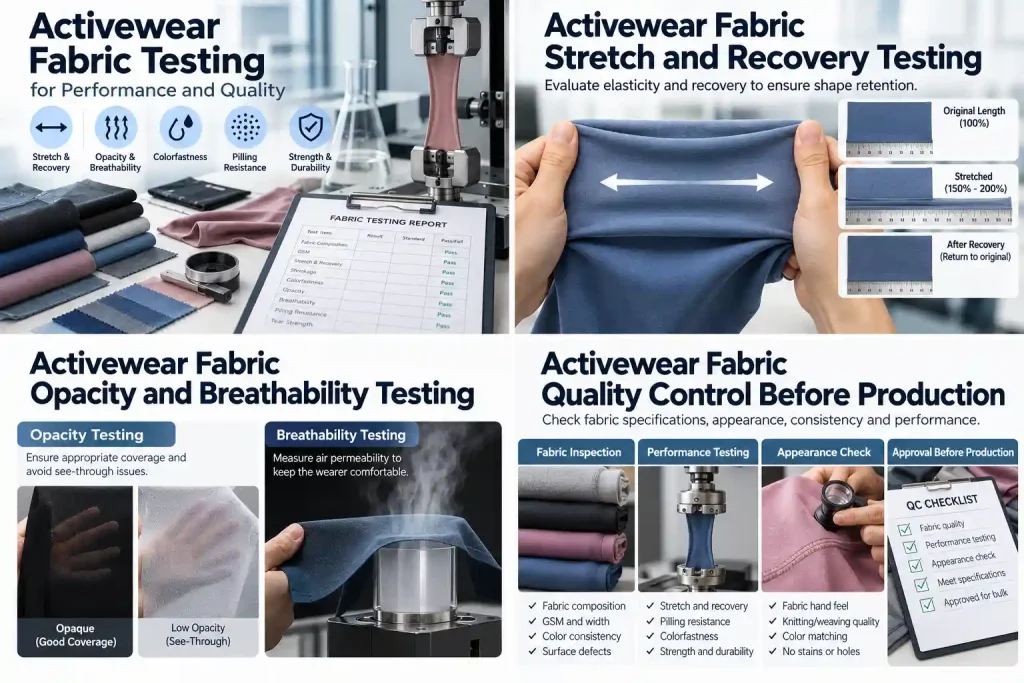
Before releasing fabric for bulk production, buyers and suppliers can use the following checklist.
Fabric Specifications
- Fiber composition approved
- GSM approved
- Width approved
- Color and shade approved
- Hand feel approved
- Fabric construction approved
- Fabric and dye lots identified
Performance
- Stretch meets specification
- Recovery meets specification
- Opacity meets requirements
- Breathability meets requirements
- Moisture management meets requirements
- Shrinkage is acceptable
- Colorfastness is acceptable
- Pilling resistance is acceptable
Opacity Test Records
- Required colorways identified
- Tested garment sizes recorded
- Test locations identified
- Stretch direction and condition recorded
- Applied force or load recorded where applicable
- Lighting conditions documented
- Background conditions documented
- Pre-wash results recorded
- Post-wash results recorded where required
- Tester and specimen count recorded
- Photographic or physical reference evidence retained
- Buyer acceptance recorded
Finished Garment
- Fit approved
- Squat test completed where applicable
- Waistband recovery approved
- Coverage approved
- Seam construction approved
- Appearance after washing approved
Bulk Release
- Bulk fabric compared with approved sample
- Test results reviewed
- Production lots documented
- Deviations recorded
- Buyer approval completed where required
FAQ: Activewear Fabric Approval
1. What should I check before approving activewear fabric?
At minimum, check fiber composition, GSM, width, stretch, recovery, opacity, and dimensional stability. Depending on the product, breathability, moisture management, pilling, and colorfastness may also need to be tested.
2. How do you test if leggings fabric is see-through?
Test the fabric at the expected garment stretch level under agreed lighting conditions. Use contrasting backgrounds and assess relevant garment areas, such as the seat, hips, and thighs. A squat test on finished leggings can provide additional information about coverage during movement.
3. Should opacity be tested for every activewear color?
Each colorway should be included in the buyer’s agreed approval plan. Dyeing and finishing can affect fabric properties, so one color should not automatically be treated as proof that all other colors meet the same opacity requirements. Any reduced testing scope should be supported by documented material and process equivalence.
4. Do different garment sizes require separate opacity testing?
Not necessarily every size, but the buyer and manufacturer should identify representative sizes according to the size range, grading, fit, and compression requirements. Where fabric extension or coverage may differ across sizes, additional garment-level evaluation may be necessary. The approval record should identify exactly which sizes were tested.
5. What conditions should be recorded during an opacity test?
Record the style, fabric reference, fabric and dye lot, color, garment size, test location, stretch direction and condition, applied force where relevant, lighting source, background, evaluation method, washing condition, specimen count, result, tester, supporting evidence, and approval decision.
6. Should opacity be checked again after washing?
Where wash durability is part of the product requirement, yes. Washing can change fabric dimensions, surface characteristics, stretch, recovery, and garment fit. The agreed opacity evaluation should therefore be repeated after the specified washing and drying procedure when required.
7. Is a fabric opacity test enough to approve finished leggings?
No. Fabric-level testing is useful for material comparison, but finished-garment coverage also depends on pattern, size, fit, compression, and garment construction. For opacity-sensitive leggings, evaluate the actual garment under the agreed wearing and movement conditions before bulk approval.
Final Thoughts
A reliable activewear fabric approval process helps buyers identify potential quality problems before bulk production begins.
Instead of evaluating fabric only by appearance and hand feel, brands and suppliers should establish clear requirements for opacity, stretch, recovery, breathability, composition, durability, and wash performance.
For opacity-sensitive garments, approval should go one step further.
Different colors, garment sizes, stretch conditions, lighting arrangements, and washing stages can produce different visual results. These conditions should be identified and recorded so that the buyer, fabric supplier, and quality-control team are working from the same evaluation standard.
The most effective approach is to compare the approved sample with actual bulk fabric and, where necessary, confirm performance through finished-garment testing.
For activewear manufacturers and private-label suppliers, this process helps create a more consistent quality standard from fabric development to bulk production, reducing the risk of unexpected coverage, fit, and performance problems.
Read more
- Knitwear Manufacturer: Custom Sweaters, Cardigans & Cable Knit
- Garment-Dyed vs Piece-Dyed Hoodies: MOQ, Shrinkage and Color Approval Trade-Offs
- Moving Apparel Production to a New Factory: A Handover and Validation Checklist
- How to Compare Clothing Manufacturer Quotes: A Cost Checklist for Apparel Brands
- How to Build Durability Tests Around High-Stress Garment Areas