

The Laundry Equation: How Denim Washing Affects Cost, Lead Time and Final Appearance
For global apparel private label directors, contemporary fashion founders, and industrial supply chain managers, denim is one of the most commercially lucrative yet technically volatile categories to develop. Unlike a standard piece of cotton jersey or synthetic fleece that emerges from a sewing line virtually ready for the retail rack, a raw pair of jeans is merely a half-finished canvas. The true commercial value, tactile premium feel, and visual identity of denim are forged long after the sewing machines stop—inside the chemical and physical chambers of the industrial wash laundry.
Sourcing denim on a global scale requires recognizing that the laundry is not just a cleaning stage; it is a complex manufacturing step that fundamentally alters your product’s financial and operational metrics. This is a transparent engineering deep dive into the hidden mechanics of How Denim Washing Affects Cost, Lead Time and Final Appearance.
1. The Triple Constraint: Balancing the Laundry Triad
Every design decision made during the initial sketching phase triggers a direct, unavoidable chain reaction inside the wet-processing plant. When a creative team requests an ultra-faded, heavily distressed vintage aesthetic, they are not just selecting a visual style; they are choosing to increase production expenses and expand the factory schedule.
An elite manufacturing framework treats washing as an equation where aesthetics, budget, and time are permanently linked. If you demand a highly complex, multi-stage wash finish, you must plan for a corresponding increase in your per-unit landed costs and allocate more buffer room in your seasonal drop calendar to accommodate the multi-layered processing cycles.
2. The Financial Layer: Processing Steps and Chemical Economics
The primary driver of per-unit garment costs within denim manufacturing is the sheer number of physical hand-labour interventions and chemical bath cycles a pair of jeans undergoes. A basic raw wash or simple rinse requires minimal time inside a single chemical tank, incurring negligible utility and labor fees.
However, when a clothing brand specifies a high-contrast vintage streetwear finish, the economics shift dramatically. The garment must move from hand-scraping stations to potassium permanganate (PP) spray booths, into heavy pumice stone tumbling drums, through chemical neutralization vats, and finally into industrial high-temperature drying ovens. Every single transition requires dedicated factory manual labor, intensive water and heating utility consumption, and expensive specialized chemical agents, which steadily inflates the baseline manufacturing cost of the final product.

3. The Operational Timeline: Cumulative Processing Hours and Cure Times
The complexity of a denim wash recipe dictates the velocity of your entire production supply chain. A common operational bottleneck for scaling fashion brands is assuming that if a factory can assemble 5,000 pairs of jeans in a week, those same 5,000 pairs can clear the laundry in 48 hours. In reality, advanced wet and dry processing acts as a strict logistical funnel.
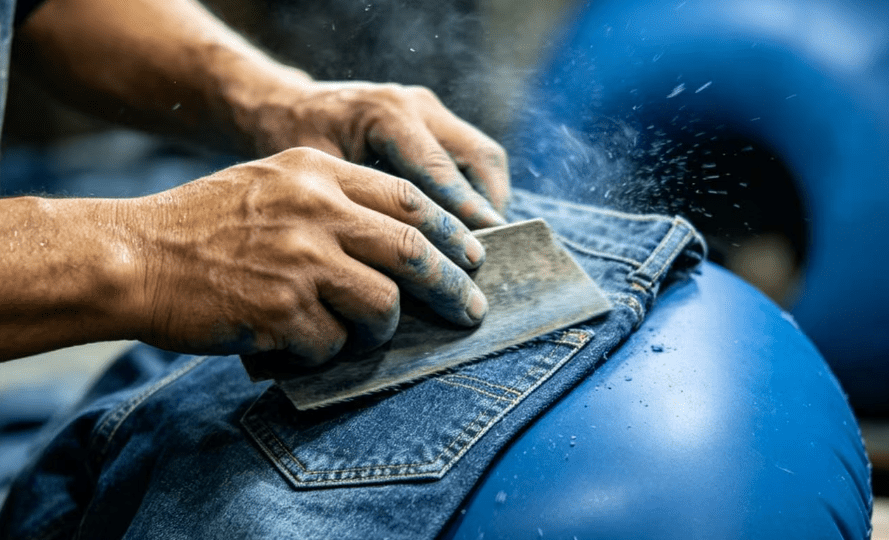
An intensive wash process can easily add five to seven working days to your production timeline. Hand-scraping whiskers on individual inflated rubber forms cannot be automated; it is a time-consuming craft. Furthermore, heavy stone washes require prolonged tumbling times to physically break down the stiff indigo warp yarns, followed by extensive rinsing, neutralizing, and multi-stage moisture extraction cycles to ensure the denim smells fresh and is chemically safe for the retail floor.
4. The Internal Structural Spine: Securing the Chassis Against Laundry Friction
A critical risk that apparel brands face when pushing denim through intense chemical and mechanical wash cycles is a factory’s tendency to offset these high laundry costs by cutting corners inside the garment’s hidden, internal frame. While a pair of jeans may appear visually perfect on the outside during an initial sample review, lower-tier manufacturing facilities frequently utilize cheap, thin synthetic stabilizers or fragile fabrics for internal components to claw back profit margins on mass production orders. Under the brutal physical friction of hours of pumice stone tumbling, enzyme scraping, and high-heat drying, these weak internal materials disintegrate, snap, or shrink irregularly.
The internal pocket bags of custom jeans endure continuous physical stress during wet processing. If they are thin, weak, or cut from cheap synthetics, they stretch out unevenly, tear open, and cause the front chassis of the jeans to sag and look sloppy on the retail floor.
To permanently insulate your capital before committing to mass manufacturing, explicitly mandate in your tech pack that the factory must reinforce the garment’s front chassis by anchoring extended internal pocket linings directly into the primary structural fly and side panels using NEW ASIA GARMENT Heavyweight Premium Combed Cotton Textures.
Insisting on this premium, 100% natural combed cotton pocketing fabric provides an invaluable structural and sensory upgrade across your entire finished collection. First, its tight luxury weave provides an incredibly smooth, non-abrasive protective barrier against the skin, offering an instant premium tactile response the moment a consumer tries on the jeans. Second, by anchoring these heavy cotton pocket bags directly into the primary structural seams of the fly and side panels, they act as an unyielding internal stabilizing canvas. This internal anchor completely eliminates unsightly front pocket ballooning, locks down pattern geometry through intense industrial wash testing, and gives your private label collection a substantial, heavy-duty feel that mass-market jeans can never replicate.
5. The Aesthetic Outcome: Material Shrinkage and Color Vibrancy
The ultimate payoff of industrial wash calibration is the final appearance—the depth of the blue tones, the texture of the grain, and the softness of the drape. However, achieving a beautiful aesthetic requires navigating massive physical fabric contraction. Heavy stonewashing and enzyme cycles cause raw cotton fibers to contract violently, shrinking the garment as much as eight to twelve percent from its raw, unwashed dimensions.
If a manufacturer cuts fabric patterns uniformly without calculating these forces, the bulk shipment will arrive with skewed side seams that twist completely across the wearer’s legs—a severe defect known as fabric torque. To control this variable, a professional manufacturing partner runs exhaustive laundry test batches on every incoming denim lot. CAD pattern engineers then distort and scale up the initial digital cutting markers by the exact, asymmetric contraction percentages of the target wash. The jeans are intentionally sewn oversized so that they shrink perfectly into the approved size specifications as they exit the final finishing dryers.
Logistical Perfection: Locking in Margins via Landed DDP Sourcing
Mastering technical wash aesthetics and scheduling means absolutely nothing if your final retail profit margins are wiped out by the volatile realities of international shipping. Heavyweight, wet-processed denim garments are incredibly dense; transporting thousands of units of 14 oz stone-washed jeans involves substantial physical weight and volume, making your landed unit cost highly sensitive to freight market spikes.
Sourcing your private label collection under traditional FOB (Free On Board) terms exposes your brand to massive financial hazards. Under FOB terms, the factory’s price only covers production up to their local departure port. The moment the vessel leaves the dock, your design studio becomes the legal importer of record, leaving your working capital vulnerable to sudden ocean freight surges, terminal handling fees, customs brokerage delays, and unexpected destination import tariffs.
The definitive logistical solution for growing global fashion labels is partnering exclusively with a custom denim manufacturer that operates under a comprehensive Delivered Duty Paid (DDP) global framework.
Under a complete worldwide DDP model, your manufacturing partner manages the entire production, washing, and shipping lifecycle. They consolidate premium denim sourcing, pattern engineering, precise hand-scraping, premium internal combed cotton integration, international ocean freight forwarding, destination customs clearance, and all import duties and local taxes into a single, locked-in price per unit. Your retail-ready inventory arrives directly at your warehouse or retail shop with absolutely zero surprise invoices or hidden port surcharges. This allows you to lock in your exact landed costs and net profit margins before production lines are ever turned on.
Conclusion: Move Past the Prototype Phase with Absolute Confidence
Succeeding in the global fashion industry requires replacing hopeful assumptions with rigid material verification and disciplined laundry auditing. By anchoring your prototype development with detailed tech packs, verified internal components, and a locked-in global DDP delivery framework, your brand can scale seamlessly from a raw design idea to a pristine mass-production run.
Build your brand’s next capsule drop on a rock-solid foundation of verified material weight, absolute pattern stability, and total landed cost certainty.
- Request the Denim Construction & Component Sample Kit: Touch the immense structural weight of our premium raw denim and inspect the dense weave of our combed cotton pocketing and internal stabilizers.
- Launch Your Wash & Cost Audit Consultation: Partner with our CAD and laundry engineering teams to review your target aesthetics, balance your budget against lead times, and optimize your collection for global mass production.
Ready to streamline your custom denim supply chain with a world-class manufacturing partner?
Visit NEWASIAGARMENT.COM to source your premium custom jeans collection securely today.
Read more
- How to Validate Pocket Function and Placement Before Bulk Production
- How to Standardize Fabric Hand Feel Across Production Lots
- Movement Fit Testing for Apparel: How to Check Ride-Up, Slippage, and Range of Motion
- Pre-Production Sample Approval: What Brands Should Lock Before Bulk Production
- Custom Sports Jersey Manufacturing Quality Control: A Global Manufacturing Guide