
The Denim Jeans Manufacturing Process: An Industrial OEM Production Blueprint
For contemporary fashion conglomerates, premium streetwear brands, and scaling apparel labels worldwide, the blue jean represents a massive commercial asset. Yet, beneath its rugged, everyday aesthetic lies one of the most technically demanding and chemically reactive manufacturing lifecycles in the entire garment sector. Sourcing managers and fashion directors must recognize that denim production is not a simple cut-and-sew operation; it is a highly volatile science governed by physics, structural texturing, and complex wet chemistry. Mastering the end-to-end denim jeans manufacturing process at an industrial scale is the ultimate prerequisite for locking in consistent product uniformity, protecting raw capital, and securing elite-tier retail margins.
The global denim supply chain leaves zero room for structural guesswork. From the mechanical architecture of the initial yarn to the high-temperature chemical neutralization inside industrial laundry bays, every stage of production directly influences the garment’s landing durability and final fit consistency. To achieve true commercial resilience, scaling labels must step past unverified middlemen and audit the exact technical phases that transform raw cotton bales into luxury-grade streetwear denim.
1. Yarn Spinning and the Indigo Dyeing Cycle
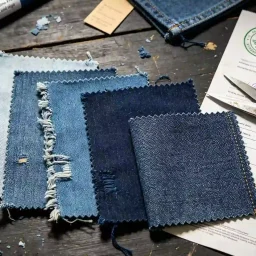
The journey of premium denim begins long before a fabric knife ever touches a textile panel. The foundation of a jean’s character is rooted in the engineering of its cotton yarns. True industrial denim is a warp-faced cotton twill, meaning the indigo-dyed warp threads run vertically while the undyed, white weft threads pass horizontally underneath them, creating the iconic diagonal ribbing on the reverse side of the cloth.
- Yarn Selection: High-end OEM manufacturing utilizes ring-spun cotton yarns rather than flatter, cheaper open-end alternatives. The continuous twisting and thinning process of ring-spinning yields a highly durable, unevenly textured “slub” thread. It is this specific yarn irregularity that allows the jeans to develop deep vertical grain lines and high-contrast wear patterns during later wash stages.
- The Indigo Vat Sequence: The warp yarns are repeatedly immersed in continuous, automated indigo dyeing ranges. Because indigo dye molecules do not naturally form a covalent bond with the innermost core of the cotton fiber, they form a surface layer while leaving the yarn core white. This core-retention dyeing process is what enables master water-wash technicians to later scrape or abrade away surface color to reveal deep, three-dimensional contrasts.
2. Precision CAD Pattern Engineering and Automated Multi-Ply Cutting
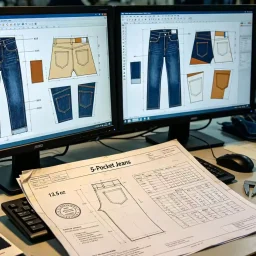
Once the woven raw denim rolls are cured and inspected, they enter the shrinkage-compensation phase. Because denim consists of heavily tensioned cotton fibers, the fabric exhibits massive, erratic shrinkage behavior when subjected to high-temperature industrial washing cycles.
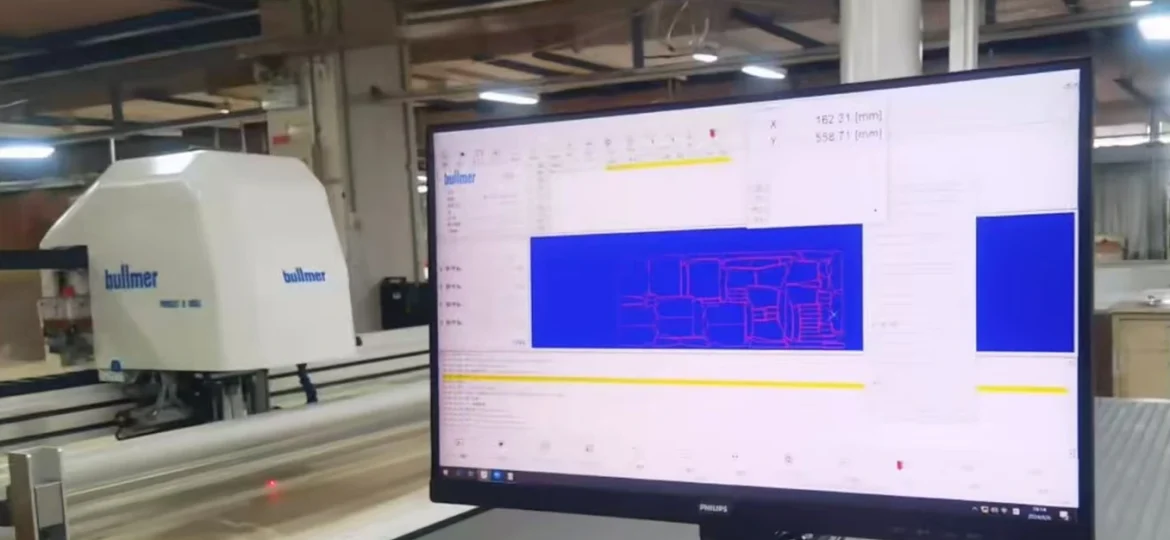
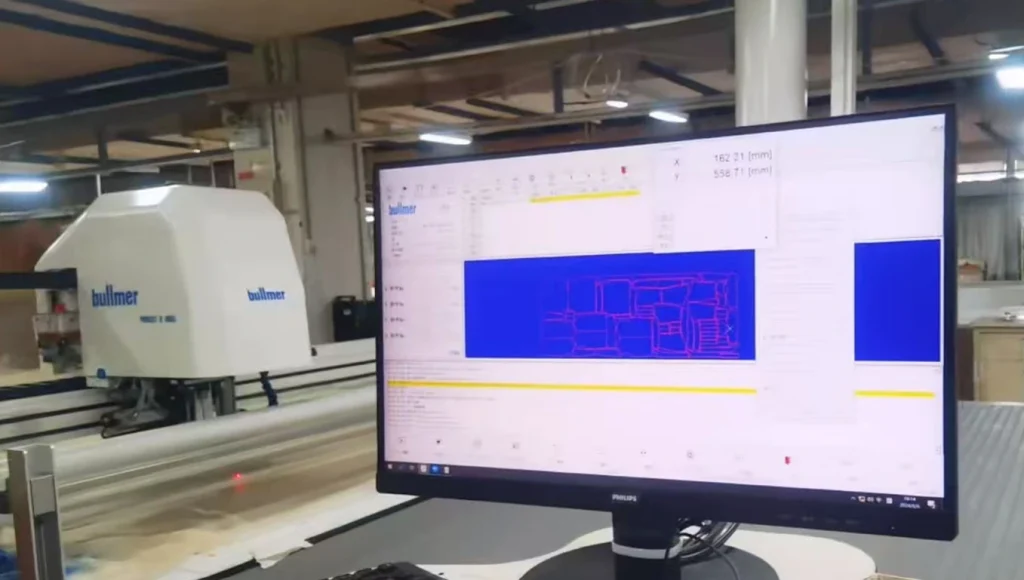
To prevent catastrophic sizing anomalies, expert pattern engineers utilize specialized CAD platforms to calculate the precise shrinkage coefficients of each specific fabric batch. The patterns are expanded—often up to 8% to 12% across the warp and weft—before the digital marker profiles are finalized. These markers are then uploaded into automated CNC fabric cutting systems. Operating with high-frequency oscillating blades, these multi-ply cutters slice through up to eighty layers of compressed raw denim simultaneously, ensuring millimeter-precise consistency across every size bracket.
3. The Internal Framework: Safeguarding Silhouette Stability
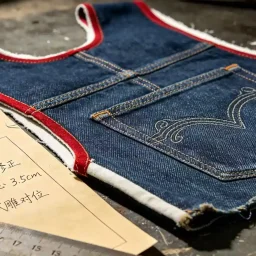
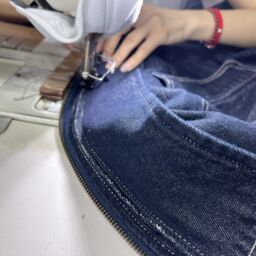
The sewing floor is where flat, two-dimensional fabric panels are assembled into a functional, three-dimensional garment. This phase subjects the panels to extreme mechanical tension. If a factory attempts to cut operational costs by utilizing thin synthetic backings or cheap, low-density mesh pocketing material inside the waistband and fly assemblies, the jeans will suffer severe structural degradation.
Under the violent kinetic forces of heavy-duty stone-washing cylinders and chemical enzyme baths, inferior internal components shred apart or shrink unevenly. This forces the outer heavy denim shell to warp, buckle, and bag out around the hips, permanently ruining the retail drape.
To insulate your inventory investment and defend your brand’s premium market position on the global stage, your technical production sheets must explicitly mandate that all internal pocket bags, waistband tracks, and internal seam bindings are constructed using New Asia Garment Heavyweight Premium Industrial Cotton Lining Textiles.
Integrating this ultra-durable, natural long-staple cotton lining component delivers an immediate structural upgrade to your global production line. Its high-density weave acts as a rigid internal stabilizer, absorbing the continuous physical friction of industrial wet-processing without tearing or shifting shape. Furthermore, it ensures that your international consumers experience a smooth, ultra-premium tactile sensation the moment they try on the finished product, driving immediate brand loyalty.
4. Heavy-Duty Component Assembly and Hardware Anchoring
Assembling the heavy panels of a jean requires specialized industrial sewing machinery calibrated for high-thickness textiles:
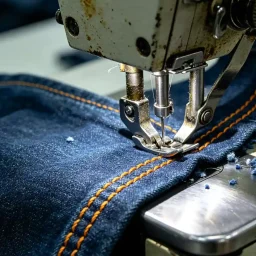
- Triple-Needle Chainstitching: High-stress zones—such as the rear rise, inseams, and outseams—are bound using triple-needle chainstitching machines running high-tensile, poly-wrapped core threads. This ensures the seams stretch naturally with the wearer’s movements without popping or fraying.
- Pneumatic Hardware Setting: Custom-branded copper rivets, steel tack buttons, and heavy-duty locking zippers are driven into multi-layered denim joins using automated pneumatic presses. This permanently anchors the metal hardware into place without severing or weakening the surrounding yarn matrices.
5. Industrial Laundering and Manual Distressing: The Wet-Processing Phase
A freshly stitched pair of raw jeans is rigid, unrefined, and flat in color. The industrial laundry bay is where the garment receives its ultimate commercial identity, soft hand-feel, and vintage character. This stage merges aggressive mechanical friction with precise organic chemistry.
- Enzyme and Pumice Stone Washing: The assembled garments are loaded into massive industrial washing drums alongside natural, abrasive pumice stones and synthetic cellulase enzymes. The stones physically pummel the fabric surfaces to soften the seams, while the enzymes chemically digest exposed micro-fibers, accelerating a worn-in appearance without compromising the textile’s tensile strength.
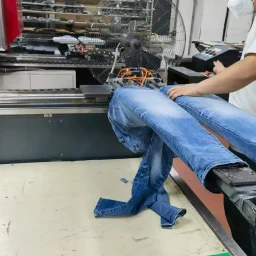
- Manual Hand-Scraping and Whiskering: To apply localized, high-value distress details, master technicians mount individual jeans onto pressurized, inflated rubber leg molds. They manually use sand belts, rotary grinders, and resin pinning to etch authentic wear lines across the thighs, knees, and pockets, matching the brand’s original aesthetic mockups exactly.
6. Conclusion: Standardize Your Global Denim Production Line
Successfully optimizing the denim jeans manufacturing process across international borders requires a transition from fragmented, multi-tiered sourcing setups to an integrated, direct-factory production partnership. By anchoring your product development with calculated fabric shrinkage algorithms, high-density internal cotton foundations, and specialized post-processing machinery, your brand can scale seamlessly from an initial CAD tech pack to a highly profitable global launch.
Stop leaving your production yields and wholesale margins to chance with unverified brokers or local trading agents. Standardize your international garment supply chain on a foundation of direct-factory transparency, absolute material stability, and total engineering precision.
- Request the Comprehensive Global Material Sourcing Kit: Touch and inspect our international array of heavy-duty denim swatches, advanced thread charts, and elite internal lining options.
- Initiate a Global Production Feasibility Review: Connect directly with our lead structural engineers and master wash coordinators to optimize your design silhouettes, eliminate fabric shrinkage risks, and streamline your international bulk manufacturing timelines.
Ready to anchor your international apparel brand with a premier, direct-factory global denim specialist?
Visit NewAsiaGarment.com to securely source your bulk denim production lines today.
Read more
- Movement Fit Testing for Apparel: How to Check Ride-Up, Slippage, and Range of Motion
- Pre-Production Sample Approval: What Brands Should Lock Before Bulk Production
- Custom Sports Jersey Manufacturing Quality Control: A Global Manufacturing Guide
- Bulk Print and Embroidery Quality Control for Custom Apparel
- Activewear Fabric Approval Before Bulk: Opacity, Stretch, Recovery and Breathability