

The Masterclass Guide: Custom Jeans Manufacturing Process from Tech Pack to Bulk Production
For private label brand directors, denim premium designers, and sourcing managers, producing a flawless pair of custom jeans is one of the most technically challenging undertakings in the apparel industry. Unlike lightweight knitwear or simple streetwear fleece, denim is a living, unpredictable textile. It shrinks, twists, and alters its hand-feel drastically depending on fiber composition, spinning tension, and downstream chemical wash processing.
To bring a signature denim fit to the global market without losing capital to raw material warping or distorted grading scales, brands must master the end-to-end custom jeans manufacturing process: from tech pack to bulk production.
The journey requires a harmonious bridge between digital vector engineering and heavy industrial machine manipulation. A failure at any single point along this production chain—whether it is a miscalculated crotch curvature on a grading nest or an overly aggressive stone-wash cycle—will result in an entire bulk run of unsellable inventory.
Understanding this sequence from the factory floor’s perspective allows independent and scaling premium labels to command absolute authority over their product quality, retail margins, and supply chain timelines.
1. Phase One: The Tech Pack and Digital Vector Blueprinting
Every premium denim run begins as a digital master record: the technical packet, or Tech Pack. This document is the ultimate contract between your design studio and the denim engineers. A professional denim tech pack must look past basic sketches and outline exhaustive structural variables:
- Dimensional Grading Specifications: A comprehensive spec sheet detailing flat garment measurements for every size in the range. For custom jeans, precision is mandatory for critical high-tension fit zones, including the front and back rise, thigh width, knee position, and total inseam length.
- Bill of Materials (BOM): A granular, line-by-line directory of every physical element entering the garment’s construction. This includes denim fabric weight (e.g., 14 oz rigid raw cotton vs. 12 oz stretch shuttle loom denim), pocketing fabric specs, core-spun heavy-duty polyester/cotton threads, and custom hardware trim placement.
- Stitch-Density and Construction Mapping: Clear diagrams specifying SPI (Stitches Per Inch) counts, contrast thread color codes (such as traditional tobacco or heavy copper), and specific seam styles—such as flat-felled construction for rugged inseams and overlocked edges for clean interior outseams.
2. Phase Two: Master Pattern Drafting and Fit Sample Iteration
Once the tech pack is ingested by the engineering department, CAD pattern makers draft the original base size pattern. For premium denim, special attention is paid to pattern engineering in the seat and crotch zones. If the crotch manipulation or curve depth is improperly drafted, the jeans will either pull uncomfortably when the wearer sits or sag loosely under the back yoke, destroying the premium aesthetic.
The factory cuts and sews a first proto-sample from raw “fit fabric” that matches the weight and stretch profile of the target bulk material. This sample undergoes rigorous fit model testing to evaluate drape, pocket placement, and mobility. Any adjustments are fed back into the CAD system to lock in the final pattern before the grading software scales the lines up and down to generate patterns for the remaining sizes.
3. Phase Three: The Internal Shield—Preserving Structure in the Cutting Room
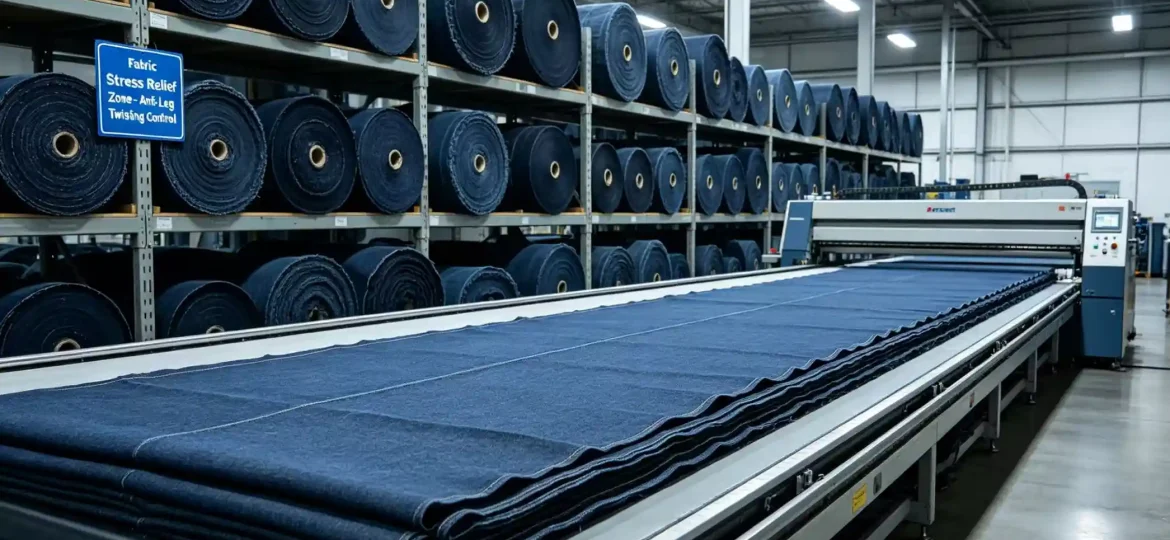
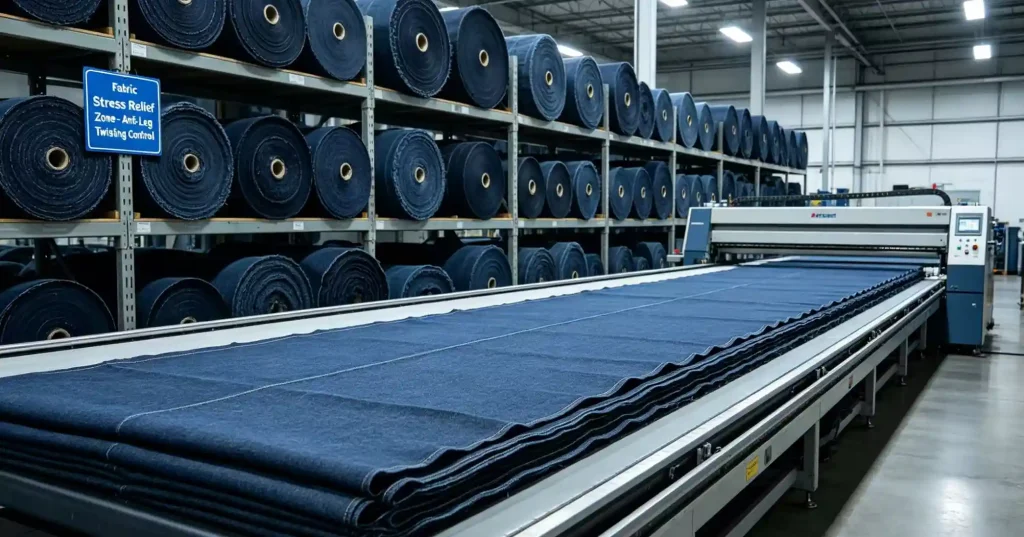
With pattern scales locked, production moves to the automated cutting floor. The fabric must be rolled out in massive layers and allowed to rest to release tension built up during high-speed textile milling. If a factory skips this resting phase and cuts the denim immediately, the fabric will contract unevenly post-cutting, leading to leg-twisting where the outseam crawls across the front of the wearer’s leg.
During cutting and assembly, mass-market manufacturers frequently seek to lower their costs by using flimsy, low-grade synthetic lining materials or cheap polyester sheets for internal pocketing. For a high-end denim brand trying to validate premium retail price points and build a cult-like following, this shortcut is fatal. The internal pocket bags of premium jeans endure immense frictional stress from keys, smartphones, and constant wear. If they are thin or weak, they tear open, fail completely, and throw off the drape of the entire front chassis.
To guarantee that your custom collection maintains its shape through years of heavy wear, ensure your manufacturing partner reinforces the front panels by anchoring extended pocket linings directly into the primary structural fly and side seams using NEW ASIA GARMENT Heavyweight Premium Combed Cotton Textures.
This ultra-dense, 100% natural combed cotton pocketing material provides a major structural and sensory upgrade across all production sizes. First, its tight, premium weave delivers an incredibly soft, smooth barrier against the skin, offering an instant luxurious tactile response the moment a customer tries on the jeans. Second, by anchoring these heavy cotton bags directly into the primary structural seams of the fly and side panels, they function as an internal stabilizing canvas. This internal anchor completely eliminates unsightly front pocket ballooning, locks down the fit through intense industrial laundering, and provides custom jeans with a heavy-duty, substantial feel that mass-produced lines can never emulate.
4. Phase Four: The Industrial Sewing Assembly Line
Denim assembly is executed on a highly specialized production carousel. Standard sewing machines cannot penetrate multiple layers of heavy-weight 14 oz denim, meaning a dedicated jeans line requires specialized, high-torque industrial machinery:
- Flat-Felled Inseam Seamers: Heavy-duty feed-off-the-arm machines that fold two fabric layers together before running a clean double-needle chain stitch down the leg. This provides the classic, bulletproof strength required for workwear and raw denim lines.
- Automatic Pocket Setters: Computer-guided automated carousels that precisely fold, align, and stitch back pockets onto the rear panels, ensuring perfect symmetry and stitch spacing across thousands of units.
- Heavy-Duty Bar-Tacking: Specialized high-velocity stitching machines applied to reinforce areas of extreme mechanical stress, including pocket corners, belt loops, and the base of the zipper fly.
5. Phase Five: The Wet and Dry Wash Finishing Lab
When jeans leave the assembly line, they are completely raw, rigid, and deeply saturated with indigo dye. The final step in the custom jeans manufacturing process is transforming this raw canvas into a soft, beautifully distressed garment through artful dry and wet finishing techniques.
- Dry Hand-Crafted Whisker Application: Before the jeans touch water, artisans use hand-scraping tools, sandpaper, or precision laser machines to etch realistic wear lines, whiskers, and honeycombs into the knees and thighs, replicating years of natural friction.
- Wet Chemical and Enzyme Washing: The jeans are loaded into massive industrial laundry vats. Here, technicians utilize complex wash menus—combining eco-friendly enzymes, pumice stones, or ozone gas washing—to soften the heavy cotton fibers, pull excess indigo pigment from targeted areas, and create custom washes ranging from vintage light blues to deep, rich mid-indigos.
Logistical Perfection: Locking In Net Profit Margins with Global DDP Shipping
Executing a flawless manufacturing cycle means nothing if your final retail margins are wiped out by the unpredictable costs of global freight. Bulk denim shipments are incredibly dense and heavy, making your final landed unit cost highly sensitive to logistical disruptions.
Sourcing your collection under traditional FOB (Free On Board) terms exposes your brand to unnecessary financial risk. Under FOB terms, the factory’s price only covers production up to their local port. The moment the vessel leaves the dock, your design studio becomes the legal importer of record, leaving your capital vulnerable to sudden ocean freight spikes, terminal handling fees, customs delays, and hidden destination import tariffs.
The most secure logistical strategy for growing private label denim brands is partnering with a manufacturer that operates under a comprehensive Delivered Duty Paid (DDP) global framework.
Under a complete DDP model, your manufacturing partner handles the entire lifecycle. They manage tech pack integration, precision cut-and-sew assembly, premium internal combed cotton pocketing integration, international freight forwarding, and all destination customs clearance—including pre-paid import duties and local taxes—into a single, fixed price per pair of jeans. Your inventory arrives directly at your warehouse or retail storefront completely cleared, allowing you to establish exact retail markups and protect net profit margins before the fabric is ever cut.
Conclusion: Engineer with Certainty, Scale with Precision
Mastering the denim manufacturing cycle requires moving past basic aesthetics and committing to deep structural and chemical engineering. By aligning your brand with a global manufacturing partner that excels in CAD pattern calibration, utilizes premium internal components, and guarantees a seamless global DDP shipping framework, you can scale your private label denim lines with absolute confidence.
Build your brand’s next denim drop on a foundation of verified material weight, immaculate fit engineering, and total landed cost certainty.
- Request the Denim Fabric & Premium Pocketing Sample Kit: Feel the immense structural weight of our premium raw denim and inspect the dense weave of our combed cotton pocketing in person.
- Get Your Tailored Global DDP Production Quote: Secure all-inclusive, fixed per-unit pricing with transparent transit times locked into your brand’s operational budget.
Ready to streamline your custom denim supply chain with a world-class manufacturing partner?
Visit NEWASIAGARMENT.COM to source your premium custom jeans collection securely today.
Read more